Pet Sematary (1983)
"When I'm asked . . . what I consider to be the most frightening book I’ve ever written, the answer I give comes easily and with no hesitation: Pet Sematary. It may not be the one that scares readers the most. . . All I know is that Pet Sematary is the one I put away in a drawer, thinking I had finally gone too far."
Stephen King, Pet Semetary, 1983, "Introduction," 2001.
 |
| Winston Churchill makes a comeback (Pet Sematary, 1989) |
When I scored the battered first edition of Pet Sematary back in the final year of my middle school misery--another garage sale find, all mine for a buck--I was excited for a new, scary story from my very favorite author. I was in no way prepared for how traumatizing it was going to be. The cover featured a gape-mouthed cat--perhaps meowing, perhaps snarling--that reminded me of the sassy cat in The Last Unicorn, not in coat coloration so much, but in that fat-faced, furball, tomcat asshole-who-has-seen-shit kind of way. How bad could it be?
Turns out, it can be bad. It can be beyond bad. It can be really, really scary, unnerving, freaky, nightmare-inducing, creeping-horrors-in-the-daylight BAD. The first edition dust jacket offers few details to the plot, there was no internet in 1985, the movie version was still a few years away from being made, and I knew no one who'd read Pet Sematary at that point in my life. There would be no spoilers. I was just going to experience it raw, stupid, and unfailingly naïve.
 |
| The impossibly handsome Dale Midkiff as Louis Creed (Pet Sematary, 1989) |
Before reading further, if you, too, remain somehow unspoiled from the exquisite horror of Pet Sematary, unaware of the shocking twists the book takes, further and further down into the unthinkable and profane, by all means stop reading this entry now. You owe it to yourself to check it out, buy it, or borrow it so that you may experience the ugly, grinding wakemares and drilling, lingering nausea for yourself. Pet Sematary is a rough ride, not for the weak hearted.
 |
| Stephen King makes a cornball cameo (Pet Sematary, 1989) |
I decided to go ahead and listen to the audiobook since I'd read my old copy of Pet Sematary to pieces; I know the story well and figured it would be interesting to see how an actor would inhabit it. The Christine audiobook experience left me optimistic about the interface, but I was even more intrigued when I saw that Michael C. Hall (Dexter, Six Feet Under) would be the narrator. He has this sort of monotone affect that was either going to be irritating or cunning. His reading was phenomenal. The pacing was perfect, and his command of tone--from that bland, storytelling no-voice, ramping up to heart-stumbling terror--fit exactly into the story King just had to tell. He even got that Maine accent honed so accurately, it would be easy to think he was an entirely different person.
Look, the baby scree-ing voices narrators tend to use for these audiobook performances--most often for kids, sometimes for women (ugh)--are never going to work for me. Call it a fault in my own perceptions, or maybe I wasn't read to sleep often enough as a child, who knows. But Michael C. Hall's rendering of Ellie and Gage Creed's voices was the least distracting I've heard so far. By a big margin, too. More important, Rachel Creed, the grown-ass woman, sounded normal to me, perhaps the tiniest whisper of falsetto echoing through, but so measured and precise it was frankly a relief. Outstanding job; bloody, undead kisses all around.

 |
| "Kite's flyin', daddy!" Louis and Gage (Miko Hughes) |
According to King's introduction to a 2001 edition of Pet Sematary, much of the plot's framework was built on incidents he and his young family experienced during his writer-in-residence tenure at the University of Maine in the late 1970s. There was a house out in rural Maine, a friendly neighbor across the "rud," said rud was just as busy with big rigs as the novel, there was a "Pet Sematary" adjacent to the property, a death of the family cat, and a close call with their youngest son, Owen, in a hair-raising race to the road that King, or simply a compassionate turn of fate, won in the end (he does not remember which, and frankly, who would).
Kings become Creeds in the novel. Louis Creed is a doctor, Rachel Creed is a stay-at-home mother. They have a second grader named Ellie (Eileen) and a toddler named Gage. They also have an old tomcat named Winston Churchill, "Church" for short. While elements from King's experiences make their way into the story, the novel diverges starkly at the foot of a huge deadfall that rests opposite the circles of graves in which resident children have buried their pets for decades. When the kindly old neighbor Jud Crandall calls Louis to come across the road to inspect a dead cat (which is the ironically newly-fixed Church, who had no business crossing roads anymore), the old timer makes a fateful decision to share a bit of local lore with the young doctor. He leads Louis up to the pet cemetery, the very-dead Church toted along in a trash bag, then proceeds to climb up the deadfall, warning Louis to follow him precisely. Beyond the deadfall, the path that led up to the pet cemetery continues to an ancient Micmac (Mi'kmaq) burial ground, through nightspooks and gobbling terrors, screams, ghost lights, a crash in the dark. Jud never explains what they are doing there, only directs Louis to dig, bury his cat, build a cairn, and, once it is done, they simply head back home.
 |
| Jud Crandall's (Fred Gwynne) exposed Achilles gave me nightmares forever. |
 |
| The screaming in that theater was . . . appropriate. |
Those familiar with the tale, and plenty more who could see the next turn of events from a mile without headlights, know that Church lazes in the next day, somehow alive, though stupider, stinkier, clumsy, and now sporting a real zest for not just killing little animals to bring home for show-and-tell, but eviscerating them and leaving the carnage for Louis, especially, to find. As unsettling as Church's resurrection is, it allows Louis to at least side-step the inevitable sorrow of his daughter's grief, even though it costs him sleep and well-being. Jud fills in some blanks, explaining the history of the Micmac burial ground as far as he knows it, his own beloved dog's return from the dead, admitting that the outcomes of reanimated animals trend more toward the unfavorable. Jud confesses that the compulsion to share the secret was as much of a driving factor as anything remotely humane, like restoring life to a family's beloved pet, or saving a little girl from the inevitable heartbreak of losing an animal.
There's a great deal of wrestling with death throughout Pet Sematary--one of Louis's first patients at his new job at the university dies, Jud's wife dies, Church dies, and Louis and Rachel fight about how to explain death to Ellie due to trauma Rachel experienced when she was a child, witnessing the long illness and horrible death of her older sister, Zelda. Then there are the inevitable stories of death circling the pet cemetery itself: dogs, hamsters, even a bull . . . and later revelations that come to light in the darkest pit of despair.
 |
| When Rachel Creed (Denise Crosby) first sees what has come back from the Micmac burial ground, it is her childhood wake- and nightmare, her terminally ill sister (Pet Sematary, 1989). |
 |
| This shot absolutely wrecked me. It's so magnificently crafty, with the bed and its loud bedspread at center fore, the cluttered mantel at the back wall. You could easily miss the tiny, pale figure in the shadow by the dresser. Zelda (Andrew Hubatsek), hunched small, a vast chamber of bitter, vengeful rage within (Pet Sematary, 1989). |
It should have been abundantly clear even to a fairly intelligent 13-year-old that King was only winding up for the curve, which really wasn't a curve at all, but a crack shot right between the eyes, as hard and as fast as it goes, dead bang center. But I never saw the death of Gage Creed coming. Even when King said it, prefaced it by that perfect day of kite flying, straight up said it was about to happen, my brain refused to accept it. First stage of grief, right? Denial.
The set up and the punch down come one right after the other, so as the horrifying tale of Gage's death and funeral unfurled that very first time beneath my unbelieving eyes, my mind had no choice but to catch up and accept the brutal violence of the accident (semi truck vs toddler, and the description is breathtaking but sparing, and still far too much) . . . and the predictable plummet into the blasphemous abyss. Because once Gage is dead and buried, you know Louis is going to dig him up (bad), steal him away to the Micmac burying ground (very bad), and hope for the best (the absolute worst).
 |
| The jeering Zelda transforms into Gage, outfitted to match the print that used to hang in Zelda's room, Oz the Great and Terrible. |
 |
| Rachel's terror transforming to shock. |
 |
| "I have something for you, mommy!" |
 |
| This isn't an "Oh shit, why do you have a scalpel, undead Gage?" face, it is a "My baby is alive and I cannot even see the knife or begin to understand its significance" sort of face. |
There are supernatural forces at work, pushing Louis Creed toward this hideous eventuality, as well as pulling him back with warnings and omens (the first patient, Pascow, makes appearances to both Louis and his daughter, Ellie), but the most compelling obstacle between unbearable grief and the irreversible corruption of his beloved child's body and memory is Jud Crandall's firsthand knowledge of the only other human known to be dragged along that path, up to the Micmac burial ground, only to return a gruesome horror, spewing personal, dark secrets he had no way of knowing, and generally scaring the bejesus out of everyone. Jud's warning tale ends in tragedy, the resurrected young soldier, home dead from WWII, killed once again by his grieving and now entirely insane father, who then turns the gun on himself.
 |
| Church's last supper |
It should be enough to stop Louis Creed from making such an irrevocable mistake. Of all the stories Jud has told Louis about the Micmac burial ground, the best case scenario was Jud's own childhood dog, which came back as awkward and stupid as Church, save the bonus viciousness, but not much more than smelly, warm meat. It should have been more than enough.
Jud's warnings go unheeded, of course, and Louis learns the hardest way of all that "sometimes dead is better." As I listened along to Michael C. Hall's performance, I thought back to that first reading, how it reads like a freight train charging full speed across a rickety bridge, blowing sparks and screaming, careening down that spindly track. In the readings since, the shock of the first experience dampened but hardly gone, I've come to understand why it reads so well, so fast and supercharged and genuinely gripping (the reader literally grips the damn pages, sweaty sweaty sweaty). The older you get, the more you learn about the dark side of human nature. Pet Sematary is a car wreck. Much of horror writing is exactly that, the vicarious thrill of someone else's suffering or demise, feeling the racing pulse of near-death, the shock and scare, and still coming out the other side very much alive. But Pet Sematary is the worst of it, as dark as it gets, as low as it goes. King stretches past the limits of common decency--for is there any desecration more taboo than that of a child?--and still the reader is unable to turn away. It is, in every way, the Ultimate Car Wreck. Or truck wreck, if you wish. That, and the fact that it's written like greased lightning, not mired in exposition but anchored in the real, the visceral, the grind and gallop of ordinary life catapulted into the supernatural, unnatural, and obscene. It's a genuinely good, though harrowing and sometimes spiritually grueling, read.
 |
| In the movie, Gage manages to drag Rachel up to the attic for the ultimate jump scare for daddy. Before the audience can spend too much time obsessing over the logistics of such an endeavor . . . |
 |
| It's evil doll Gage! |
 |
| "Gage's flyin,' daddy!" This is when the audience screams, half in terror, half in mild hysteria at the utter absurdity. (And, no, he didn't actually say that. And, no, I do not apologize.) |
After the first time through, still reeling from the gruesome, grim ending ("Darling"), one of things that stuck with me was little Ellie Creed's increasing hysteria. It starts before Louis manages to hustle them out the door, fake magnanimity toward his wheedling in-laws just to get Rachel and Ellie out of the house and the state, her behavior escalating into deafening siren's screams of nightmares featuring dead collegians with cryptic warnings, knowing in her gut that something is terribly wrong with daddy. A great deal of supernatural, cosmic weight is thrown into explaining Ellie's reaction to being sent half the country away apart from her daddy and so soon after burying her baby brother, but parents will testify that kids pick up on things, hidden things, minute shifts in the foundation of love and safety and home and family. King didn't really need Pascow (Paxcow to Ellie) to tell her something was dreadfully amiss back home in Maine. Her whole world had just been rocked to the core; death, which she had only just recently begun to understand after the passing of Jud's wife, had visited their dooryard, where her tiny tyke of a little brother had managed to outrun her hero, her protector and most beloved father, and meet death with a final, horrid thud on a bright, sunny day. Her brother gone, her home turned to a dark tomb of silence and mourning, her parents barely functioning, steeped in hell, drifting in out out of rooms like wraiths, Ellie is feeling the once firm foundation rattle, crack, and thump. Her needle for threat detection is set to "sensitive." Though she knows something is wrong, even Ellie doesn't know just how wrong things have gone.
Louis buries Gage up in the Micmac burial ground then collapses into a deep, exhausted sleep. Gage comes back, steals his father's scalpel, and dispatches Jud first, his late-arriving mother later. Louis awakens to realize that Gage has returned, has stolen his scalpel, and has gone over to Jud's. He knows things have gone awry. Louis loads up on syringes and enough drugs to kill the whole town, puts down Church, puts down Gage. Freaks out in a corner for a couple of hours. Then makes his second-worst decision of his life and hauls Rachel up to the burial ground. The novel ends with that gravel-throated greeting, Rachel returned from the Micmac burial ground at the close of the longest day of terror, heartache, and unforgivable loss. We don't know what happens after she returns. The 1989 movie suggests that she kills him. I believe she kills him. After that? God. Too horrible to imagine (though from some quick perusing of the 2019 movie, it seems someone had some applicably vile ideas).
 |
| "Come to daddy, evil Gage." |
 |
| I still can't believe they released this in 1989. |
 |
| What a perfect look of betrayal. |
Except Ellie. I kept circling her and circling her. Life is cruel, sure, but to go from having a normal family to losing all of them so horrifically in a matter of weeks? Monstrous. And it all came back to Louis Creed. King suggests that supernatural forces push him toward the grotesque act of reburying Gage in the spoiled soil of the Micmac burial ground, and it is certain that the forces of grieving are some of the most powerful in the human experience, but 13-year-old me did not care. Circling, circling. The book stayed with me for weeks. I even wrote one of my song/poems about it, I believe it was called "Mr. Creed," very formal. (Side note: All of my adolescent poems were songs of some sort, with well thought out melodies that I had no way of writing down, but whenever they were read aloud, they were always read as poems, never songs. Eventually my songs all turned to the same stone.)
 |
| "No fair!" A moment clearly orchestrated to make the audience laugh, if nothing else to counter the unrelenting horror that unwinds in each frame that follows that chase to the road. While the very end still shocks, the absurdity, mania, and hilarity of Gage's killing spree ends on this twisted, lighter note, making the whole affair at least palatable, if still completely TOO FAR, Stephen. |
It is important to mention that I did not have a father growing up. My parents were divorced a month before I was born and he saw me maybe once when I was an infant. After that, I can count the times I saw him on one hand. I only remember a few of them with any real detail, and they were all bad. Not in a scary or abusive way . . . more in an embarrassing, sad way. The first time, I was riding in the back of an El Camino (a very Park City vehicle, the town of my father's people) with the only paternal cousins I knew, when some strawberry blonde hippie doof jumped in, joshing and joking around, eventually pulling his shirt over my head like a teenaged idiot boy straining his brainmuscle for the height of slapstick hilarity. He hyuck hyucked and drove a knuckle into my head and eventually we arrived wherever we were going and he hopped out and took off somewhere else. I was four years old and mad as hell. I asked my cousins who that man was and they gaped at me as though I'd spoken Latin, grew horns, and levitated. That was your dad, dummy, they said.
Huh.
The next year he showed up in Texas to take me somewhere for my birthday. To this day, I have no idea why my mother and grandparents allowed it, but off we went, driving in to the nearest town (Seymour) to arrive at the five and dime where I could have "whatever I wanted." So I picked out the shiniest, sparkliest, trashiest trash, dollar toys that my mother never let me get because they were literal garbage that broke pretty much the first day I had them. Then he took me back to the ranch and the next time I saw him I was graduating high school.
I don't remember the thought process underlying that compulsion to invite him, but I'm sure it had something to do with pretending to be normal. We were surprised that he actually came, fifth wife in tow, the one that finally stuck. They were both polite. He was severely wrinkled, looked sixty rather than forty, with those unmistakable horse teeth bucking out in nervous laughter. I was overwhelmed with all the people and the gifts and the cake, plus my friends and I were late to Project Graduation, where they locked us in the school overnight for "clean fun," with refreshments, music, games, access to the swimming pool, etc. He gave me a necklace. I tried to stay in contact with him, wrote him a letter about my whole life, such as it was at seventeen, but after a couple of awkward phone calls, that was that.
My family never dragged his name through the mud, never regaled me with stories of what a raging asshole he was, never really told me much of anything about him. My grandfather bit his tongue in the effort on more than one occasion, but my mom was sly. She knew my father would show me what kind of person he really was. The only time she ever told me anything that wasn't a brief, funny, "no bad guys here" kind of story, it was at my urging. Early on, it was a challenge to understand how my half sisters and half brother all fit, who he married and didn't marry, which kid was born when, and where I stood in that whole mess. I wanted to know why they got divorced. She refused to call him names, drag him down with colorful language. She just laid out the facts, no embellishments, no smack. Over the years, accumulating the data and letting it coalesce, I came to my own conclusions. He was a selfish, entitled, immature, dipshit prick.
Never doubt, he did me a favor at that first meeting in my memory. He embarrassed and upset me. A stranger was antagonizing me and being stupid and weird. Imagine my shock to learn that he was this mysterious "father," a person I knew other kids had, sort of a matching set with "mother" that was supposed to come with the family unit, my clear deficit about which I had only just begun to feel self-conscious. I knew I was unlike most other kids, that even kids with divorced parents still had both a mom and a dad in their lives. Believe me when I tell you, even very young kids know when they are different, especially when it comes to being raised by a truly single parent, when the other parent just fucks off to Neverland and leaves you high and dry to fend or fail. I knew I was other. I remember those same cousins trying to figure out if I was a bastard or not. Sure, my parents were married once, but they were divorced before I was born, so . . . probably a bastard.
I mentioned these people were from Park City, yes? You know, the BTK is from Park City. This is just a fact I am stating.
Anyway, I grew up pining for a father, but never my father. I would always remember the capering man-boy from the El Camino. I had those fantasies where my "real" father would turn out to be someone else (the peak dream was Barry Gibb, could you imagine) but as my own horsey teeth grew in there was little doubt who helped to make me. Still, I wished for that protector devoted to my mother, who cared for me, provided stability and material comfort, dare I hope wealth? Of course I dared. It never happened, but that was okay, too. In the end, I realized most of my dreams were centered around some distant benefactor (Papa Gibb, always on the road), who would provide a wishlist of Magnificent Things and Fabulous Trips, more than a true father. It was a corrupt dream.


So, Mr. Creed.
Though nothing in my life could ever compare to the horror of consequences that ruined the Creed family once Louis decided to disinter his baby son's destroyed body, the complete and cruel disregard for his one surviving daughter put a welt in me that will probably never heal. As my thoughts of Ellie keening for her father kept circling, the same sentence clanged and crashed around my skull: How could he do this to her? How could he do this to her? How could he do this to her?
As a daughter who understands a father's abandonment all too well, Louis Creed's actions, no matter how manipulated by grief and the supernatural, were un-fucking-forgivable. Louis Creed, a doctor, a man of science, who, by firsthand and word of mouth evidence of the burial ground, knows that the best he can expect in a reanimated Gage is a creeping, mute horror, should understand, absolutely and without a sliver of doubt, that his baby boy will likely come back a slinking, altered, malevolent thing. Could he have known it would lead to such utter ruin? Jed dead, Rachel dead, Gage and Church redead? No, but a true protector should have balanced out the books, put it all down for reckoning, and seen even with grief blurred eyes that the risk was far too great for what would be, at best, a sad and sickening reward. Worse yet, even if he'd been driven half mad by the events of that day, even if the evil power from the burial ground was blotting out the rest of reason, wasn't there a glint of Ellie's face, a memory of his living daughter who still needed him? Would need him now more than ever? What about Ellie, you asshole???
Still a good read, but seriously? Fuck. That. Guy.
 |
| The theater was YELLIN. A picture can't show active oozing. |
 |
| Someone's about to get what's comin' to him. In both versions (including, I suppose, the newest remake), I scortched brain cells imagining what the remaining undead would do next. Kill, kill, kill, I suppose. Maybe get locked up in an asylum? But would that, er, oozy bit ever heal? Or maybe she'd get locked away at some government facility to be endlessly studied. Area 52, perhaps? |
About the movies: I'll likely never see the newest one. I watched the Fandango Movieclips on You Tube and it appears they did some kind of job on it. I don't hate the idea of Pet Sematary as a movie, exactly, I'm just . . . ambivalent, I guess. It's a cruel story. I was absolutely shocked when they made the movie back in 1989. It was hard to believe that a major studio had faith that an American audience of the late 80s could stomach such a horrible idea, but then again: car wreck. I had forgotten that Gage in the book is basically just a rehash of the other reanimated person, the WWII soldier, spewing ugly secrets, but way more murder-y. Listening to Michael C. Hall do a demon baby voice was the worst part about the audiobook, not because it was compelling or unsettling but because it was, well, silly.
And this is probably why the 1989 movie was ultimately acceptable to most audiences. The producers seemed to realize it would be absurd to have little Gage saying all these evil, bwa ha ha lines when they could just punch up the campy creepy cute factor and kind of get away with it all. I don't remember much about the movie (save Zelda, good God, we will always, always have nightmares about Zelda), but I remember that last scene (so good, darling) and I remember Gage slyly telling his father that he played with Jud and with mommy and "now I want to play with yewwwwww." It was ridiculous and hilarious and somehow awful and freaky and terrible all at once. Which sums up a lot of King's work, naturally.
 |
| The 1989 movie's interpretation of the Micmac burial ground. |
Before I get to the grading, just one last thing: just lately there was apparently some hubbub on the social medias regarding whether or not listening to audiobooks actually counts as "reading." In the most technical terms, no. But I'd counter the argument, which I'm already imagining in a condescending, well, actuallyyy sort of tone, with a Gage Tours Park City response of Fuck Yewwwww.
First, everyone stop forgetting that disabled people exist. Not just blind people who may or may not know braille. People need access to books in every form available and for reasons far beyond "just being lazy." I prefer to read actual, paper books. It's my jam. But I can't bring myself to go to the library during a never-ending pandemic (as of this writing, US cases 9,028,298; deaths 229,109, via the CDC), I'm not going to rebuy every SK book, the Internet Archive is under siege, and Audible had a free trial. Lucky me! And, frankly, lucky all of us to have so many incredible options.
 |
| The dollar theater where my friends and I saw such classics as Batman, Tremors, and, of course, Pet Sematary. I got this shot just before they tore this gorgeous jewel to the ground. They paved the Palace and put up a Cracker Barrel. Sacrilege! |
Second, and I cannot emphasize this enough, listening to an audiobook requires a whole new set of skills. It's not like watching a movie, unless the movies you tend to watch are sixteen hours long. Okay, if every movie you watch is the extended Lord of the Rings trilogy box set, sure, we can talk, but only to a point. Movies do all the work for you. It's a visual and auditory experience wrapped up tight in a predictable, two hour block. If a listener has an audiobook playing in the background while doing chores, making lunch, answering phone calls, etc., it is too easy to lose the narrative. Details big and small will fall down the cracks and there is no way truly immerse in the story. If you want to "read" via audiobook, you have to will yourself to pay attention. It's possible to do other stuff while listening to an audiobook, but it can't be too distracting. I know people listen to audiobooks while driving, but I know I could not. Sure, I'd manage not to plow into Starbucks or drive off a mountain, but I'd never really experience the book. Some people can walk and chew gum at the same time, but I just swallowed that gum and tripped over a rock and now I need stitches.
Third, allowing a narrator to occupy that intimate space in your brain is really freaking hard. I mentioned not being read to as a kid all that much; I know I was read bedtime stories--there are vague, blurry memories--but it wasn't nightly and it ended when I was pretty little. While that may be a factor to a degree, there's a whole other Giant Ass Wendigo looming in the forest at night that overshadows everything else. Trust, baby. Don't have it, can't find it, lost it somewhere in the dark. Intellectually we know that acting is just fake ass bitches being fake, but unless and until I'm immersed in a movie, I refuse to be entertained. I just can't do it. Most of the time, it's not a problem. But if the acting is bad--even just some small, one-line part--or if the narrative jumps the shark, yanks the tone, or blats stupidity for whatever reason (looking at you Spiderman 3, Sex and the City 2, The Sweetest Thing), I may go on full lock-down.
Manhunter is one of my all-time favorite movies. It's the first to feature the Hannibal Lecter character, William Petersen is a calm surface of a lake churning with tension, every moment is laden with Epic MOOOOOOD, and Michael Mann directs the living shiznit out of it. It's gorgeous and creepy and iconic. It certainly beats the hell out of that ego trip 2002 remake. I'm sure it has plenty of things wrong with it (no one likes the ending, for instance), but the one thing that sticks in my craw, that gets me every single time no matter how many times I see it, is the ever so brief scene when Molly and her kid discover there are battalions of cop cars and even a helicopter outside, come to save them from a serial killer. Why? Because the cop that shoos Molly and Kevin back inside the house says something to the effect of "Come back inside. Please. Come back inside" with such flat, self-conscious affect you're half convinced he's a Terminator before you remember it's the wrong genre. The line might as well be, "I am scared. Please. Shoot me with this prop gun." At first I was just "what the hell," but let it go because there was so much more to the movie. Over time, though, it grates. Not because of the guy, more because of the poor guy. I have spent far too many moments of my life worrying about that guy, feeling sorry for that guy, wondering where that guy is and how the hell he landed a role, even a minor role, in a major motion picture. At best, I chortle when I should be clutching my pearls and digging on the drama of the scene (danger! action!). Instead, my brain usually starts blatting the alarm oh God, here he comes, it's the get back inside guy, cringecringecringe, is he okay, Jesus get him some water, he's so scared, I feel so bad, why is this happening.
 |
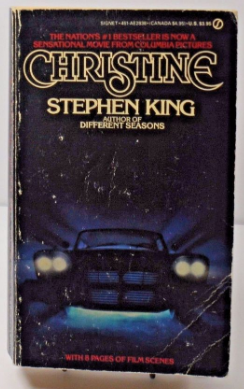
| The first edition cover design is equally creepy and cute. |
 |
| Come on, look how cute he is. This was my idea of Church, save the pegleg and eyepatch (The Cat, The Last Unicorn, 1982). |
It's a trust thing, letting stuff like that run over you and still managing to groove to whatever silliness some trick is trying to sell. I'm sure there were tens of people who enjoyed The Sweetest Thing, but that dripping trashbag of a movie only managed to make me mad. I can't stand second-hand embarrassment, it feels like a violation, and that movie is nothing but second-hand, down in the dirt, never coming back from this, hardcore humiliation. I mean, at least Spiderman 3 contained its horrifying moments to a strut walk and a dance scene.
This is also why the falsetto is so upsetting to me. Listening to a man baby talk makes my hackles rise. I step out of the story, take one or five steps back, and glower. What is this? Why are you doing this? What are you trying to pull? I suppose it is the biproduct of terminal gullibility. The lie detector is more of a lie annihilator in the form of an indiscriminate machine gun. Everybody gets shot.
So imagine what it takes to really get into a story, a long story that stretches out to fifteen, sixteen, some twenty hours, listening to one person read it to you using whatever gifts of projection they have in their skillset. If you've never read the book, you have to be focused to really get into it. If you have read the book, you have to get over any deviations in pronunciation, annunciation, and tone that formed the construct of that world beforehand. Audiobooks aren't sliding your eyes across the page and sending your brain on trip to elsewhere. Audiobooks require a middle man, and your brain, even if it is a fractured little walnut of mistrust and preconceptions, must allow, for the simple sake of entertainment, what in so many ways feels exactly like an invasion.
Screenshots of the 1989 film Pet Sematary from Fandango Movieclips via YouTube. Screenshot of "the cat" from The Last Unicorn via YouTube user gewdygirl1.