Showing posts with label books. Show all posts

Monday, November 18, 2019

NIGHT SHIFT (1978)

Vampires and pigeons and rats O MY.

Fifty Shades of Wheat.
In a coincidence straight from the bowels of a certain wreck of a factory, I happened to read Stephen King's Night Shift short story collection around the same time the song of the same name was topping the charts back in 1985. Much like the Night Shift short story and subsequent movie adaption of "The Lawnmower Man," King's collection and the Commodores' song have little in common.

Nevertheless, my mind plays the song whenever I pick the book up to read it anew, much like it has since I first got my hands on the ratty, used paperback edition (whose back I cracked without mercy or regret the first go around). It was the version with the hand on the cover, the hand full OF EYES. Creepy and humorless, thus completely fitting for the work. There's no question of the inspiration--the doomed astronaut in "I Am the Doorway"--and the cover art does what the cover art is supposed to do: make the buyer want, no need to know just what the hell is going on in these here pages. It fits. It works. No discordant disconnect. Like how the song plays in my head whenever I set eyes on the book.

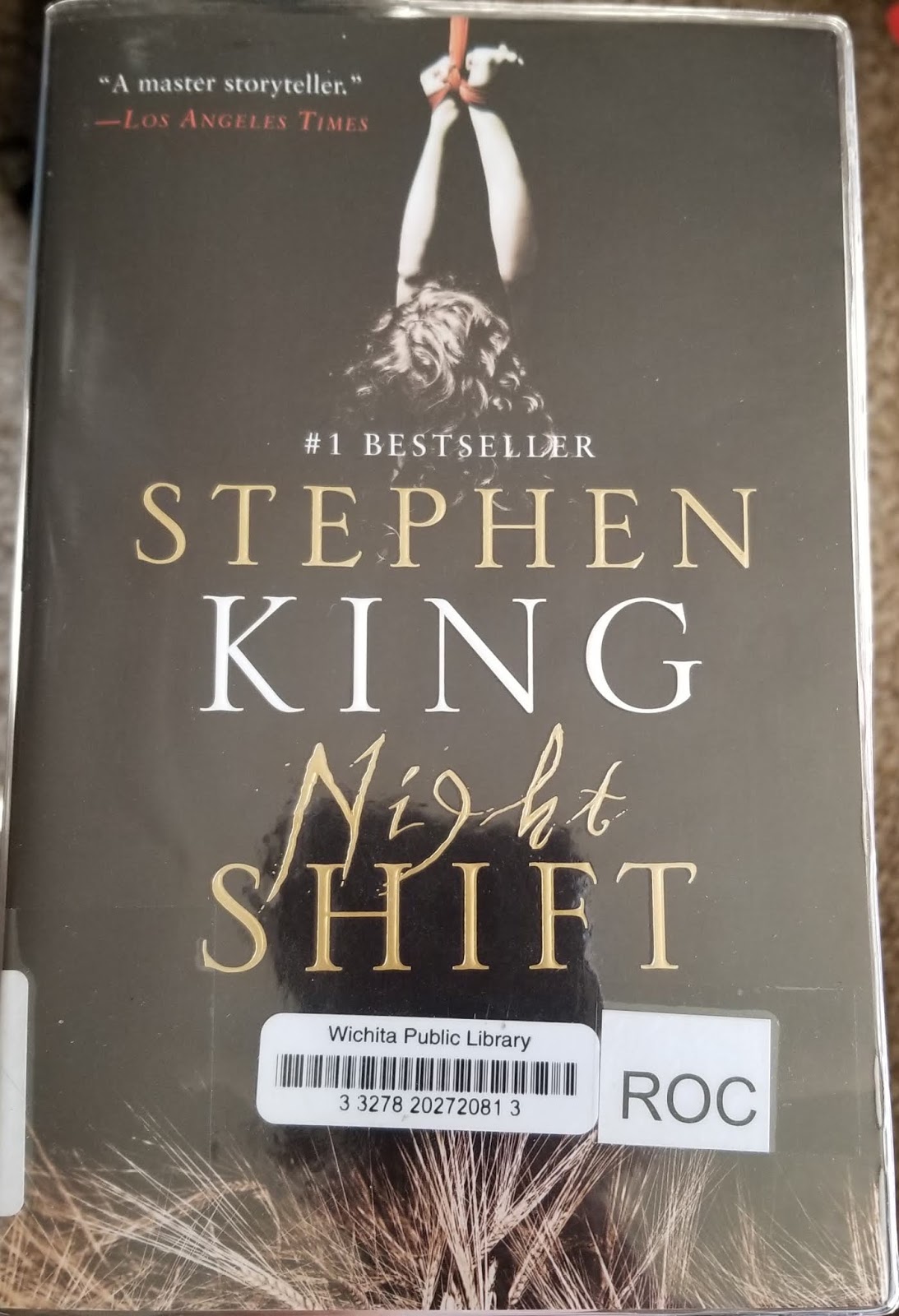
I wish I could say the same for the newer, library version I recently finished. I guess the cover art is meant to allude to the short story "Children of the Corn" but it's the worst kind of faceplant fail for a couple of very valid reasons. According to the copyright page, the library paperback is a reprint of the August 2012 Anchor Books edition. Can you guess which raunchy little indie-penned trilogy was released commercially earlier that same year? None other than the saucy, slap and tickle romp through one seriously bad relationship: the Fifty Shades of Grey series. And sure, there is a "bound woman" in "Children of the Corn" but she's not tied up with sexy ribbon. She's crucified. With barbed wire. Her eyes have been gouged out and her sockets and mouth have been jammed with cornsilk. Not remotely sexy.

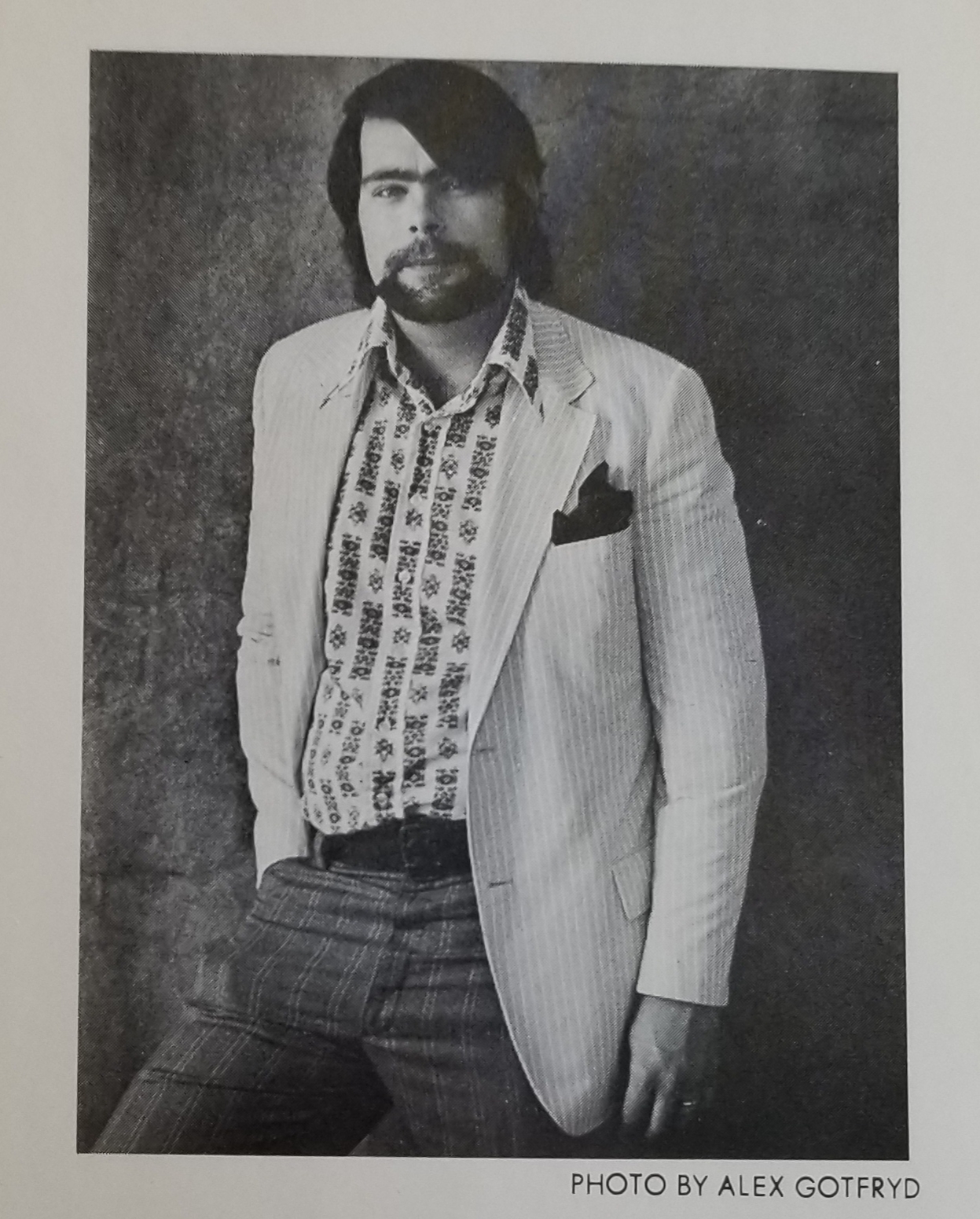
Great author photo, tho.
It's not the first time I've seen similarly sad attempts to capitalize on another newer or more popular book's comet ride to fame and fortune. I once worked on a book for a distribution client whose nonfiction cover design for something completely unrelated to teen vampires turned out to be a blatant rip off of the first edition design of Stephanie Meyer's Twilight. I don't recall the outcome of the uncomfortable conversation with the client, but I do remember that the design was changed. What was the big deal? It was borderline stealing and full-on LAME. Ugh. This isn't the same, but it is stylistically suggestive and not immediately evocative of the source material, that which the cover is trying to sell, allegedly. Clang clang clang.

Also, look across the bottom of the front and back covers. I'm pretty sure that's wheat, not corn. Maybe it's meant to be corn tassels but I don't think so. It certainly isn't the standard image one would use to say "CORN field," especially if you are alluding to a story about children of the CORN--you'd think more green husks, lines of leafy plants, etc. To be fair, stock photos can be criminally mislabeled (it happens more than you'd think)--just Google "corn field close up" and you will see plenty of...wheat.

In the long run, does all this matter? Yesno. It matters to foolios like me who would have loved to work on any edition of Stephen King's work, past or present. It irritates me that they didn't try harder.

Aside from production woes, the most striking thing about Night Shift the actual book (what really matters, I know I know) is how perfectly it encapsulates a specific time. The dark swell of the late 60s, the gritty undertow of the 70s. There's a pervasive gloom hanging over the whole work. It is a weird trip back to an era growing dimmer in the rearview, where so many customs once so common would be met with outrage now. The ubiquity of smoking, for example--how it was literally everywhere, so casual, so common, so accepted. All throughout Night Shift, characters just smoke. They go into buildings smoking...they take a seat in waiting rooms ready to light up...there's even a scene in a hospital where a son helps his dying mother smoke one last cigarette. They won't let her have aspirin, oh no, but the cigarettes in her nightstand are totally fine. For the cancer patient. In a hospital.

I love that the library had to add the little
label for the title. For the sake of uniformity,
ya gotta. Katie says hi.

Flat cut trim--it's uncommon, but I have seen rough
cut trims on paperbacks. It is the very definition of
"extra," though, and entirely unnecessary. Further,
it makes page turning a chore.
I lived during this age, smoked in fast food joints and restaurants, smoked in bars and clubs, smoked in people's houses, at parties, in stairwells, all the designated smoking areas. I even got to experience smoking on planes, though only as an observing child sucking up all the extra second-hand smoke that my little lungs could absorb. I remember what it was like to drink down the bar to closing time, roll into bed half dead, and wake up the next morning smelling like a charred hellhound. There's a wide gulf of time between the days when smoking was the norm, when at least half the people you knew were regulars, and the here and now, where smoking is banned everywhere (with noted exceptions, hello casino jones), and the social contract has all but shut out those dirty birdy smokers. There was a reason my last years of smoking took place in my apartment and nowhere else--societal pressure, baby. It's a hell of a drug. But in Night Shift, smoking just is. It is a pastime as all-American as apple pie (with a smoldering butt jammed in the middle).

There's also some casual drunk driving, another throw back to a stupider era. It's not to say that society collectively embraced such reckless behavior back in the pickled past, but the seriousness of it, and the underlying sense of gravity and shame associated with drunk driving today, was far less common prior to educational campaigns and the unwavering tenacity of groups like MADD (Mothers Against Drunk Driving). I liken those olden golden days to the current trend of Wine Moms and their shrill slogans plastered on t-shirts, wall art, bumper stickers. Drinking two bottles of wine a night is fine as long as we're all doing it, amiright?

Even worse, depending on the state, the drunk driving laws could be very lax, sometimes just the equivalent of a whoopsy daisy you had a little boom boom. Prime example: I know a person who totaled their car, woke up covered in blood and glass in the hospital with a cop standing over them, face serious, judgmental but fatherly, who said, I'm gonna give you a warning, just don't do it again. That was it. And wouldn't you just know it...my acquaintance did it again...and again. They just didn't get caught. Hell, I had relatives who regularly drove while intoxicated. Friends, too. But ever so slowly, people stopped being so casual about it and started taking drunk driving seriously.

The best kind of praise page. No references to this or any
other work, just an unabashed lovefest for an author
who stands at the very top of his field.
In some ways, you can align the changes in societal mores in terms of overall safety with the dawning of the squeaky, straight-edged 80s. Imagine the terror of the 60s, the unparalleled social upheaval from coast to coast: the war, civil rights, women's rights, the counterculture, hippies, dippies, and Charlie Manson and his clean-cut little coven capering on the news. Then came the inevitable, crippling hangover of the 70s, burnouts and serial killers run amok, gas prices soaring, the economy circling the drain, all the kids self-medicating, all the adults half bombed and starting to think this American Dream shit is nothing but ass vapors. On so many levels the trust was broken, blown out, burnt to the ground.

Embossing evident on the back of the front cover.
Then came the 80s. New romantic skinny ties with gelled hair and coke habits. Citizens rebranded to Consumers and gave each other permission to find purpose in materialism, the pathological accumulation of Things. Cars and picture frames and houses and projection tvs and boats and track suits and motorcycles and wine racks and ottomans and 100 percent pure cubic zirconia. The Home Shopping Network delivered more delicious Things, more stuff to pile on top of other stuff crammed in dusty hutches while the oldest stuff found its way to the basement or the attic or the closet or the yard sale because more was good, but newer was better. MALLS were a brilliant thing, a beautiful neontopia to drop ten or a thousand dollars on any given Saturday. There were no limits to the number of jeans! Blue jeans, black jeans, pegged jeans, stone washed, acid washed, multi-toned, even pin-striped. Chic, Lee, Guess, Jordache, Calvin Klein, Gloria Vanderbilt, and Levi's but only 501's with the button fly-eye-eye. So many chunky, over-sized sweaters with wild graphics, and layers and layers of popped collar Oxfords to wear underneath--Izod, Polo, Ocean Pacific board shorts and don't you dare forget the forty-seven Swatch watches to wear up and down each arm like a goddamned postapocalyptic psychobabe on her way Bartertown to bet on Thunderdome. Things!

Author bio page also shows that bad glue job. There
shouldn't be such an uneven gap in the gutter.

I've lived this nightmare. You have to update the
previous publications page, but there are so manyyy.
So you set it in a smaller and smaller font until
it virtually squeaks.
Pegged pants, rolled sleeves, feathered hair lacquered with various gels, mousses, hairsprays; everything tight, tight, tight. Even the music seemed tighter, seamless and produced to perfection...no more smelly, hairy, drunk Golden Gods swaying at the microphone with their fuzzy navels out. No more grit, not one speck...at least not on the commercial stations. Just clean, coiffed, pancaked mannequins tripping tight, tight, tight dance moves to swift, tinny beats. Clean, tight...and safe. Just Say No. This Is Your Brain On Drugs Any Questions. Greed Is Good. Love Shack, Baby Love Shack.

It was like the 60s were the shock and awe, where the ugly undertruth was churned up and exposed to the bitter light, and the 70s rumbled with queasy aftershocks of too much reality and not enough weed in the world to dull it. The 80s opened its eyes to the horror and deemed it solvable. We became suddenly aware of the concept of child molestation, child kidnapping, child murder, and the faceless boogiemonster everyone could get behind with a pitchfork: stranger danger. Donahue and Oprah taught us the perils of freedom, the worst of what could be, the stories behind the faces on the milk carton. Letting your kids run wild in the streets was truly at your peril. As long as we were protecting the children from outside harm, we realized we'd had just about enough with all the babies flying through wrecked windshields, so child safety seats morphed from optional to required by law. There would be no more joyriding in the back of the pickup and no more calling shotgun. Then, as if our tight little coked up minds could bear one more outrage, some psychopath tampered with over-the-counter pain killers, so now just about everything requires some sort of safety seal to assure Consumers that their drugs (and juice and sour cream and...) are safe. Safety cords on blinds, plastic bottles instead of glass, flat beds with no fluffy blankies for infants, wacky rubber playgrounds! And no more sticking keys and forks in outlets to find out about electricity the hard way. There was something to purchase for every safety need.

More glue shenanigans.
But Night Shift's stories take place right before all that, at the cusp of it, in the wasted embers of what was left after the 60s blew out the circuits and jam banded into oblivion. There is a grating anger running through so many of the stories; angry couples on the verge of relationship collapse ("Children of the Corn"); shitty, resentful husbands ("The Lawnmower Man"), angry fathers unleashing punishment for next to nothing ("The Boogeyman"), angry vermin ("Graveyard Shift"), angry aliens ("I Am the Doorway"), even angry trucks ("Trucks" lol) for God's sake, all bent on vengeance, murder, obliteration. Then there are the shitty, shitty men: hateful men, malevolent men...from manipulative Lotharios ("I Know What You Need"), to cruel post-apocalyptic boyfriends ("Night Surf"), to happy-go-lucky serial killers ("The Man Who Loved Flowers"). It is difficult to find a sympathetic character in these stories, though there are a few outliers (the doomed protagonist from "Jerusalem's Lot," for one).

Half title page.
I haven't read Danse Macabre or On Writing in ages, so I hope to get some enlightenment there. Are the stories collected in Night Shift meant to serve as an extended exercise in unreliable, sometimes wildly flawed characters? After all, you wouldn't want to read Night Shift assuming that's just how people were back then--assholes, basically--and I certainly don't remember my childhood that way...exactly. Though the sexism and racism were definitely unchecked and festering. Watching a truly bad character get what's coming to him can be satisfying, but even characters that we're supposed to root for are too unsympathetic to bother. It is clear that King is stretching his creative muscles in terms of plot and story--the more outlandish and weird, the better--and it seems he was game for just about any wild notion ("The Mangler" is somehow both hilarious and deeply horrible, an absurd but delightful detour through Hell)--but his early character work is all over the place. The women remain flat, though some spark ("The Last Rung on the Ladder") and at least one catches fire ("The Woman in the Room"). The men are more fleshed out, though some remain inscrutable, one at least by nature ("Battleground"--fantastic fun). One too many of the "heroes" read as obnoxious little assholes, however, and one wonders if this is authorial counterintuitive manipulation or simply a "sign of the times." Whatever the case, King is cutting his teeth, working it out, and in every subsequent novel and collection the "constant reader" can see how he's getting better and better.

Full title page.

Full fledged copyright page, resplendent with
Library of Congress Cataloging-in-Publication
(cip) information. This was the eighth reprint
of this particular edition.
Some of the stories live only within the pages of Night Shift, others were adapted into student films (dollar babies!), but several are easily recognizable especially to 80s Cablevision zombies like me. "Children of the Corn" is probably the most recognizable to anyone, having spawned film adaptions and sequels and too many cultural references to count. I hadn't read the short story in decades so was relieved to find it far more economical in plot than the 1984 film which was, for lack of a better word, silly. "The Ledge" and "Quitters, Inc." were part of the Cat's Eye compilation film, both of which are solid, simple concepts on the surface, but are annoying in execution as the characters in both stories are products of "the times," i.e. when women were peripheral pawns in the Stories of Men. Funny aside: I was relating the gnarlier details of "Quitters, Inc." to my mother over pasta and breadsticks at Ye Olde Olive Garden when a server caught the tail end of a sentence that went something like "...and if he gains too much weight, they cut off one of his wife's fingers." To which said server yipped, "what!" And I had to explain, no sir, just, ugh, Stephen King. Short story. Horror guy? That one. Sorry. There wasn't time in the exchange to mention that it was in the sexy old days when your wife was property enough to get the first punishment if her husband happened to take even a single drag of a nasty ol' cigarette. Yeah.

What makes me think this is from the original
printing? The typeface, for one, is very familiar,
and reminiscent of the early published SK works.
The type is also heavier than the new prelim
material. In cases where we didn't have original
electronic print files, we would scan in and print
from the original, adding on our own prelim
pages as needed to update the publisher info.
The end product always looked very similar
to this edition of Night Shift

Permissions page, the best way to "place" the
contemporary narratives. 
And of course there is "Trucks," a not terribly fleshed out little story about semis driving themselves, running down humans with murderous glee, and enslaving the rest to feed them fuel until...well, the story never says. (Un)fortunately, someone decided to give Stephen King a hat that said "Director" on it and he made a little film called Maximum Overdrive starring the beefy jock from The Breakfast Club, Emilio Estevez. Hoo boy. The movie expands on the revolution, so that not only semis and construction vehicles are autonomous, but soda machines, ATMs, and hair dryers (one of the more hilarious "death tableaus" of the movie)--basically any "machine" is revving up and ready to kill. There is also an attempt to explain the cause (aliens and/or comets) and a relatively upbeat resolution that in no way strengthens the story. The movie does have truly funny and clever bits, and who couldn't love an AC/DC soundtrack, but the best part by miles is Stephen King's cameo. King is a born hambone, and this brief clip is just about the right amount of clown. Little slivers of humor can't make up for what a stinker the movie turned out to be overall, but as with many of King's works, sometimes it's better to leave it on the page.

The weirdest "updated" section of backmatter,
an ad page for the novels that preceded Night
Shift
(and The Stand which was first published
that same year). It's only weird because they
bothered to update the previous publications.
The inclusion of the ad pages in the backmatter
is very old school, and usually when you're still
trying to "sell" your author, something Stephen
King surpassed--by lightyears--decades ago.

See? It's weird. Just one more paragraph
about The Shining and then miles of blank
space because...why? Only the publisher knows!
While the upcoming Skeleton Crew short story collection will always be my favorite (and contains within it a story that scared me so bad I had nightmares for weeks), Night Shift does deliver, if not so much in scares than in memorable ideas, that 70s gloom of a mood, and special, bell-bottomed weirdness that makes a few of the stories really stick. My personal favorites are "The Mangler" (insane), "Battleground" (gonzo), and funnily enough, "The Lawnmower Man." The movie is pure shit and largely unrelated to the short story, even if you squint at it through your third eye. It does King's short story a great disservice merely by existing and every copy should be burned and dropped in a deep trench. The actual story, however, is classic King on a mind melting tear. The narrative starts off insipidly mundane (lazy husband has to get the lawn mowed, boo hoo hoo woe is Man) and then goes completely B-A-N-A-N-A-S in a direction that, at first reading, my little 14-year-old mind could not adequately absorb (mythology and gophers and PAN o effing MY??). My old woman mind, however, reels. It's deranged, delicious, hilarious and just...wrong. If you read Night Shift for nothing else, read it to redeem the poorly maligned "Lawnmower Man." Wonderfully weird stuff.

Grade: C
Scary? (0-nope to 10-you will die): 2. Overall I would classify the collection as more unsettling than anything. Unless you are afraid of rats, kids, or SMOKING.
Warnings: More casual bigotry, common profanity, proportionate gore, general human shittiness, SMOKING.
Artifact: Flawed 2012 edition reprint. Paperback, flat cut, trade pulp, embossed CMYK cover. The typeface for the bulk of the book (contents, stories) appears to be the original type, but the add-ons in the prelims (updated for this publisher's edition: title pages, copyright, ad, author, praise, etc.) don't match and are frankly all over the place in terms of design. The cover is a misfire for the aforementioned reasons. And, personal peeve, the text block is not glued evenly, so there are weird gaps and tears in the gutter that simply should not be there. It's not so egregious that you'd kick it back to the printer for a do over, but it's not good, either. (RIP my 1978 edition. It smelled heavenly, too, like imagination run wild, not unlike a possessed steam-iron-folding machine unleashed on the streets, shrieking bloodlust through the night(shift)).
Friday, October 11, 2019

Stephen King Redux

The Great Unburdening (a.k.a. Preface a.k.a Purpose a.k.a not really about libraries but certainly about things you find in libraries so just chill and come float with me for a minute or ten)

Almost three years after offloading nearly all the books in my personal library, I've decided to re-read every Stephen King book in chronological order. I used to own them all, but not anymore. I still have a few King titles that I simply could not part with, but the majority were sold to the Strand for nickles. I spent years growing my King library, but the more stuff you have, the more you are anchored to the ground. Personal libraries are great--I wouldn't be opposed to having one in some unknown future--but you pay for them many times over, especially if you move a lot. There were many things I used to value above all else (you should have seen my extensive photo album collection), but after recovery I took a good, hard look at all of my Things and found that the majority of it meant very little to me. I got rid of just about everything save a few truly treasured pieces (and yes, I still own a whole damn box of pictures). I've had few regrets since. It is nice to be eely free. I could pack up my car and jet within an hour. Will I? Probably not. But the option is delicious.

I do regret giving up my tattered paperback of The Bachman Books since King has allowed "Rage" to go out of print (for personal reasons, more on that later). Luckily for me, the library has a copy in storage. Here's hoping it is the complete Bachman books and not the revised version currently pissing off Amazon customers, a version that very deliberately omits "Rage." Some trick on Ebay is selling the same exact paperback copy I had for fifty bucks. Ugh.

But I am looking forward to the journey, especially watching as King's craft sharpens, the stories tighten, and his voice becomes stronger, more natural, deeper. There will be some wrecks along the road (o the horrors of his early female characters) but it will be my first sober read-through from start to now, and more than a few are works I've read only once or twice, which is good (I'm looking forward to reading On Writing again) and horrid (O God, 'Salem's Lot). It will be something else to revisit the King works I read to tatters, too, especially the works close to my heart (looking at you, IT). And there's no denying the pleasures of frolicking in good, solid horror during the Halloween season (which will of course continue on through the rest of the holidays, a great distraction from All That Mess).

Let the good times roll...

CARRIE (1974)

Tormented teen unleashes powerful telekinetic vengeance on a bloody "Night to Remember."

"Just like the white winged dove / Sings a song /
Sounds like she's singin..." unintentional Stevie
Nicks-inspired design. Dust jacket is doing what
dust jackets do--see the scarring?
Things get a bit muddled after the first few, but I do recall that Carrie was the second Stephen King book I read, and at the very green age of thirteen, right in the middle of my own tornadic maelstrom of pubescent horror. My mother's library--a large, lumbering python sandworming all around the house--consisted largely of sci-fi and fantasy novels: Heinlein, Asimov, Herbert, Jordan, Card, Cherryh, on and on. As a typical preteen, I rejected anything that Mother liked, so sci-fi and fantasy were bleh, westerns were phhpt, and soul music was ugh. But in packing and unpacking boxes over the years (we moved a lot), I did have a general sense of the inventory. One deeply bored day in the summer of 1984, I thumbed through her dumb library of space operas and fantasy bodice rippers and found one book that rung a bell. Wasn't this...a horror book? A scary, R-rated movie horror book? I don't recall asking for permission, but I probably did, and set about the breathless endeavor of reading my very first "adult" book full of sex, violence, f-words, and REDRUM. It was wild.

Back of the dust jacket, nice and chewed up from
too many moves across cities and states. 
Life in the early teen years being what it was--tortured? pubescent? the difference is?--it took a year for me to figure out that mom had yet another King gem hidden in the copious stacks of pew pew interstellar gang bangs and half horse immortal archers of destiny and whatnot: a slim little novel called Carrie. At the time I knew next to nothing about the movie (and was completely annoyed and grossed out the first time I saw it), so it was an entirely new story to me. And could I relate? Well, yes and no. I could relate just like every preteen girl could relate, but some girls could feel Carrie's pain far more personally and keenly than others. It is a delicate time, transitioning from a kid to a pre-woman, and while there are challenges for both boys and girls, there is something deeply sinister that rides along on the girl's experience, smoking rudely, flicking ashes, and leering without end. Sure, boys are super short for the longest time (cute! smol!), and some even acquire a yodel (adorb! squee!), but imagine being commodified like a car (at best) or meat (at worst), a thing to be treasured on a pedestal (two-dimensional, inauthentic, trapped), or rendered chum to be consumed at will, by eyes, hands, mouths, worse (objectified, cheapened, bound, chewed up, spit out).

Trashed jacket edges and a faded spine. In my days, the most
common (and cheapest) stamping was gold or silver metallic,
so it is possible that this started out as a shiny gold, but it's
a simple, ghostly yellow now.
For me, puberty was a thoroughly upsetting experience, often terrifying, completely gross. I came to hate every square inch of my body, this thing that had somehow beckoned unwanted advances from boys my own age to men old enough to know better. Walking down the sidewalk, out of convenience stores, grocery stores, shopping at the mall, the cheap shots came from any direction: wet kissing noises, whistles, various catcalls, indecent proposals, groping, massaging, and even assault. All of which were experienced under the age of fourteen. I may not have had a religiously deranged mother, but I knew the hot poison of Attention; the unkind gaze, drilling assessment, the snorts and giggles, endless whispers. And we all knew some real-life version of Carrie, too. Girls who were duly commodified and deemed unworthy, to be terminally teased, tormented, and devalued sexually. Where all women are expected to at least pass, break even, find some equal to weather the storm of conformity and tribalism, these lowly Carries wandered the clanging halls of public education alone, marked, stinking of rejection and suffering. I don't remember the target of this unrelenting cruelty at the junior high stage--I was frankly under siege in a very real sense, on a daily basis, and had little time to extend a thought or compassion to anyone else. But I remember the high school Carrie. She mostly tried to keep low and as far from the barking, dogging, flogging, sneers and jeers as she could, but the anger in her face was clear. She was trapped in enemy territory. No matter what she did, how she dressed, styled her hair, walked this way or that, it was wrong. And there was always someone ready to tell her exactly what a piece of shit she was.

I love a good design ethic, taking the same fonts and flourishes from the front
cover and putting them on the spine stamping and title pages. It is a truly lovely edition.

Why are people like this? Lots of reasons. Preteens and teens, though, are the worst of the worst when it comes to othering. They pull no punches, hit below the belt, scratch and blind. Reading Carrie for the first time was a balm on my spirit in so many ways. King got it so right. Are kids really that cruel? Yes, they are. In many different, highly inventive, deeply hateful, infinitely cruel ways. Are all kids like this? Of course not. Not all kids and not all the time. So many play the Sue Snell, at least laughing along in the moment, flushing with embarrassment in reflection. Is it because we are more like apes when in groups of like-minded individuals, flinging shit and screeching incoherently? Adults are literally doing this now in the in realm of politics so yeah, of course kids are capable of the same and worse. The mob rules.

But this is why Carrie's murderous revenge is so glorious, especially to a preteen reader living under one or many thumbs. I was too scared to fight back and didn't have telekinesis to launch my foes into the sun, but I did have my mighty pen. While it is no coincidence that I started writing the same summer I read The Shining, my foray into vengeance writing is the direct bi-product of reading Carrie for the first time. These mean little stories were short, unflinching, and brutally violent. Eventually I ended up tearing those stories up and setting them on fire. In the moment, though, furiously pouring my own rage and terror onto the page, it felt profoundly uplifting, even godlike. I used their real names. Unspeakable crimes were committed. For a bitter minute, there was some glimmering ghost of justice. A little time passed, I read and reread what I wrote, and grew frightened for my soul. I was still very young, incredibly impressionable, and ninety percent certain I was evil (remember, the self-hatred was fully formed by then), so that fact that such thoughts had come out of my head was too disturbing to bear. So adorable. I wish I could hug 13-year-old me, but she'd probably say NO HUGGING and I'd have to respect her prickly wishes.

No headbands but that's predictable for a first novel, first print. I can't
tell you when headbands transformed from an integral part of the
binding to a mere decorative flair, but I do know that publishers will
skip them as an unnecessary (if not utterly whimsical and fun) expense. 

Rough cut pages, super sexy trade level flair.
I wonder what my grandparents would have thought had they read one of those stories instead of the sexy song I composed during church and directed most heavingly toward a boy in the first pew. They were livid about the sexy song (there was touching and kissing and "knowing" in it, pant, wheeze) so I imagine they might have been apoplectic about the murder story. I was well into adulthood before I realized it was me who should have been mad as hell for having my privacy violated. Parents, don't do this. Because here's what: Throughout my teen years I was writing constantly: songs, poems, stories, journaling. I had many notebooks and always had one on me if the urge to write struck. I wrote some predictable shit, crazy shit, sexy sexy songs and poems, songs about witches and damnation and storms of justice and comeuppance and what have you, rhymed "love" with "up above," "glove," "dove," and so on...and I wrote straight up torture porn that scared even me. But in reality I was a good girl. I toed the line, I rarely talked back, and I was a people pleaser. Moody? Yes. Whiny? Sometimes. Smoked secretly for years? Sure. But I was a "good," "nice" girl. Your kids' writing might tell you something or nothing at all. But reading it and yelling at them about it (or having a third party yell at them because you are too much of a coward to confront the child yourself) is not helpful, ever. It destroys trust. And I must say, to be perfectly clear, that my mother never violated this trust. Ever. What a mensch.

Gorgeous full title page.


And totally see-through copyright page. This
may be a first print, but I honestly can't tell.
This may be the most scant copyright page
I've ever seen. No cip data, no publisher
data, and no edition or printing data. So I'll
just pretend it's a first edition, first print!
Carrie's mother, on the other hand, what a wench. King loves a crazy mama, and clearly relishes a big crazy mama blowout showdown, rumble in the jungle type thing, though it's usually in a parlor of some sort. I can think of three straight off: Eddie Kaspbrak's mom in IT, Frannie Goldsmith's mom in The Stand (you have to read the unabridged version for that showdown, though), and of course Carrie's mom, who is a living confrontation, ready with her tracts and bible, screeching damnation at pretty much anyone anywhere. Imagine being harangued and threatened both at school and at home, no safe spaces, toeing a line that is forever in motion, especially during the formative years of childhood. You'd set fire to the whole town with your mind if someone dumped a bucket of pig's blood on your head, too. Especially if you were a teen still under the thumb.

Carrie was never one of my favorites as much as I enjoyed it the first time around. Once I got into the larger catalog that existed by 1985 (some thirteen novels under his own name, five novel(lla)s under Richard Bachman but recently attributed to King at that time), there were far meatier meals on the table and his universe was expanding exponentially. At first reading, it seemed breathless and fast-paced, jumping from third-person narrative, to news reports, to testimony, to first-person autobiography, and back again, whipping from the present to the past and a colorful array of voices and tones. At this most recent reading (an estimated fifth since 1985) the cracks in storytelling are evident, but understandable. The first half of Carrie is more fleshed out and evenly paced, but as the narrative flips from one source to another as the events of prom night unspool, the pace becomes more and more frenetic. It's funny that it read so much more naturally when I was thirteen, almost as if the book was paced like the mind of a hormone-soaked teen girl under fire. Reading Carrie now reminded me of another King character, a writer of course, remembering coming out of his first novel "scarred and shaking" (or similar). I'll have to tag back to that once I come across it since I can't remember who said it in which novel or story (but I will!).

The "Book Club Edition" stamped in the lower right hand corner of the front
flap is the only real clue I have that this might not be a first edition and is
very likely not a first print, either, but I'll live in denial until someone tells
me otherwise. 


I nearly fall dead every time I see this author photo. It is
just...everything. The white jacket. The print oxford. The
Cool Dude Stance. The Bob Seger Werewolf styling. That
one lush, wild, gorgeous eyebrow. It is transcendent. Why is
this not always his author photo for every work forever??
(Author photo and cover design by Alex Gotfryd.)
This is why reading Carrie is so important to me right in this moment of my life. I don't know if it was the first novel King ever wrote, but I know it was the first novel he published. I am currently deep in the pages of my own first novel, feeling a bit bruised and a lot scared, but still invested, still digging the story, and wanting desperately to do right by it. Carrie has its flaws, but it's still a compelling story and a genuine page-turner. I hope that my own efforts will be even half as good.

Grade: B
Scary? (0-nope to 10-you will die): 3, so not really. Unless you have no sense of what teenagers can be like. I give it a three for the suspense factor, which is very high. Even though you know what's going to happen, it builds.
Warnings: Dirty birdy words, n-word, casual bigotry, Aunt Flo, ohuh, lots and lots o'death, general human shittiness.
Artifact: Beautiful early edition (print number unknown). Hardcover, red paper casing, glossy stamping, no headbands, rough cut, white endpapers, medium white stock. I always half loved, half hated the jacket: the type and artwork are very "70s-80s Stevie Nicks, white witch, watercolor"...but the woman featured is frankly too striking and objectively beautiful to be Carrie. This is the first King novel to jacket disconnect...and is unfortunately not the last. There have been some truly terrible misfires over the  years. Overall, it is a lovely, very well-made edition.


'SALEM'S LOT (1975)

Wildly uninteresting windbag gets the girl, loses the girl, speaks in long monologues about Stuff. Also there are vampires.

Woof.

If I were to make a list of every Stephen King book from very favorite to biggest butt barnacle, 'Salem's Lot would win the worst prize.

I have now read 'Salem's Lot three times. My first read-through was between 1985 and 1990, or between the ages of thirteen and eighteen. I hated it. It stayed pristine and untouched in my library, moving from one place to another, bookcase to bookcase, duly dusted but uncracked, making it all the way to New York City before I decided to pick it up again. Maybe I hadn't given it a fair shake? After all, I had only ever read it once and could not remember a thing about it, save that it was about (yawn) vampires. Maybe it's actually good! But no. Second reading completed (est. 2005, mid-thirties, still not into it) and back on the shelf it went. Ultimately it got sent off to the Strand with the rest of the library. I'm not even sure I got money for it.

Look, I LOVE an irreverent vampire story. There was a spate of silly vampire movies and books that dappled my teenhood with bloody glee: lots of whimsy, humor, gore, and cheap scares...bring it on! We all read at least the first two Anne Rice "Lestat" novels (I gave up after the second, but most didn't), laughed at the goofy idiocy of Once Bitten (I can still remember the chorus from the dance scene song, "Hands Off," God help me do not watch it unless you want to die of secondhand embarrassment but definitely watch it's so terrible), screamed and howled and immediately rewatched Fright Night (more vampire dance trance silliness here), and swooned hardcore over those sessy sessy Lost Boys (seriously, what's with all the dance/music scenes in the vampire movies, like literally all of them? Though I must admit "I Still Believe" has been on my permanent playlist since 1987). But there's a limit, ay? I can't really watch the Twilight movies, though I like the part where Edward looks like he's going to vomit the first time he sees/smells Bella. That's high comedy, son. But standard vamp? Yawwwwwn. (Oh, but we loved Grace Jones in Vamp, another funny, totally irreverent, terrible but memorable 80s stripper vampire movie.) But Dracula in a cape? Vampires in general? Vampires living in haunted houses on a hill? Meh. It's just not my thing.

On Point. Jacket photo collage copyright 1993 by Thomas Holdorf. Jacket hand
lettering by Craig De Camp. Jacket design by Peter R. Kruzan.

All the fancy endpapers.
Before proceeding, I must state that 'Salem's Lot still kicks the shit out of many, many bestsellers over the decades up until now. Easily. It isn't a bad book. It's a fledgling novel from a very talented, megastar writer. You can actually see him flexing his skills throughout, sometimes nailing it (so to speak), but frequently sweating out those metaphors and similes like he's trying to meet a minimum imagery requirement. It is very much a second novel sort of work. Not bad, not great, just is. In addition, if I am completely fair, I'd already read other blockbuster, titan titles by King by the time I read 'Salem's Lot. It didn't stand a chance in vampire Hell.
Ad page (or, Previous Works) updated to c. 1990.
What did strike me this read around (where again, I did not remember any of it, other than the fact there would be vampires, including a baby vampire) was the world building. It is one of the things I love so much in King's strongest writing: He can create whole, real worlds that you can smell and taste, places that you grow fond of, think about, wish to visit at least once if not forever. There is a real effort to create a place called Jerusalem's Lot, to render it real off the page. It is not as successful as later creations, but the work is evident. 


'Salem's Lot, like any aged novel, does grate in unsurprising ways, e.g. more casual bigotry, standard countryfried homophobia, and the Silly Smalltown Girl Who Lives to Be a Chapter in Some Man's Book. And of course the Hero Who Talks Down to Her. Upon reading through the first meeting of Susan Norton and Ben Mears, I stomped out of my room and announced to the house in general, "I remember why I hated this gd book." I'm not sure who King is attempting to create in his hero, but he reads like a more mature, less obnoxious version of Harold Lauder from The Stand. This is not a compliment. Condescend much, Ben Mears? UGH.

Now this is a copyright page. I was a reprint
manager eons ago. If memory serves, the
bottom line indicates this was the 28th
printing. At the next reprint, they would
remove the 29, and so on. Most mere
mortal titles feature a simple 10 count
(eg. 10  9  8  7  6  5  4  3  2  1).
The vampires themselves are an uneven bunch. For a very long book about vampires, there is very little vampiring going on. The best rendering, by a mile, is the first vampire Ben and co-hero Jimmy Cody confront at the morgue. She is a mother reborn, calling for her dead child under a mortician's sheet, and King's description of her supernatural strength and carnal malice is incredibly effective. The main baddies, Straker and Barlow, are mere bookends to the stronger, world building element of 'Salem's Lot. There's a lot of hinting around them, with brief though memorable appearances from Straker (an obvious predecessor to Leland Gaunt in Needful Things, shop and all) and a belated, fumbling introduction and exit of the Biggest Bad of the book, the unknowable Barlow, he of the slicked back vampire do and the most sassy burn letter ever written. I could not help think of Duncan Regehr (babe) in The Monster Squad (another 80s great, though you flinch when they say the "f" word), overacting his little Dracula heart out and having the time of his (undead)life. It's all just a bit...silly.

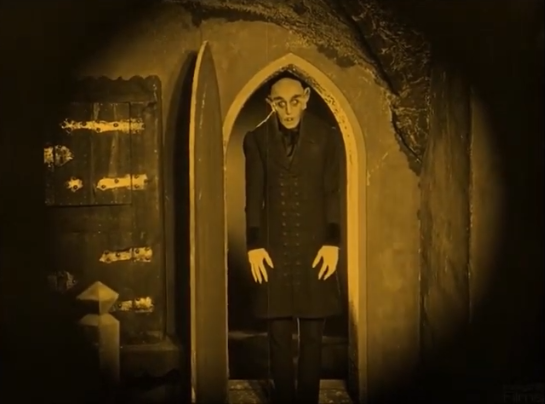
I have never seen Nosferatu in its entirety. I probably never will. At this point, I'm not sure why I'd need to except to check it off some nonexistent list, a.k.a. "100 Classic Horror Movies to See before You Die (Of! Fright!)". But I'll tell you what: Nothing in the vampire genre has ever scared me as badly as those flickering frames of Max Schrek as Orlock, especially when he's just STANDING THERE being a terrifying, otherworldly WEIRDO. I've always been a sucker for the Slow Chase (see Halloween, It Follows, so many others) and Max Schrek is like the Originator (Ain't No Imitators) of that creepy shit. To this day, it freaks me the hell out. If I'd seen Ol' Orlock as a kid, I would have had legit, yelling for mama nightmares. It would have imprinted.

80s Buzzcut King (Photo by Tabitha King).
Barlow could have been a lot of things, but in the end he was much ado about little if anything. And not very scary to boot. (Sorry, suckers!) Maybe if King had written him a seductive dance scene...

Grade: C
Scary (0-nope to 10-you will die): Solid 6. Others have claimed it's the "scariest Stephen King book everrrr" but it isn't. Very little vampire action and a "hero" who is very hard to like. If you don't much care what happens to the main characters, it's hard to get worked up about what happens to them.
Warnings: casual bigotry, homophobia, dead babies, undead babies, misogyny gone wild, sex scene where a certain someone says "Oh Susan."
Artifact: Library Book! According to the copyright page, this is the 28th printing of an edition put out sometime around 1993 (based specifically on the cover art credit cited above). It is a mighty hunk compared to my slight little Carrie volume and could easily knock a vampire into next week if you chucked it just so. Hardcover, black paper casing, metallic red stamping, red headbands, flat cut, red endpapers, heavy cream stock. It's hard to tell through the heavy plastic film that protects the book from unsavory elements (patrons! o susan!), but the cover appears to be 5-color, CMYK plus metallic. I am probably remembering that wrong, but either way, super fancy for what comes out looking more sepia than anything. In any case, the cover art itself is truly inspired, spooky and beautiful, with the back cover imagery clearly evoking the Catholic Church juxtaposed against the front cover's haunted Marsten house, both ensnared in deep thickets. A lovely and fitting artifact, indeed.

Up Next: Come play with us, Danneeeeeeeeee...


But seriously. This Guy.

Gah.

GAAAHHH.

Nope.         No.

[dead] [un]