I finally encountered my first Sketch McSketchityballs Rest Area: Gee Creek, just north of Vancouver, Washington. The facilities themselves were fine, if not a little far from the parking (making 3 a.m. bathroom sprints a joy), but the patronage was...sketch. Even though it was very cold (low 40s, high 30s) there were a lot of people hanging out in the parking lot, lots of old beaters, at least one prostitute sighting, and one definite drug deal going down outside the gentlemen's restroom. The stop was also too far from the highway for my comfort, separated by a heavily wooded area and, to add insult to perceived injury, the trucker section was way on the other side of the overlarge rest area facilities and grounds. I actually like being closer to the truckers--I don't care if they are imbibing in drugs or hookers--I'm assuming that most don't, that it is just a job like any other, and they are trying to get some safe sleep before moving on, just like me. I always feel more protected when there are idling trucks nearby. I hardly ever see the drivers--just the glowing lights in the dark--but their presence still comforts me.

It took me awhile, but I finally did sleep through most of the night (save that one fun run up the hill to the loo at 3 a.m., of course), waking up around 7 the next morning to quick heat up the car and get on the road. The entire landscape was thick with mist, an annoyance to some, I know, but to a Kansan whose mist sightings are near nonexistent, it was a treat. I arrived at the
Mount St. Helens Visitor Center just as it opened at 9 and took the tour through the well-worn exhibits before watching the little movie explaining the mountain, the volcano, the eruption, and all that's happened up until now.

When I was sketching out my trip I knew I wanted to go through Portland to visit Will's pizza joint, and I knew I wanted to spend some time in Seattle. While finding libraries at all of my main stops was part of the plan, as well as finding libraries for places in between should the time allow, I pretty much knew the primary tourist stops I wanted to make beforehand (Arches, General Sherman, Devil's Tower, etc.). At some point it occurred to me
HEY, where is Mount St. Helen's, anyway? Washington, right? I had no idea it was right there, practically on the way from Portland to Seattle.
For some of these places, you really have to ask yourself: Do I want to drive xxx miles to see this for an hour or four? Exactly how much does this mean to me? Because lots of these places are far out of the way, and the sicker you feel (be it a cold, tummy traumas, demon possession) the less likely you are going to want to hop skip and jump all around the map to see these sights. That's why Mount Rushmore was originally on my list...and then it wasn't.
 |
The Center features statues of different types of people
common to the mountain (loggers, campers, geologists)
and for some reason they are all all-white, as though
covered in ash. |
 |
| Old Timey Smoke Finder. |

But Mount St. Helens is a different matter. I might've decided to figure something out even if it would have taken me six or eight hours out of the way instead of just two. This was a historic monument from my childhood, a place of nightmares and wonder, and I absolutely had to go.
 I remember when Mount St. Helens erupted
. I was eight, the prime age for an overimaginative child to believe all sorts of wild, cataclysmic things. Once I knew it could happen, I believed that it would...
anywhere. We got Mount St. Nuthin in Kansas, but that didn't stop me from thinking it was possible for the earth to crack open and vomit hot death ash all over the land. It's similar to how swimming became all the more anxiety ridden after
Jaws came on the scene. Like there was no way Jaws was going to gnaw on your legs in Crystal Lake, but that didn't stop us from shrieking our little heads off when tiny fish would kiss our feet.
At eight years of age, the most permanent, monolithic things in life are your parents, your grandparents, your family, teachers, friends. You understand there are more ancient things all around you (who didn't go through an obsessive dinosaur phase, I ask) but the idea that your home, your school, your favorite playground... even your mom could be suddenly incinerated or swept away in a massive mud and ash flow was simply unacceptable. So when Mount St. Helens happened, it was beyond horrifying.
 |
| Photos ©Gary Rosenquist, 1980. |

While it is still horrifying, age has added that sense of wonder; such destruction is what shaped this earth, after all, and I considered it an incredible opportunity to see the mountain just thirty-seven years after the event, a microscopic amount of time in geological terms.
The Center, which is located off the main highway about an hour from the closest vantage point to Mount St. Helens, was fantastic, with lots of information I never knew about the 1980 volcanic event, plus history predating the modern eruption that tends to dominate the mountain's story. I loved the Native American histories, especially Mount St. Helens, the wife, winning the fight but "still burn[ing]."


One of the things I never knew about the explosion was the fact that it was a lateral event, with the side of the mountain effectively sliding off in
one last push of seismic and volcanic energy. You can see it in Gary Rosenquist's series of photos above or (more clearly)
here. We all knew something might be coming because it had been in the news, with film of steam vents and reports of earthquakes in the area, all of which culminated in the evacuation of citizenry nearby, much to the consternation of said citizenry, with
one famous hold out losing his life in the eventual explosion, along with fifty-six other people who either refused to leave or were there to document or study the ongoing volcanic activity.
 |
| Baby trees! |
It's shocking to see what changed from the impact of the blast, from the creation of new lakes, to rerouting of streams, and even the layout of the surrounding valley. But within all that change remains the aftermath of the eruption itself. You can still see what's left of the blown out mountain not only in the soil just beneath it (the pumice plain) but chunks of the former summit creating little hills in the outlying area. And all around you can still see clutches of dead trees, trunks with shredded edges where the tree was just snapped off by the massive force of the blast and flows, and the trees themselves, leeched white from instant death and laying bare for all these years.
The drive from the Center to the
Johnston Ridge Observatory (named after the geologist quoted above who lost his life that day) was winding but still serene and beautiful. Once you pass over the harrowingly high
Hoffstadt Bridge you're in the "Blast Zone." The incredible thing is that you can actually tell, not just from debris fields still visible from the 1980 blast, but from the tree growth within the blast zone. I was particularly charmed by all the baby firs and pines growing in thick patches along my route. I looked it up (thanks, Google)--these types of trees can live for 1000+ years, and these little babies are less than 37 years old, tops. You can also tell by their soft, green tops--not barky or splintery at all. Sproingy green babies!
One of the things that struck me about the sight of Mount St. Helens was just how
huge it turned out to be in real life. I always imagined it had blown its top off and now sat squat and cratered, a monolith no more. But no sir, no ma'am, this is not the case at all. Not even close. The mountain, though cratered, is massive. Take away the recent volcanic event and every spec of history attached and it is still very much worth seeing -- I'd recommend the snowier times, like now. A smooth sheath of glittery snow topped the crater's edges down the side of the mountain. I could see the gleam of billions of ice crystals even miles away. It was, in a word, breathtaking.
I'm not sure if average citizens can get any closer now that it is a preserved area, but I reached the end of my journey at the Johnston Observatory, parking in the huge lot and making my way up the small hill to a building that looks prepared for another event should one arise, save the glass, of course. As I reached the outer doors and read the sign it finally struck me that it was named for
David A. Johnston, the volcanologist killed that day, doing his life's work, and uttering those last words now memorialized at the Visitor's Center, all over the internet (including his bio on Wikipedia), books, and film. It was strange to realize that he perished somewhere nearby, and that everything I could see from that vantage was flattened, destroyed, covered in lava flows and ash, and the indescribable gravity of nature's power. It makes you feel small and exposed.
I got emotional--because that's what I do when in public, around people, preferably strangers, with nowhere to run--and knew that it was mostly because they named the building after him. I always imagine geologists as living in two worlds: one of science and beakers and haircuts, one of nature and rock hammers and headbands. Hippy scientists in grubby campers filled with camping gear and delicate instruments. I know little of David A. Johnston, but his name is all over the Mount St. Helens event, and I know it is there because the people in his field and in the forest service loved and respected the hell out of him. And that gets me right here (bam) in the breastbone and the eyefaucets. You have to respect a volcanologist--they study a thing that is always trying to kill them.
As I left, a moment of levity: There are signs warning of wily chipmunks in the area. I didn't get a close up read, but the gist was that they would steal your wallet if you let them and, lo and behold, on my way to the parking lot this little shit came at me like he had the weight advantage...to which I replied by squeaking at him and taking his picture. Moxie!
Lil' rat. Probably rabid.

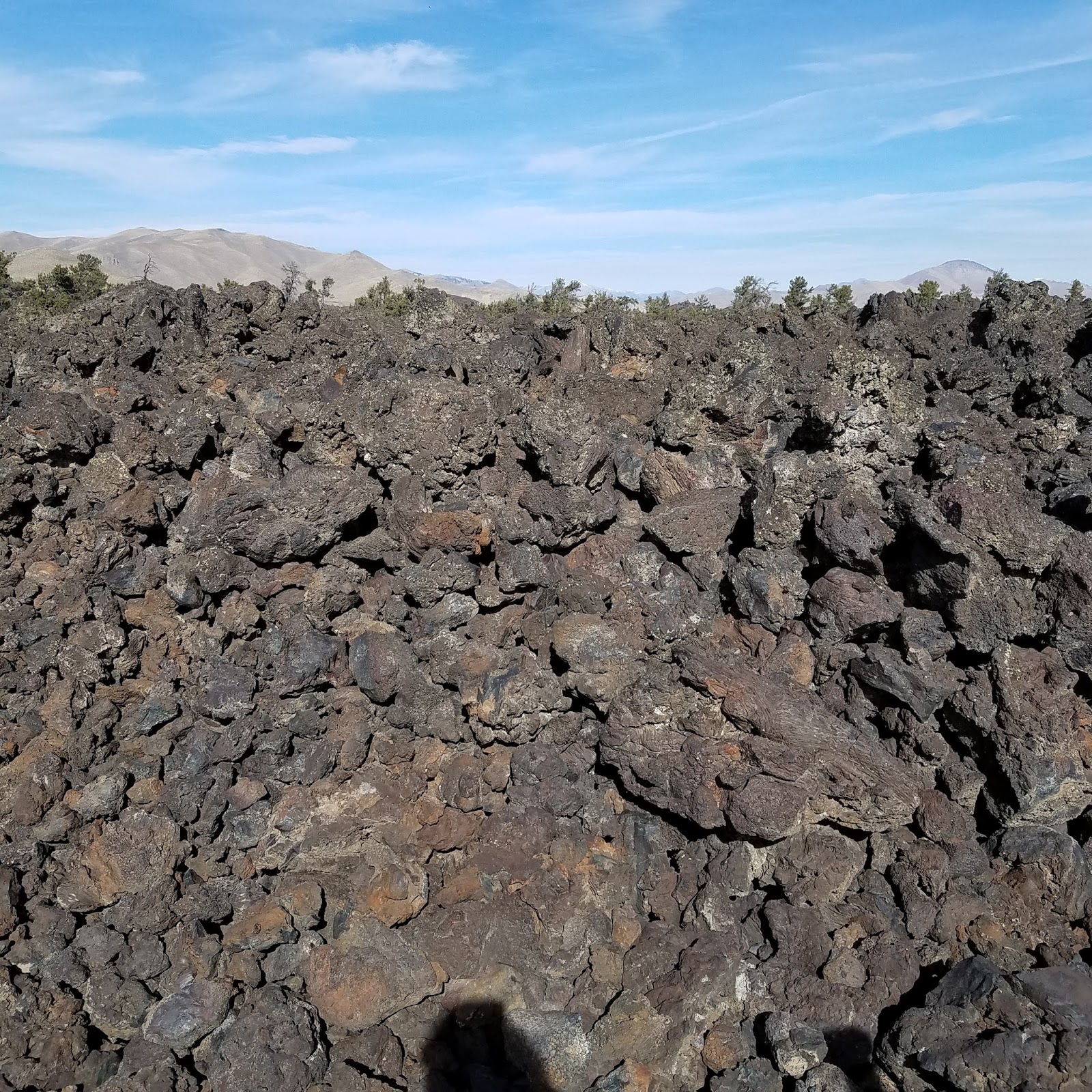
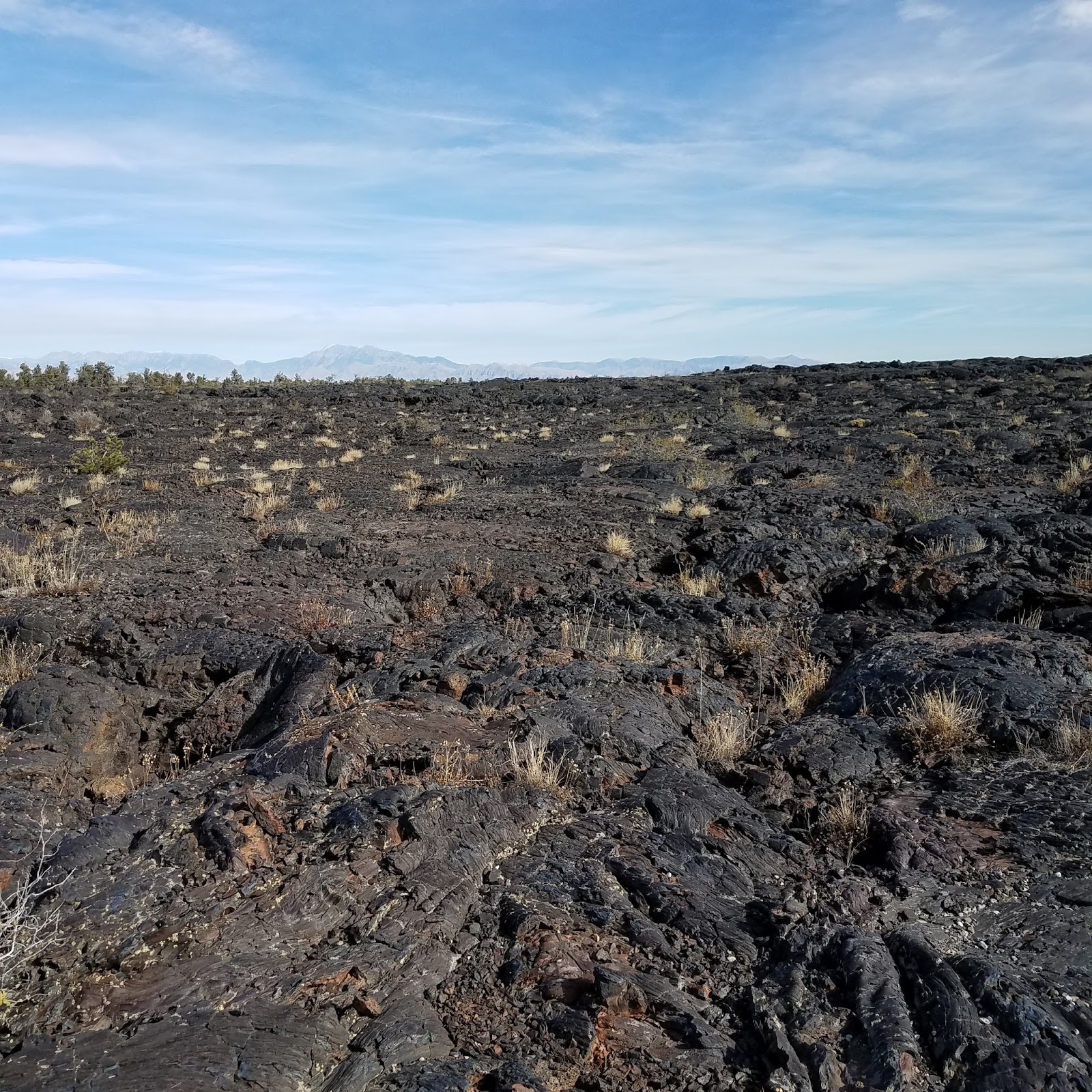
 If you never get out of your car and take a closer look, making sure to read the signs that explain what you are really looking at, it would be easy to whisk by the Craters of the Moon National Monument and Preserve assuming that a lot of land was about to be sculpted into something twee and dopey like "Gentle Meadows" or "Coyote Hills," complete with minimalls and parks and maybe even a library. All with matchy matchy stonework and raw wood paneling and cursive fonts.