Friday, January 10, 2020

Owning Your Shit in the Age of Spin (Rage, 1977)

RAGE (1977)

After the Sandy Hook massacre in 2012, Stephen King sat down and wrote an essay about violence in America titled "Guns." In the essay, King addressed his decision to let the book Rage go out of print. Rage, originally titled Getting It On, is a particularly significant piece of the bestselling author's oeuvre since King himself has identified it as the first novel he ever wrote. The fact that King wrote the story of a high school shooter while he himself was a junior and senior in high school only solidifies the incredible value of the work [1]. King's insights and perspective from the direct point of view of a high school kid lends a level of authenticity that is clear, honest, and blunt. Rage, before it is even considered as a piece of literature to be enjoyed or reviled, already stands as something to be studied, discussed, and protected.

Scary skull concept. Are you scared? It fits,
though I'd argue most directly to just one of
the novels within: The Long Walk. I could
swear my edition had much sharper cover
art and CMYK color processing, but I can't
be 100% certain. It kind of looks like they
scanned in a copy of the original and this
is what came out, like something from a
1985 Xerox machine. 
In the essay "Guns," King mentions rewriting Getting It On some ten years after that first draft and sending it to his publisher to print under the pseudonym Richard Bachman, "[w]here it was published as Rage, sold a few thousand copies, and disappeared from view" [2]. This is a bit of an oversimplification of the matter, since most King fans back in those grody days of the 80s remember when King's pseudonym was discovered and, more precisely, when King's publisher was kind enough to release most of the Bachman works (sans Thinner) under one title, The Bachman Books. I had my paperback copy for decades, spine cracked, pages yellowed and torn, before surrendering it to a giveaway pile, never considering the fact that it was, as of the late nineties, incrementally but increasingly irreplaceable. Because after a series of school shootings linked directly or indirectly to Rage, King decided he'd had enough and asked the publisher to let it go out of print [3].

If you look it up, you can still find plenty of copies of either Rage or The Bachman Books for sale, almost all of them used (and any purporting to be new, buyer beware). The new, "international edition" of The Bachman Books sold on Amazon has taken a few hits to its star rating over the years since the original description included Rage even though the book itself (yet another 2012 edition) does not. They've updated the description since, but the pissed off reviews still stand. People want Rage, more likely than not because it completes the works of Stephen King. And no one likes being told they've been shut out of a special club where only a special few get to know the secret handshake. I don't know, maybe they should've jammed Thinner in there as a consolation prize.

While I can see how perceptive, well-read
fans caught on to the ruse, I would still insist
that the Bachman books do feel different.
They're grittier, somehow. Meaner.
You can't unring a bell...and you can't unshoot a gun. King describes his decision to let Rage go out of print as something he did with "real regret." While he does not believe the story was the singular cause of any one of the violent incidents connected to it, he considers Rage "a possible accelerant" [4]. Which was all the reasoning he needed. From any genuinely compassionate perspective, it is completely understandable. 

Since learning of his decision to let Rage go out of print (which took years for me to truly understand--I was a bit out of it for a long while), I've experienced a surplus of supportive, combative, compassionate, and mean spirited feelings about it. As with any King work that I absolutely adored in my teen years, It's Complicated. At this writing I'm balanced on slim blade, where two opposing arguments weigh exactly the same...and (at least in the exact here and now) I'm not sweating it so much because of one very awesome reason (more on that in a minute).

On one side, I understand where King is coming from. Anyone who has read more than one of his books knows that he's an empathetic person, someone who can create whole, true humans out of thin air full of depth, history, and feeling. And anyone who has read his chatty forewords, afterwords, and varied addenda are doubly tuned in to King's self awareness, sensitivity, and genuine affection for his fans. The criminal incidents that can be connected to Rage started with hostage taking and ended in multiple murders. Even the most incidental connection between the least damaging act of violence and something I wrote would absolutely sting like hell. I would feel sick and struggle for perspective. It would hurt. So I get it. After the killings in Paducah, Kentucky, King called it. He couldn't bear the association any longer and, more importantly, he didn't have to. 

On the other side, the place where I tend to linger, is the question of censorship. Until the last copy of Rage or The Bachman Books perishes from earth, I suppose you could never exactly call the decision to take this one particular King story out of publication "censorship," but Never. The. Less. Access to Rage is effectively restricted. You can try to buy it online, but you're rolling the dice whenever you buy something used sight unseen. You could attempt to find a copy in a used bookstore, and maybe you will get lucky. And your library might be hoarding a copy like a bright and gleaming Precious, back in storage, not out in the stacks where any idjit bastage could just up and steal it. There are tepid little pools everywhere, no doubt, but the fresh spigot to Rage has been cut off.

Savage secrets, ghoulish game shows, and em-dash abuse, oh my

Rage
speaks to a certain teenage mindset, one twisted to seek validation through violence and chaos, but it also speaks to a lot of other teenage mindsets, and plenty of empathetic adults, too. Rage should be available for study--for academics interested in King's early, formative work, his very first novel is, quite frankly, extremely vital. And yes, for history, as well. It's just one fragment to the exhaustive school/youth shooter formula that we're still trying to solve to this day, but it's important that historians, sociologists, educators, psychologists, and politicians get every fact they can to try to understand this problem better. This includes access to the novel Rage--and not just a synopsis, either.

There are sales/ad pages aplenty in
this edition of The Bachman Books.
This one appears in the frontmatter.
Shameless! I do love that Fangoria-
style font, though.
Leaving Rage out of print is not exactly censorship, but it's got its lips pressed against it and the glass between the reader and the work is getting all kinds of fogged up. It's censorship adjacent and I Don't Fucking Like It.

How do I balance on this impossible edge, both sympathetic and disapproving? In the best way, of course, because revisiting this King classic comes with a sunshine-y side story, and it's time to glow and crow about the Wichita Public Library. Let's talk those bitches UP. Because after realizing what I'd done (goodbye my copy of The Bachman Books, I hope someone is loving you), I had to come to terms with the fact that I might not be able to get my hands on a complete copy at all. I searched the Wichita Public Library's website and found that they did, indeed, have one paperback copy. It even listed Rage in the description. More intriguingly yet, it was in the "Storage Collection" and the shelf location was "Ask for Staff Assistance." It was also checked out at the time, so I put a request in and warned myself not to get my hopes up. After all, there were versions of The Bachman Books out there being advertised as intact that were, in fact, not intact, sending customers into their own mini-rages over false advertising and general vexation about not being able to get the thing they wanted. 

Full title page. Obligatory "Explain
yourself" section included. Anyone
who thinks the Bachman books are
just throwaways that should have
stayed in the trunk are just dead wrong.
Wait til you hear all of my Strong and
Loud feelings about The Running Man.
The good old Wichita Public Library came through, though, didn't she? The best part yet, it appears to be the same edition I owned as a kid. I'm not 100% certain it is the exact same since there are weird little differences in the color values on the cover and there's some wackadoodle typesetting in the interior, but it's the same cover design, same interior content, and was published roughly around the same time my own copy was clutched in my sweaty little hands, at the twee age of 14, still smarting from my time in the clink, aka middle school. The library's copy has a creased back cover and some pages that are a little beat up, but the binding is remarkably strong and, aside from just age, it is in fantastic condition. When I first picked it up, I rifled through to see if Rage was really there, and was squawked with joy to find it complete and whole. A real copy of The Bachman Books in my hand! And all courtesy of the Wichita Public Library. Fucking heroic. 

So that's what's got me balanced here, half compassion, half rrrrage against even the hint of censorship, because librarians Know What's UP. Somebody was fully aware that Rage was out of print and would be harder for the general reader to get a hold of. Not impossible, but harder. So they secured a copy and then double secured it by keeping it safe but available to any patron that requested it. I only had to have a library card in good standing to check it out and take it home. No surrendering of kidneys or first born boychildren required. It's even renewable so long as no one else requests it. Fucking. Heroic.

I would just like to state for the record, before moving on, that I know I've related stories here about my tendency to break book backs, fold pages, and all around act a damn ingrate when it comes to the treatment of my own books, but rest assured I treat library books with the utmost care, always. I've been especially sensitive to this copy of The Bachman Books because I know how much it is worth. So, no sweating WPL. I promise not to crack any spines.

Copyright page, jammed tight from top to
bottom. The bottom margins in this book
are obscene. Like, who dares? Apparently,
Signet, an imprint of Dutton Signet, a
division of Penguin Books USA Inc.
Growing up, The Bachman Books was always a favorite, placed much higher than the pulpy horror King frolicked in during the early-to-mid 80s (Firestarter, Cujo, Christine, etc) at least in my estimation, with three of the stories (sorry Roadwork) true rippers and roarers, fearless, bold, brutal, striking, and even in the depths of speculative, near-future fantasy, so very real. As a bruised survivor of hellschool, I found high school to be a far milder, much more pleasant place to score those C's and B's, but when I first read Rage I still remembered with cruel clarity the stifling victimhood of the bullied. Middle school, high school--it all translated. 

In the essay "Guns," King spends a little time outlining the every day circumstances of the kids who carried out those Rage-adjacent incidents; what happened during each incident, certain things uttered during or after, and what was going on in their lives just prior to acting out. In each case, there are sad moments of attention seeking--blustering, infantile, pathetic neediness--and declarations like, "I don't think I can kill anyone....I don't think I can do it," "Why am I doing this?" and "Kill me! Please! I can't believe I did that!" [5] In each case, the kid was under some sort of external duress, whether it was guardian neglect or abuse, or bullying from schoolmates. This theme isn't new--it's basically the same refrain we've heard after every school shooting. The difference, however, may be in how these particular kids reacted to their own actions. Why am I doing this? I can't believe I did that. What have I done?

It is real! It is complete! Thank you, Wichita
Public Library! As much as I believe readers
deserve full access to Rage, it is actually not
my favorite novel in the collection. It's not
even my second favorite. Still good, though.
Still worth fighting for.
Reading Rage now, under the shadow of its quiet death, forces the reader to think not only of the story unfolding, but of the context outside the story; its earnest beginnings (King laboring away at his typewriter, smudged glasses and pimple-faced, bent over the keys and typing a wild whir because he's got Something To Say), and the dark, sad demise (sullied by association to the despair of its creator and sent silently out to sea). Considering the notoriety, you'd expect to find a much bigger bloodbath within its pages, kids bodies sprawled in gore, a grinning psychopath with a gun. But it's really more like The Breakfast Club with a pistol. There is a body count, but the construct is deliberate and the message is clear: Charlie Decker doesn't shoot his teacher because he's a stone cold killer out for blood; he shoots her because he's got a stomach ache. And why does Charlie have a stomach ache? Because he has a controlling, distant, judgmental dickwad of a father. Because he has severe anxiety and has been trying to manage it on his own to no avail. Because he's starting to lose cohesion, grow more paranoid, and has nowhere to go but to his bedroom, day after day, to quietly crack up. Because when his teachers put him on display, trembling at the chalkboard, mocking his ignorance, slathering sarcasm and snotty shots at his back while he tries to work it out, stomach turning and churning, mind whirring, until finally its just one shot too many...well. Chaos. 

I love the early author pages for King--they get
more and more effusive and it's literally still the
tip of the iceberg with this guy. So much more TK.
The story begins during an interim period where the lead character, Charlie Decker, attends classes while awaiting his fate. Weeks earlier, Charlie brained his science teacher with a wrench after an unfortunate chalkboard showdown. The teacher was severely hurt, but lived. After counseling, meetings with police, lawyers, administrators, and psychologists, it's decided Charlie can return to school for a period while they decide if he's going to finish high school where he started...or end up at the reform school. But it's already too late for all that, really, because the teachers keep sniping, and now his paranoia is validated by actual stares and whispers, so when Charlie is finally summoned to the principal's office to be told his future, Charlie is already spring loaded to snap. All it takes is one more mealy mouthed lecture from a condescending adult and Charlie commences with what he calls "getting it on." There's a scene in the principal's office, followed by a locker set on fire, and finally Charlie rejoins his math class, blowing away the teacher and taking the students hostage. When another teacher comes along to tell them to evacuate because the fire alarms are now blaring, the teacher is given a chance to escape yet can't seem to grasp the situation--to listen to the students' warnings to leave--and gets shot as well.

When I was a senior in high school, I went through a very mild but memorable incident with the principal's office that immediately made me think of Rage at the time, not because I went off and acted out or anything, but because it reminded me so much of the administrators and teachers, and really most of the adults, in King's story. As King illustrates again and again, adults don't listen. Ever. They just make sarcastic remarks, nag, sermonize, finger wag, judge, humiliate, undermine...they "grind you down" as Pig Pen, one of Charlie's hostages in Rage, would say. They never, ever listen. This little incident of mine had to do with tardiness. I was late to school because I was doing something for my mother, by her direction and permission. The principal's office was deliberately obtuse about the whole thing, rules are rules, etc., and they were hellbent on giving me detention. The condescension was thick, bull-headed, and entirely unnecessary. They ended up reversing their decision, but not before extracting a good deal of frustration and anxiety out of me, the sickly-sweet nectar of the petty dictatorship, and only after my mother called and raked them hard over the coals. There was no satisfaction in that, either, none at all. I remember sitting in the library and stewing over it, mulling and mad, and thinking of Rage, the deliberate, obtuse bullshit of grownups. Being seventeen, the exact same age as Charlie in the book, and so close to finally being out from under that giant, collective grownup thumb, made such a small incident even more bitter and frustrating. The condescension, so close to emancipation, was unbearable. 

Backmatter ad/sales page updated sometime after
the first printing of this Signet edition. Gerald's
Game, Needful Things, and The Wastelands were
all published in the early 90s, several others listed
were published after 1986 when this paperback
first went to print. Funny the things they go out
of their way to update...and the things they don't.
After Charlie kills "the grownups," silencing their dismissive derision and flippant disregard (and all subsequent grownup interactions over the intercom are threatening, confrontational, and table-turning lashings), the class becomes a sort of confessional, where kids share like stories, moments of pain and embarrassment, secrets never told to anyone until now. Stitched deep through it all is the insipid violence of artifice and the conspiracy of "Society" (the grownups) to make kids behave a certain way, believe a certain way, conform as directed and submit to be ground down, sometimes all the way down, until you are a walking stomach ache with a gun. In some way or another, everyone in the class participates, engages, relates...everyone except all-American Ted, who becomes more and more enraged as the hours tick by. Ted likes the clean artifice, despises the dirty real, and hates Charlie most of all for setting this ugly little Breakfast Club in motion. Eventually the class really isn't hostage anymore and Charlie facilitates a final act of chaos, one last bit of education where the class teaches Ted a lesson.

Spoiler alert from 1977, but Ted lives. He's not doing great afterward, at all, but all the violence done to him is not by Charlie's hand, at least not directly. It stands to reason that someone built entirely of ersatz could never bear so much blinding reality. The heat--and his classmates ruthless hands--melt poor Ted down to a drooling nub. Charlie goes to the mental hospital, the rest of the class graduates and moves on. Are they better people for it? Worse? Was one morning stripped of pretense enough to build a lifetime of honest living? The story never tells. But I think about those boys out here in the real world, those stupid, sad boys and their daddy's guns, reading Rage and Getting Ideas. Why am I doing this? I can't believe I did that...

Like, they seriously went bonkers with the ad pages in this book. Buy! Buy!
Buy! But this is how you hustled before the internet was a thing.

Rage isn't a free-for-all of gun toting vengeance. The murders are almost perfunctory. The story is more about the conversation, the connection, kids across different social groups coming together to engage in real talk, down to the grit and the ugly, and coming out the other side still alive, and  accepted. Don't you think those real world sad boys read Rage and felt a sort of painful keening, a desire to be heard and understood, to be accepted, validated? I do.

See? What tomfoolery is this. I mean, they're advertising a book
that the reader is literally holding. 
Compared to other "teen shooter" or "school shooter" works in King's oeuvre, Rage is actually quite tame. I found "Cain Rose Up," a short story included in the Skeleton Crew collection, to be far more disturbing. Charlie Decker does terrible things, but he's impossible to hate--his anxiety is relatable, he's funny, insightful, and has a bright inner world that might've grown an entirely different way under the guidance of a better father. Curt Garrish, the main character in "Cain Rose Up," is cored out, keyed up, and ugly deep into the bone. His most banal thoughts are peppered with images and inclinations of violence, murder, decay, and complete, unhinged sickness. Garrish has a nasty  thought for every person he encounters and his redemption arc is a flat line. He is a far more suitable "hero" to the modern mass shooter, school or otherwise. He's a shell for want of a chamber.

Worse yet, there's Todd Bowden from Apt Pupil, a novella in the Different Seasons collection. Through a shockingly devious act of extortion, young Todd basically procures a pet Nazi in hiding, and forces the man to regale him with stories of the war with all the gory details, a quid pro quo that grows more and more depraved as time goes on. Bowden is a budding Nazi of a sort, though he is not so much concerned with racial purity or ethnic cleansing so much as he is attracted to acts of torture and murder. Through a series of events, secrets are unearthed, and the boy, now a teen, is cornered by his own lies and subversion, and the story ends with all-American Todd Bowden sniping cars on the highway until the cops finally take him out.

Bowden is another, much likelier idol for modern shooters to emulate. A baby Nazi with a depraved inner world almost entirely devoid of healthy thoughts or any sense of goodness. Garrish and Bowden are examples of the grotesque, the thing no one really wants to talk about, something so familiar in the pimple-faced killers who committed their crimes after all iterations of Rage went out of print and, apparently, out of vogue with more modern teen psychopaths. More often than not, we witness--time and time again--an unapologetic, vengeful, irredeemable murderer. The last crime "connected" to Rage--the final straw for King--happened in 1997, two years before the incident that is widely considered to be the beginning of the "modern age" of dead-eyed shooters: Columbine. When incidents of school violence became less a cry for help and more about the body count.

The very last page of the book is this public
service announcement that would be sad if
it wasn't so close to the truth. We don't have
a literacy problem so much as we have, er,
a reading comprehension problem...or an
"easily succumbs to propaganda" problem...
or a severe addiction to conspiracy
theories problem...take your pick.
There are so many.
There were dead-eyed killers before, just as there remain regretful killers now, but the scales seemed to have dipped heavy on the flat-eyed, pinch-mouthed sinews of unchecked misanthropy. The influence of a 24-hour news cycle, the immediacy of the internet, and our constant connectedness have all played a part in the evolution of the school shooter. The education system gets its slice. The parents of these killers own a large share of the responsibility, banal hardships and best intentions be damned. Except in egregious cases, I would not hold a parent of a teen shooter criminally responsible for their child's actions, but I do believe wholeheartedly in Owning Your Shit. The stories of mass shooters so often follow the same, frustrating narrative, where at some point it was clear that the future murderer was in psychological crisis and the people closest to the situation just let it ride and hoped for the best. No matter the circumstances, if your child is in crisis, you are responsible for getting that child the help that he needs. A broken arm gets set and placed in a cast. A cancer stricken body gets radiation and/or chemo. A fever gets a baby aspirin. The brain is an organ, too, and when it flags or fails, you have at least try to make it better.

Taking Rage out of publication certainly didn't stop school shootings, anymore than it directly caused those incidents in the 80s and 90s. Ineffective gun laws, lackadaisical mental health initiatives, and our fitful if well-meaning social experiment play much bigger roles than any work of fiction, Moutain Dew Commercial, or Marilyn Manson song.

The Sandy Hook perpetrator fired 156 rounds and killed twenty-seven people, including himself, in less than five minutes [6]. He was on the spectrum, deeply ill, and completely isolated from the world [7]. His exact prognosis can only be guessed through the remnants of his writings, interviews with those who knew him, and his last, irredeemable actions in this world, since it had been years since anyone had bothered to get him the help he desperately needed. His father and brother were no longer in the picture; his mother allowed her sick son to dictate their lives. As deeply ill as the killer clearly was, his mother still stocked their shared home with plenty of guns and ammunition. He never had to buy a single round. He just had to take one of those unsecured guns, load it, and kill her. Then he gussied up in his proto-military/SWAT swag, drove over to Sandy Hook Elementary, and murdered 26 human beings who had done absolutely nothing to cause his misery.

Instead of censoring Rage, why don't we censor the ability of the weakest, sickest, and most dangerous among us from getting their hands on weapons that can wipe out an entire first grade classroom and support staff in less than five minutes? Instead of focusing our smart-mouthed talking points on one novel, one musical artist, or one video game, why don't we collectively Own Our Shit and admit that, while this problem is undoubtedly complex, there are at least two major, contributing factors that could be addressed any time we are ready to stop bickering and actually Do Something: gun reform and a mental health revofuckinlution. Without a real effort to trust one another, confront the ugliness within our society, and a full-hearted embrace of methodologies that could help everyone (and not just the lucky few), removing Rage (or Skeleton Crew, or Different Seasons, or In Cold Blood, or American Psycho, or Catcher in the Rye...) from the shelves is about as well-intentioned and ineffective as those torrents of thoughts and oceans of prayers.

Grade: B+
Scary? (0-nope to 10-you will die): 2, it's more unsettling than scary.
Warnings: School shooting, gun violence, slap fights, conformity reform, the phrase "getting it on," asshole dads.
Artifact: Well preserved 1986 paperback reprint, glossy cover, possibly CMYK, but could be flat color, mass market pulp paper, margins to set your hair on end. Large crease on the back cover and roughing of the edges, but the spine adhesive is holding strong and the spine is barely cracked. Oldie but goody.

References
[1] "Guns," Stephen King, ebook, Philtrum Press, January 25, 2013.
[2] Ibid.
[3] Wikipedia, linked.
[4] "Guns," Stephen King, ebook, Philtrum Press, January 25, 2013.
[5] Ibid.
[6] Wikipedia, linked.
[7] Stuff.co.nz, linked.

Friday, December 27, 2019

The Twisting Lens of Fractal Time and the Beautiful Ravages of the Snotpocalypse* (THE STAND, 1978, 1990)

THE STAND (1978, 1990)

The world catches the flu and drops dead. If things weren't bad enough, a psychotic, narcissistic, jiveturkey clown drives the surviving population to cataclysmic ends using fear, lies, and the malignant power of the cult of personality...heyyyy...

I'm not going to say anything about this cover
other than the painfully obvious: it has nothing
whatsoever
to do with the book. I couldn't torture
a guess out of this even if I wanted to try. 
I started reading the original version of The Stand (published 1978, set in the early 80s) as a snot-nosed high schooler. The Stand remained my very favorite Stephen King novel until It came along and stole this Loser's heart, in many ways, forevermore. The original publication, a relatively slim 800+ pages, was still a hefty undertaking for a kid that had never tackled anything thicker than 500 pages at that point. Packed within those pages, with careful plotting and an underlying moral so clear even a squirrel-headed teeny could catch the drift, was a story thick with interesting and conflicted characters, creeping horrors that revved up to roaring terrors, and a doubling down of misfortunes so sinister in conception one wonders if the lesson was all that clear after all.

A grimly humorous irony--and cherished memory--was the fact that the only time I could ever devote to reading The Stand the way I wanted to (straight through, no interruptions save the necessary) was either during summer break or, as I was more keen to do, when I was home sick from school with hours of hacking, coughing, and sneezing time to spare. There was something deliciously twisted about delving into the demise of the human race under the relentless virulence of the US government created superflu, Project Blue (aka Captain Trips), while combating my own garden variety virus. The very first time I read The Stand was under the heady fog of flu, propped up on pillows and swimming in tissues. The bonus visceral experience made that reading just as scary as you'd imagine. I've often wondered if that inaugural reading hardwired me to enjoy the first half of the novel just slightly more than the last. To this day, it remains true, though it's balanced out some over the years. It's either that, or perhaps because the first half of the novel is primarily rooted in reality--germ warfare is real, human egomania is boundless, stupid happens--whereas the back half is steeped in fairy-tale mysticism and the cruel extension of trials, a seemingly never-ending battering of heartache, disappointment, failures, and the looming threat of complete annihilation.

Same as above...and the description is wrong.
What the hell, dude.
So I read The Stand during various outbreaks of colds and flu, gleefully suffering from some of the same symptoms that were so effectively killing people in the story, enjoying a sick thrill not dissimilar to those movie-rides at Disney where the seats jimble jamble and they mist you in the face to heighten the experience. By the time the "complete and uncut" version of The Stand came out in 1990, I'd read the original more than a half a dozen times. It was well-worn and well-known. When I finally got around to the new edition, it was more of a curiosity and less a thrill. Nonetheless, I loved many of the additions, especially the confrontation between Frannie and her mother, and felt that most of what King added back served to strengthen the overall story. All in all, though, I had "moved on." There were quite a few King works that lit my fire hotter and brighter than the dusty ol' Stand, and college was expanding my tastes in insatiable bounds, so my copy of the complete and uncut edition of The Stand got shelved for a once-a-decade read through (if that) if for nothing else, a tiny, faded taste of nostalgia...me on my bed, buoyed by blankets and tissues, goggle eyed and snorting through the demise of the world. Good times.

Before I go on, I must acknowledge a certain elephant, for he is quite lorge, full trumpet-y, and stinky. It's been weighing on me ever since I started re-reading these first King novels, so I suppose now is as good a time as any to talk about the rotten facts of bigotry. I can't speak for every popular novel from the past, but I'd imagine similar levels of sexism, racism, and homophobia are smattered through the pages of many bestselling mass market paperbacks with yellowed edges and cracked spines. When portraying the general populous, or at least the primarily white-faced facets of it, the truth is laid bare for all to see. In the 1980s, women may have "come a long way," but they were expected to marry and reproduce. They might work, but they better fix dinner, bake pies, do the laundry, raise the children, and clean that house Spic-n-Span. People of color were gaining traction, but racism was rampant, systemic, and largely unacknowledged by whites (imagine now but much, much worse). And homophobia? Standard. Remember that an entire generation of gay men were left to die of a literal plague because people, at best, didn't want to talk about it and, at worst, believed that a "chosen lifestyle" was being punished by God. We all have indeed come a long way, baby. There are miles to go, even so.

You can see the decorative elements added to the first page of
each chapter, full bleed art. 


Inside cover showing embossed
stamping, first class. 
The Stand is a worthwhile read, but I would be lying if I said some passages weren't grating and sometimes downright infuriating, especially when the bigotry seeps in so casually, so matter-of-fact, that you just have to stop and take a breath. It's a relic of a bygone age. The world still requires changing, and some deep introspection and unfettered honesty, but I know the breadth and depth of my own understanding and empathy for other human beings has expanded greatly since 1978, 1987, 1992, 2001...right to the here and now. I would never claim to be perfectly "woke"--no one should--but I believe true compassion is a process and no more black and white than the protagonists and antagonists in King's The Stand. I would expect any modern casual reader of The Stand to suffer similar misgivings, discomfort, and inner conflict.

To bear the casual, ignorant, even well-intended bigotry, I've tried to see these early King works as artifacts as much as they are entertainment or art, similar to how I choose to view the almost unbearable Adventures of Huckleberry Finn, oft taught and repeatedly (understandably) challenged. Denying history--how people truly treated one another: the sorrow, the pain, and the dehumanization, both radical and casual--dooms us to repeat it. The answer to these uncomfortable/offensive uses of language and stereotypes is not censorship or incineration. The answer is definitely not to jam such "great works" as Huck Finn down highschooler's throats simply because some old, dusty mummy declared it part of the sacred Western lit canon. A thoughtful approach is required, teaching history and literature in the same breath, with a clear understanding that we are reading from a modern lens, bent to our perceptions in the Now. If wishing it could only make it true. Unfortunately, the bleak status of the public school curriculum makes it unlikely to ever expect a qualified approach to such texts, even if there were time between all those "vital" standardized tests.

First page (i) of the preliminaries, a seriously glowing
praise page. Many King fans consider The Stand his
best work and, at the very least, their favorite.

Third page of the preliminaries (iii). standard,
current-to-this-edition author bio page.
The bent lens, the perspective of Now, is always at the fore of these re-readings of King's works. Truth be told, every offhand use of the n-word bugs the living shit out of me. But I'm working on keeping that separation, working hard, because the biggest challenge is around the corner and, quite frankly, I'm already dreading it. My sentimental favorite is coming up soon. Anyone who's read It knows it is all kinds of problematic, but I'm gritting my teeth especially against the memory of Trashmouth Richie Tozier and his godforsaken "Voices," one of which is...well, predictable. There's a difference between the racist ranting of the bully Henry Bowers and the embarrassing antics of Richie's very worst "Voices," just like any portrayal of a racist ass racist being a POS racist is different from, say, a certain author who makes every African American character speak in some form of jive. Acute, virulent racism is easy to condemn; it is the sneaking, systemic racism that is harder to pin down. It's the same kind of racism that provokes such sour defenses as "I didn't mean it like that," or "you people take yourselves too seriously," or my favorite, "Obama was president, racism is gone, why can't you get over it."

I don't want to misportray The Stand as some sort of post-apocalyptic romp through the song of the South--it is absolutely not--but the blips of casual racism smart, like cutting little slivers of ice against your cheek, and if nothing else reminds the reader of just how much closer we are to understanding one another. No, not all of us, but enough to make a difference. And enough to make rereading beloved novels from yesterday a bittersweet endeavor.

I hadn't read The Stand for at least ten years when I picked up a paperback copy at the library some weeks ago (my hardcover 1990 edition went to the Strand; the original paperback is lost in the loose pages of time). Even with that gulf of time between us, I was prepared to be bored. I have read The Stand many, many times. And I'm not going to lie. This last read-through was a bit of a slog. Lots of been there, done that, and more lines and sections memorized than even I expected. But though it was sometimes tediously familiar, I still found things that surprised me, more in how my perspective had changed than anything I'd missed or forgotten.

Prelim page iv, the staggering ad page,
updated to 2014 so very interesting...
One of the biggest (and most welcome) differences was re-experiencing a post-apocalyptic novel that, for all its death and doom, still remains much sunnier than the more modern post-apocalyptic works. Much, much sunnier. When I was in my prime The Stand-reading era, the world was still years from enduring the beautiful torture that is Cormac McCarthy's The Road or the evolving ugliness of The Walking Dead. A cornerstone theme in both works is the driving Evil of Man, that once society breaks down, the survivors devolve into unspeakable violence against one another. In at least the original version of The Stand, even the "bad" side was the law and order sort of bad. Sure, mass murder was on the menu, and yes, people who broke the rules were regularly crucified, but all that rape plus rape and more rape with a side of cannibalism was a big no-no, even in the Dark Man's land. Now, the new and revised edition does feature a backstory to secondary characters Susan Stern and Dayna Jurgens, both of whom had been captured and held for purposes of sexual-sadistic pleasures of men with guns in what was leeringly called "the zoo." But even this scenario is depicted as more of an outlier, not an eventuality, and while it was hard to read, the ugly situation was readily rectified by the women of the zoo itself, taking the chance to even the odds during the tense clash between their group and that of our already established heroes, who were on the road to find Mother Abigail and her like-minded flock of "good people."

You know I love a full title page that pulls
elements from the cover design, y'alllll. Too bad
it's from the 1990 edition so doesn't match with
anything other than our wistful memories I guess.

Copyright page identifying this printing as a
2012 Anchor Books edition, the same as the
library copy of Night Shift. If properly
updated. this was the 15th reprint of
this edition.
I grew up during the Cold War in a small city surrounded by both loaded missile silos and an Air Force base, so it was a common childhood "joke" to claim that once World War III broke out and all the missiles were flying, my friends and I would simply step outside and wait for the white flash of oblivion. These declarations became commonplace especially after watching The Day After on network television; the very idea of surviving an nuclear apocalypse was more terrifying than dying in one. Despite the sadness and shock of losing loved ones and just about everyone else, the protagonists of The Stand also find adventure, new beginnings, new challenges, new community, and an underlying, driving need to congregate for a greater purpose, to make one final stand. And while Captain Trips was cataclysmic to human, canine, and horse populations, the summer of death leaves the land still vibrant and green; the grass grows wild and the deer are plentiful. The roads may be crammed with traffic jams and stalled cars full of dead bodies, but the stores are fully stocked with nonperishable foods and a comical surplus of goods. And sure, there's a capering demon set on destroying the people of the Free Zone, but they're together for now, picking whatever homes they wish to live in, working on getting the electricity back on, and setting about making some sort of society. The worst civil issues are drunks breaking windows and teenagers hotrodding into abandoned cars. As grim as the work can be (clearing bodies and burying them in mass graves, for example), the post-apocalypse is, at times, relentlessly cheery. There are picnics, for God's sake. It's sweet.

Decorative gutter on the dedication page.

The updated edition included this preface
explaining the new edition and why it
happened. I can't imagine even the tamest
King fan passing up a chance to read this
version. A very smart decision on the
part of the publisher, indeed.
That same perspective, the eyes of Now, also renders characters I once loved into something tarnished and even curdled. Stu Redman and Frannie Goldsmith are arguably the main protagonists in a very wide pyramid of incrementally less "important" characters. When I was a teenager I loved them both; I imagined Redman to be a male model Marlboro Man (and later almost identical to my imaginings of the Gunslinger), rugged with a steel jaw and beautiful eyes. He was heroic but accessible. I always imagined Frannie to be insanely beautiful, which at the time translated to Alexandra Paul in the movie of King's novel Christine, as the cross referencing, King-obsessed teenage brain is destined to do. Frannie Goldsmith was relentlessly funny, spunky, sassy, and fierce. Sure, she cried a lot, but during the time of those first readings, so did I. Then thirty years happened and hoooooo boy.

Redman is fine, maybe not so romantic, maybe not so heroic, maybe a little more steeped in reality, a little more homely in my mind's eye. His musings over his dead friends' and acquaintances' character or serious lack thereof is, in and of itself, a diminishing indictment against his own flawed nature. Redman's indulgent recollections of the dearly departed "good people" of Arnette, Texas are bracingly grim: one good ol' boy beat the shit out of his kids and another controlled the feral cat population around the homestead by crushing kitten heads under his boots. Yet nothing is quite so mystifying as Redman's unquestioning love of the extremely annoying and wildly immature Frannie Goldsmith who CRIES every minute of every day, becomes more and more shrill throughout the course of the novel, and remains infuriatingly obtuse, especially once they settle down in Boulder, Colorado. The fact that I loved her as a teen and find her obnoxious now is no surprise, I suppose, but it's more than just my transformation from youthful idiot to knowing crone. She really is just awful. Alexandra Paul in Christine would never...

Funny enough, while my sympathy for Redman and Goldsmith has dimmed, my compassion for the squeaky third wheel on their twisted lovecycle has grown. Sure, Harold Lauder is an entitled, childish, snotty little asshole, but his is a sadder story to me now. While I imagined Stu and Frannie as prom picturesque, from the very first reading I saw the angry, alienated Harold Lauder as a version of Stephen King himself. Not the man King--the wildly successful, happily married and seemingly well-adjusted King--but a sort of mangled teenage version of him: tubby, be-pimpled, black, greasy hair and lumberingly tall...I mean, how could you not see it? Harold's a frustrated writer to boot. Lauder is King if King had swerved wrong, had a different upbringing, and developed in low light all twisted and bitter.

King readers know he loves a good epigraph or
sixty, but this was one of the first to really woo
the hell out of me, I mean that BOC quote from
my (then) favorite song kicking off a book by
my favorite author? Scree. 

First page of the introductory chapter. I'd like to
point out that this gentleman is not, in fact, an
escaped patient from a "biological testing
facility." Ugh.
As I read through The Stand this last time around, I already knew Frannie would irritate (I was in my 20s when I started realizing just how dreadful she really was), but this is the first time I wondered if King deliberately wrote them that way. The strapping handsome hero and his ill-begotten prom queen, the girl Harold (Stephen) could never get except in his pubescent fantasies...were they deliberately written to vex? In the midst of all these revolving characters, each grappling with their own development and challenges, the reader must endure multiple visits to Redman and Goldsmith's love nest to witness teasing, babysitter's club notions of naughty domesticity, where they trade sly, sophomoric come ons that seem more and more disjointed from the greater narrative as each cringe-y encounter ticks off, a sort of craven, sitcom silliness in the midst of real, grownup problems including Actual, Imminent Doom. It's not to say that these characters can't be light and fun, but it happens one or three too many times by my accounting, so much so that it took me out of the story to wonder just what the hell King was up to. Trying to make us like them more...or less? I suppose it depends if you're more the Frannie or the Harold. Over the years my compassion has expanded for The Stand's various broken little boys--Trashcan Man, Larry Underwood, and even Harold--all while my patience for the patriarchy in the real world has thinned to the breadth of the last hair on Glen Bateman's head. Perhaps that is why Frannie Goldsmith's glaring shortcomings bother me so much. Goldsmith's character stalls out at "pregnant, hysterical female" and her development is hinged only on whether Stu and/or her baby survive. Any depth she might've displayed early in the novel is mired down in the grind of her screeching antics. She becomes a thing, a vessel, a come-on sexbot for her Hero Man, a carrier of the future of mankind, a sniveling wrench in the works of the Righteous. It's disappointing to say the least.

Epigraph and art plate opposite book I header.

This element does not translate well to amateur
photography. Kind of looks like old school
tv snow, doesn't it? Back when stations went
off air after the "Star Spangled Banner"?
Years grant perspective, at least if you let them, but it was still a soft surprise to find my initial resentment of other characters had lessened if not entirely evaporated. Mother Abigail was always problematic for me. I grew up going to church only under protest, a heathen child sulking in the car during Sunday school since I refused to participate, running my cassette of INXS' Shabooh Shoobah thin and squealy with the volume turned as high as I would dare in such close proximity to the frowning church. Mother Abigail's evangelical identity was completely alien, and her motivations were as confounding to me as they were non-negotiable to her. I understood her on paper, but had limited experience with the world and could not conceive of true faith. I'm no more religious now than I was then, but I understood her perfectly this time around. The same was true for Larry Underwood, the flawed hero, mega asshole who wants to be good but fails again and again. When I was a kid, I could not stand him, not one thing about him, from the beginning of the novel to the end. I didn't care that he'd improved, become a better person, or had the presence of mind to want to be good. He was just a selfish, mean little jerk with a highly stupid song whose lyrics made me want to take my fingerclaws and rake my brain (more on that in a minute). I couldn't understand Larry Underwood because I was a kid, the world was black and white, and I believed wholeheartedly that everyone chooses to be the way they are. So, if you walk like an anus, talk like an anus? You are a giant, gross butthole, sir. On purpose. It took a lot of mistakes to learn how wrong I was about that but here on the other side of the lens, Larry, while still anus-adjacent, earns some respect. He's a complex character who grows up over the course of the novel to become a person worthy and able of making that last stand...

Aside from adding depth and color to characters by
reintroducing previously cut text, the 1990 edition of
The Stand is exquisitely illustrated by Bernie Wrightson.
This panel depicts Stu, Tom, and Kojak heading home.
...against Randall Fartface Flagg. Sigh. Folks, I hate him. Young me thought he was funny and sort of scary, and Lord Have Mercy that sex scene in the desert just about scarred me for life...but in the end he's just another Pennywise in a jean jacket and sprung cowboy boots, almost too silly to take very seriously. Glen Bateman sees through the artifice, laughs his ass off at him, in fact, so perhaps it's all by design, but it sure is a lot of build up to get basically nowhere. It is possible I'm holding a grudge against the character for more general reasons specifically relating to the curve the Kingverse took sometime in the midst of the last Gunslinger books and other related novels. Perhaps the glamour just wore off. As I read The Stand this time around, everything he did and said seemed more like a gimmick than anything truly threatening...and Nadine's seduction is nothing short of ridiculous. The seduction of Nadine and Harold, really. I mean, what did they expect? He's a capering lunatic, a jeering fraud, and still they fell for it. As did everyone who chose to follow the Dark Man. But I guess we already know that people will follow an Evil Foole if he tells them what they want to hear. And maybe that's why Flagg is all the more ridiculous to me now. The parallels between that capering clown in The Stand and the dunce in the White House are chilling. The fat head full of dense, flat thoughts of Big Winning and Quite Tremendous egomania. And consider the buttons Flagg wears on his jacket...one a yellow smiley face, one a pig face wearing a cop's hat with the caption How's Your Pork? He's on any side and every side so long as the shit stirs and he can sit at the center of it and drink the tears, bathe in the blood. But they are just hollow men, headpiece filled with straw.

The Trashcan Man's last gift to the Dark Man
(Bernie Wrightson).

One thing remains the same: The Stand is an expansive, ambitious, and impressive novel. Every time I read it, I try to imagine all those spinning plates, King keeping track of every one, and somehow bringing it all home more or less to satisfaction. It's an incredible achievement. A reader could understand a continuity gap or two. Both editions have been in circulation for decades, however, which leads to some editorial curiosities. I should note that, once upon a time, I worked for a scholarly publisher. Emphasis on scholarly. Over the course of 15 years, I was entrusted with many responsibilities, both publishing-specific and managerial. At different times I was a proofreader, copyeditor, tech support, liaison, project manager, author wrangler, mean ol' department manager, and on. I worked on first editions from raw manuscript to printed book, and I worked on reprints, second editions, paperbacks, and offsets. Depending on the influence and prestige of the author (which walked almost exclusively hand-in-hand with having an agent), some of our trade authors were allowed to make corrections to the paperback editions of their books. If we went forward with a paperback at all. Authors of scholarly works were almost never afforded corrections, especially if they were minimal. The margins on scholarly works are microscopic. The print runs are tiny (if they even have a first print anymore--it's just as likely to go print on demand from the start) and the price points are enormous compared to trade titles. And no matter how much an author demands his work is the Last Word on Shakespeare, The Very Last, I Say, it is a simple matter of supply and demand. Very few people (and mostly just libraries) are going to need a densely written scholarly tome on Venetian coins in the 1100s. Barnes and Noble is not going to want a copy. It's not meant to be mean. It just is.

Truth be told, I loathe the addition of the last chapter to
the uncut version. It starts cute enough, but the trope is
tired and the message is already received (Flagg's New
Flock, Bernie Wrightson).

But King? He's a bestseller out of the gate, every time, a zillion times over. He's been a powerful, influential institution for decades. Now, The Stand came out near the beginning of his already extremely promising career--King didn't have the chops yet, the big belt buckle, and all those championship rings to knock that publisher into letting him have the full volume. That's why he had to cut some 400 pages and let it (ahem) stand with what was left. Ten years later he was a proven juggernaut, an unstoppable force of publishing and nature, so they could afford to add back in whatever King deemed still vital to the cut. It's a fantastic turn of events, one so few authors can be afforded. Which makes it extra galling that they screwed it up as much as they did.

The first time I barked aloud reading any book, this page right here. It's not
my very favorite line, but man is it up there. Such deliciously awful imagery.

If he wanted, Stephen King could have any and all of his books corrected. They could pulp whatever is in the warehouse, update all the files with corrected versions, and make all the next printings as clean as could be. He makes massive amounts of money for himself, his staff, and his publishers. His backlist is alive and well. There is no struggle on the publisher's part to make ends meet. The margins are double wide and extra roomy. The only reason they have not done this for The Stand or any other King novel must be because King doesn't want it. Maybe he values the book as an artifact, as well, a perfect time capsule from the past, where all the warts remain, even if they would be sooooo easy to fix. Tweak a couple of words, upload the files, next printing is perfect, why not? For example, when Nadine and Harold flee the Free Zone to join Flagg's people in Las Vegas, Flagg prepares a trap for Harold, which is meant to send him over an embankment to his death. It doesn't work out quite as expected, but in the end Harold is abandoned with a badly broken leg that will inevitably lead to his demise. In his last hours, he writes one last highly pathetic journal entry, signs off as "Hawk" and tucks the Permacover notebook into his saddlebag just before blowing his brains out. Later, when the four remaining male members of the Free Zone committee happen upon him, the notebook is somehow miraculously in his hands. So small, this continuity problem, so, so easy to fix. Whether it was a mistake from the original publication or the 1990 edition, I do not know, but it does lead us to the more egregious, over arching problem with the complete and uncut version of The Stand...

Acknowledgement page relegated to the back
for lack of space in the prelimiaries. SOP.
Releasing a new and restored edition of a novel set "in the near present" requires not only evening out the seams created when the extractions first took place, but demands updating the setting, vernacular, pop culture, and other miscellany to match what was then the late 1980s / early 1990s. Who wants to read about a catastrophe that definitely didn't happen back in 1980 when you could read about one that might be right around the corner? So they updated it, kind of. The problem is that there are tons of references, objects, phrases, et freaking cetera, that belong solidly and without question in the late 70s. Little things, inconsequential things, but still like sand in your sock, it grates. I found myself twitching every time I would stumble across one. I should have made a list but here are just a few from the top of my head: the "boogie down" notebook would be a rare find in 1990 because disco hatred was at an all time high so where did Stu find it in some guy's attic I think not; many, many references to the gas and oil shortages that were all the rage when this book was originally written but were a part of history when the new edition is set so why are people thinking and talking about it like it just happened or was happening when the flu descended; Flagg's politics and buttons are even more antiquated and weird with ten years between not to mention the fact that dates and ages don't add up quite right every time, either. The worst Offense? That horrid song, "Baby, Can You Dig Your Man?"--a phrase that sends me rocketing to Hell every time I even think about it--would never, EVER get traction on popular radio anywhere in the late 80s or early 90s. Maybe mid-90s? Mid to late? Maybe. My teenage brain incinerated into a tiny black briquette of hate every time I had to read that song title or any part of the song lyrics because NO. Disco was dead, "dig" was deader, and referring to oneself as "Your Man" was in the same crypt as calling female sex partners "Mama," sophisticated or otherwise. Ridiculous cheese factor aside, every mention of the song effectively catapults the reader out of the story. When I read my original paperback, it rankled the tarts, but I understood that the book was written pre-1978. It made sense even if my 1987+ sensibilities made the bitter lemon face every single time I read it. But the updated version? Set in 1990? Homey don't play that.

But maybe they already know all this, and maybe they know it would be too gargantuan an undertaking to do anything about it now, some thirty years after the uncut edition's release. And maybe that's why Harold's magical notebook will forever exist both in and out of the saddlebag for all time. Why bother correcting a continuity problem when there are so many timeline problems too difficult to correct now? After all, it isn't like there is a maniac out there with editing experience who knows the 1980s so obsessively she could reconstruct them from, like, memory.**

Grade: B+ (issues aside, it's still a helluva good yarn)
Scary? (0-nope to 10-you will die): 7. Lots of scary moments and there's no arguing the spread of Captain Trips evokes a very real, creeping horror for anyone who's suffered from respiratory ailments, especially for the first read around. I highly recommend enjoying The Stand while sick as dog.
Warnings: Casual bigotry, profanity (sometimes inspired), mid-range gore (nothing pornographic), "Baby Can You Dig Your Man?," megrims/vapors/hysteria/female problems (Frannie because She's-Pregnant), He's a Righteous Man, a sweet treat, desert monster sex.
Artifact: 2012 edition reprint from the same people who brought you the 2012 reprint of Night Shift. Paperback, flat cut, trade pulp, embossed CMYK cover. This library edition was in remarkable shape considering it is one of King's more popular novels, it is one of King's longer novels, and it is a paperback. The printing and binding were near perfect and there was virtually no wear and tear. It is possible it was a newly acquired copy, but it was still impressive. That being said, the jacket redesign is a shocking travesty, with nonsensical cover art and embarrassingly inaccurate cover copy. The ad page was updated sometime after the 2012 first Anchor Books edition, which makes the mistakes both in the novel and especially in the back cover blurb all the more galling. Sure, maybe the actual book must remain untouched for whatever reason, but they can't fix the jacket copy? (Disclaimer: I am aware that this is a library copy and realize that one or all of these errors may be updated in more recent printings. The next time I'm in Barnes & Noble I'll give it another look.)

*Not to be confused with Gregg Braden's Fractal Time, though some of the themes certainly intersect. 
**This same maniac nearly had an aneurysm during her first viewing of The Wedding Singer, a movie allegedly set in the 80s that took such outrageous liberties with the timeline that said maniac was nearly panting with rage by the end of it. The more contemporary tv show The Goldbergs takes these same liberties in every episode, but said maniac is now used to these perversions. Every depiction of the 1980s in television and movies today--and there are so many--is at least twenty percent wrong. Usually more. 

Monday, November 18, 2019

NIGHT SHIFT (1978)

Vampires and pigeons and rats O MY.

Fifty Shades of Wheat.
In a coincidence straight from the bowels of a certain wreck of a factory, I happened to read Stephen King's Night Shift short story collection around the same time the song of the same name was topping the charts back in 1985. Much like the Night Shift short story and subsequent movie adaption of "The Lawnmower Man," King's collection and the Commodores' song have little in common.

Nevertheless, my mind plays the song whenever I pick the book up to read it anew, much like it has since I first got my hands on the ratty, used paperback edition (whose back I cracked without mercy or regret the first go around). It was the version with the hand on the cover, the hand full OF EYES. Creepy and humorless, thus completely fitting for the work. There's no question of the inspiration--the doomed astronaut in "I Am the Doorway"--and the cover art does what the cover art is supposed to do: make the buyer want, no need to know just what the hell is going on in these here pages. It fits. It works. No discordant disconnect. Like how the song plays in my head whenever I set eyes on the book.

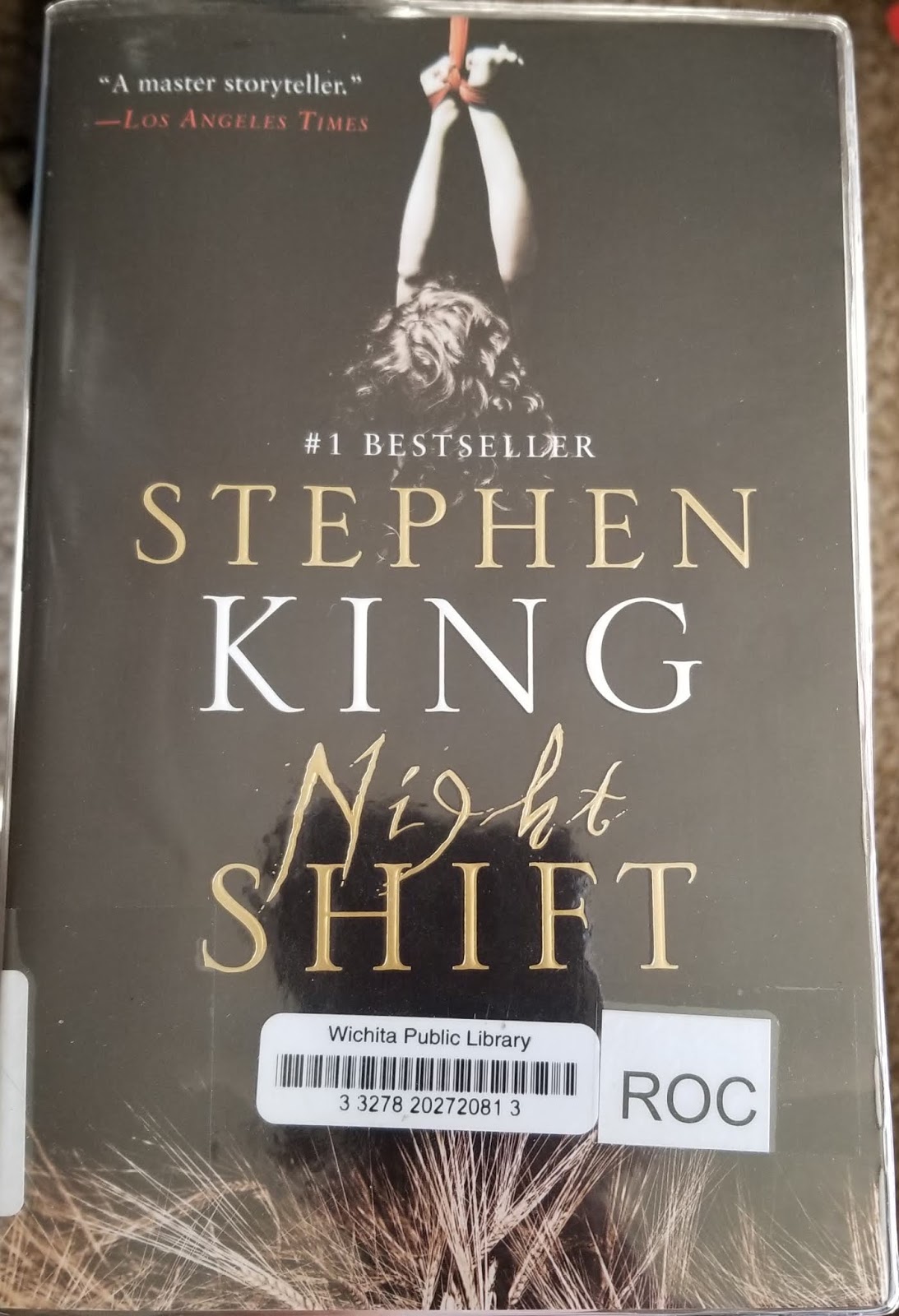
I wish I could say the same for the newer, library version I recently finished. I guess the cover art is meant to allude to the short story "Children of the Corn" but it's the worst kind of faceplant fail for a couple of very valid reasons. According to the copyright page, the library paperback is a reprint of the August 2012 Anchor Books edition. Can you guess which raunchy little indie-penned trilogy was released commercially earlier that same year? None other than the saucy, slap and tickle romp through one seriously bad relationship: the Fifty Shades of Grey series. And sure, there is a "bound woman" in "Children of the Corn" but she's not tied up with sexy ribbon. She's crucified. With barbed wire. Her eyes have been gouged out and her sockets and mouth have been jammed with cornsilk. Not remotely sexy.

Great author photo, tho.
It's not the first time I've seen similarly sad attempts to capitalize on another newer or more popular book's comet ride to fame and fortune. I once worked on a book for a distribution client whose nonfiction cover design for something completely unrelated to teen vampires turned out to be a blatant rip off of the first edition design of Stephanie Meyer's Twilight. I don't recall the outcome of the uncomfortable conversation with the client, but I do remember that the design was changed. What was the big deal? It was borderline stealing and full-on LAME. Ugh. This isn't the same, but it is stylistically suggestive and not immediately evocative of the source material, that which the cover is trying to sell, allegedly. Clang clang clang.

Also, look across the bottom of the front and back covers. I'm pretty sure that's wheat, not corn. Maybe it's meant to be corn tassels but I don't think so. It certainly isn't the standard image one would use to say "CORN field," especially if you are alluding to a story about children of the CORN--you'd think more green husks, lines of leafy plants, etc. To be fair, stock photos can be criminally mislabeled (it happens more than you'd think)--just Google "corn field close up" and you will see plenty of...wheat.

In the long run, does all this matter? Yesno. It matters to foolios like me who would have loved to work on any edition of Stephen King's work, past or present. It irritates me that they didn't try harder.

Aside from production woes, the most striking thing about Night Shift the actual book (what really matters, I know I know) is how perfectly it encapsulates a specific time. The dark swell of the late 60s, the gritty undertow of the 70s. There's a pervasive gloom hanging over the whole work. It is a weird trip back to an era growing dimmer in the rearview, where so many customs once so common would be met with outrage now. The ubiquity of smoking, for example--how it was literally everywhere, so casual, so common, so accepted. All throughout Night Shift, characters just smoke. They go into buildings smoking...they take a seat in waiting rooms ready to light up...there's even a scene in a hospital where a son helps his dying mother smoke one last cigarette. They won't let her have aspirin, oh no, but the cigarettes in her nightstand are totally fine. For the cancer patient. In a hospital.

I love that the library had to add the little
label for the title. For the sake of uniformity,
ya gotta. Katie says hi.

Flat cut trim--it's uncommon, but I have seen rough
cut trims on paperbacks. It is the very definition of
"extra," though, and entirely unnecessary. Further,
it makes page turning a chore.
I lived during this age, smoked in fast food joints and restaurants, smoked in bars and clubs, smoked in people's houses, at parties, in stairwells, all the designated smoking areas. I even got to experience smoking on planes, though only as an observing child sucking up all the extra second-hand smoke that my little lungs could absorb. I remember what it was like to drink down the bar to closing time, roll into bed half dead, and wake up the next morning smelling like a charred hellhound. There's a wide gulf of time between the days when smoking was the norm, when at least half the people you knew were regulars, and the here and now, where smoking is banned everywhere (with noted exceptions, hello casino jones), and the social contract has all but shut out those dirty birdy smokers. There was a reason my last years of smoking took place in my apartment and nowhere else--societal pressure, baby. It's a hell of a drug. But in Night Shift, smoking just is. It is a pastime as all-American as apple pie (with a smoldering butt jammed in the middle).

There's also some casual drunk driving, another throw back to a stupider era. It's not to say that society collectively embraced such reckless behavior back in the pickled past, but the seriousness of it, and the underlying sense of gravity and shame associated with drunk driving today, was far less common prior to educational campaigns and the unwavering tenacity of groups like MADD (Mothers Against Drunk Driving). I liken those olden golden days to the current trend of Wine Moms and their shrill slogans plastered on t-shirts, wall art, bumper stickers. Drinking two bottles of wine a night is fine as long as we're all doing it, amiright?

Even worse, depending on the state, the drunk driving laws could be very lax, sometimes just the equivalent of a whoopsy daisy you had a little boom boom. Prime example: I know a person who totaled their car, woke up covered in blood and glass in the hospital with a cop standing over them, face serious, judgmental but fatherly, who said, I'm gonna give you a warning, just don't do it again. That was it. And wouldn't you just know it...my acquaintance did it again...and again. They just didn't get caught. Hell, I had relatives who regularly drove while intoxicated. Friends, too. But ever so slowly, people stopped being so casual about it and started taking drunk driving seriously.

The best kind of praise page. No references to this or any
other work, just an unabashed lovefest for an author
who stands at the very top of his field.
In some ways, you can align the changes in societal mores in terms of overall safety with the dawning of the squeaky, straight-edged 80s. Imagine the terror of the 60s, the unparalleled social upheaval from coast to coast: the war, civil rights, women's rights, the counterculture, hippies, dippies, and Charlie Manson and his clean-cut little coven capering on the news. Then came the inevitable, crippling hangover of the 70s, burnouts and serial killers run amok, gas prices soaring, the economy circling the drain, all the kids self-medicating, all the adults half bombed and starting to think this American Dream shit is nothing but ass vapors. On so many levels the trust was broken, blown out, burnt to the ground.

Embossing evident on the back of the front cover.
Then came the 80s. New romantic skinny ties with gelled hair and coke habits. Citizens rebranded to Consumers and gave each other permission to find purpose in materialism, the pathological accumulation of Things. Cars and picture frames and houses and projection tvs and boats and track suits and motorcycles and wine racks and ottomans and 100 percent pure cubic zirconia. The Home Shopping Network delivered more delicious Things, more stuff to pile on top of other stuff crammed in dusty hutches while the oldest stuff found its way to the basement or the attic or the closet or the yard sale because more was good, but newer was better. MALLS were a brilliant thing, a beautiful neontopia to drop ten or a thousand dollars on any given Saturday. There were no limits to the number of jeans! Blue jeans, black jeans, pegged jeans, stone washed, acid washed, multi-toned, even pin-striped. Chic, Lee, Guess, Jordache, Calvin Klein, Gloria Vanderbilt, and Levi's but only 501's with the button fly-eye-eye. So many chunky, over-sized sweaters with wild graphics, and layers and layers of popped collar Oxfords to wear underneath--Izod, Polo, Ocean Pacific board shorts and don't you dare forget the forty-seven Swatch watches to wear up and down each arm like a goddamned postapocalyptic psychobabe on her way Bartertown to bet on Thunderdome. Things!

Author bio page also shows that bad glue job. There
shouldn't be such an uneven gap in the gutter.

I've lived this nightmare. You have to update the
previous publications page, but there are so manyyy.
So you set it in a smaller and smaller font until
it virtually squeaks.
Pegged pants, rolled sleeves, feathered hair lacquered with various gels, mousses, hairsprays; everything tight, tight, tight. Even the music seemed tighter, seamless and produced to perfection...no more smelly, hairy, drunk Golden Gods swaying at the microphone with their fuzzy navels out. No more grit, not one speck...at least not on the commercial stations. Just clean, coiffed, pancaked mannequins tripping tight, tight, tight dance moves to swift, tinny beats. Clean, tight...and safe. Just Say No. This Is Your Brain On Drugs Any Questions. Greed Is Good. Love Shack, Baby Love Shack.

It was like the 60s were the shock and awe, where the ugly undertruth was churned up and exposed to the bitter light, and the 70s rumbled with queasy aftershocks of too much reality and not enough weed in the world to dull it. The 80s opened its eyes to the horror and deemed it solvable. We became suddenly aware of the concept of child molestation, child kidnapping, child murder, and the faceless boogiemonster everyone could get behind with a pitchfork: stranger danger. Donahue and Oprah taught us the perils of freedom, the worst of what could be, the stories behind the faces on the milk carton. Letting your kids run wild in the streets was truly at your peril. As long as we were protecting the children from outside harm, we realized we'd had just about enough with all the babies flying through wrecked windshields, so child safety seats morphed from optional to required by law. There would be no more joyriding in the back of the pickup and no more calling shotgun. Then, as if our tight little coked up minds could bear one more outrage, some psychopath tampered with over-the-counter pain killers, so now just about everything requires some sort of safety seal to assure Consumers that their drugs (and juice and sour cream and...) are safe. Safety cords on blinds, plastic bottles instead of glass, flat beds with no fluffy blankies for infants, wacky rubber playgrounds! And no more sticking keys and forks in outlets to find out about electricity the hard way. There was something to purchase for every safety need.

More glue shenanigans.
But Night Shift's stories take place right before all that, at the cusp of it, in the wasted embers of what was left after the 60s blew out the circuits and jam banded into oblivion. There is a grating anger running through so many of the stories; angry couples on the verge of relationship collapse ("Children of the Corn"); shitty, resentful husbands ("The Lawnmower Man"), angry fathers unleashing punishment for next to nothing ("The Boogeyman"), angry vermin ("Graveyard Shift"), angry aliens ("I Am the Doorway"), even angry trucks ("Trucks" lol) for God's sake, all bent on vengeance, murder, obliteration. Then there are the shitty, shitty men: hateful men, malevolent men...from manipulative Lotharios ("I Know What You Need"), to cruel post-apocalyptic boyfriends ("Night Surf"), to happy-go-lucky serial killers ("The Man Who Loved Flowers"). It is difficult to find a sympathetic character in these stories, though there are a few outliers (the doomed protagonist from "Jerusalem's Lot," for one).

Half title page.
I haven't read Danse Macabre or On Writing in ages, so I hope to get some enlightenment there. Are the stories collected in Night Shift meant to serve as an extended exercise in unreliable, sometimes wildly flawed characters? After all, you wouldn't want to read Night Shift assuming that's just how people were back then--assholes, basically--and I certainly don't remember my childhood that way...exactly. Though the sexism and racism were definitely unchecked and festering. Watching a truly bad character get what's coming to him can be satisfying, but even characters that we're supposed to root for are too unsympathetic to bother. It is clear that King is stretching his creative muscles in terms of plot and story--the more outlandish and weird, the better--and it seems he was game for just about any wild notion ("The Mangler" is somehow both hilarious and deeply horrible, an absurd but delightful detour through Hell)--but his early character work is all over the place. The women remain flat, though some spark ("The Last Rung on the Ladder") and at least one catches fire ("The Woman in the Room"). The men are more fleshed out, though some remain inscrutable, one at least by nature ("Battleground"--fantastic fun). One too many of the "heroes" read as obnoxious little assholes, however, and one wonders if this is authorial counterintuitive manipulation or simply a "sign of the times." Whatever the case, King is cutting his teeth, working it out, and in every subsequent novel and collection the "constant reader" can see how he's getting better and better.

Full title page.

Full fledged copyright page, resplendent with
Library of Congress Cataloging-in-Publication
(cip) information. This was the eighth reprint
of this particular edition.
Some of the stories live only within the pages of Night Shift, others were adapted into student films (dollar babies!), but several are easily recognizable especially to 80s Cablevision zombies like me. "Children of the Corn" is probably the most recognizable to anyone, having spawned film adaptions and sequels and too many cultural references to count. I hadn't read the short story in decades so was relieved to find it far more economical in plot than the 1984 film which was, for lack of a better word, silly. "The Ledge" and "Quitters, Inc." were part of the Cat's Eye compilation film, both of which are solid, simple concepts on the surface, but are annoying in execution as the characters in both stories are products of "the times," i.e. when women were peripheral pawns in the Stories of Men. Funny aside: I was relating the gnarlier details of "Quitters, Inc." to my mother over pasta and breadsticks at Ye Olde Olive Garden when a server caught the tail end of a sentence that went something like "...and if he gains too much weight, they cut off one of his wife's fingers." To which said server yipped, "what!" And I had to explain, no sir, just, ugh, Stephen King. Short story. Horror guy? That one. Sorry. There wasn't time in the exchange to mention that it was in the sexy old days when your wife was property enough to get the first punishment if her husband happened to take even a single drag of a nasty ol' cigarette. Yeah.

What makes me think this is from the original
printing? The typeface, for one, is very familiar,
and reminiscent of the early published SK works.
The type is also heavier than the new prelim
material. In cases where we didn't have original
electronic print files, we would scan in and print
from the original, adding on our own prelim
pages as needed to update the publisher info.
The end product always looked very similar
to this edition of Night Shift

Permissions page, the best way to "place" the
contemporary narratives. 
And of course there is "Trucks," a not terribly fleshed out little story about semis driving themselves, running down humans with murderous glee, and enslaving the rest to feed them fuel until...well, the story never says. (Un)fortunately, someone decided to give Stephen King a hat that said "Director" on it and he made a little film called Maximum Overdrive starring the beefy jock from The Breakfast Club, Emilio Estevez. Hoo boy. The movie expands on the revolution, so that not only semis and construction vehicles are autonomous, but soda machines, ATMs, and hair dryers (one of the more hilarious "death tableaus" of the movie)--basically any "machine" is revving up and ready to kill. There is also an attempt to explain the cause (aliens and/or comets) and a relatively upbeat resolution that in no way strengthens the story. The movie does have truly funny and clever bits, and who couldn't love an AC/DC soundtrack, but the best part by miles is Stephen King's cameo. King is a born hambone, and this brief clip is just about the right amount of clown. Little slivers of humor can't make up for what a stinker the movie turned out to be overall, but as with many of King's works, sometimes it's better to leave it on the page.

The weirdest "updated" section of backmatter,
an ad page for the novels that preceded Night
Shift
(and The Stand which was first published
that same year). It's only weird because they
bothered to update the previous publications.
The inclusion of the ad pages in the backmatter
is very old school, and usually when you're still
trying to "sell" your author, something Stephen
King surpassed--by lightyears--decades ago.

See? It's weird. Just one more paragraph
about The Shining and then miles of blank
space because...why? Only the publisher knows!
While the upcoming Skeleton Crew short story collection will always be my favorite (and contains within it a story that scared me so bad I had nightmares for weeks), Night Shift does deliver, if not so much in scares than in memorable ideas, that 70s gloom of a mood, and special, bell-bottomed weirdness that makes a few of the stories really stick. My personal favorites are "The Mangler" (insane), "Battleground" (gonzo), and funnily enough, "The Lawnmower Man." The movie is pure shit and largely unrelated to the short story, even if you squint at it through your third eye. It does King's short story a great disservice merely by existing and every copy should be burned and dropped in a deep trench. The actual story, however, is classic King on a mind melting tear. The narrative starts off insipidly mundane (lazy husband has to get the lawn mowed, boo hoo hoo woe is Man) and then goes completely B-A-N-A-N-A-S in a direction that, at first reading, my little 14-year-old mind could not adequately absorb (mythology and gophers and PAN o effing MY??). My old woman mind, however, reels. It's deranged, delicious, hilarious and just...wrong. If you read Night Shift for nothing else, read it to redeem the poorly maligned "Lawnmower Man." Wonderfully weird stuff.

Grade: C
Scary? (0-nope to 10-you will die): 2. Overall I would classify the collection as more unsettling than anything. Unless you are afraid of rats, kids, or SMOKING.
Warnings: More casual bigotry, common profanity, proportionate gore, general human shittiness, SMOKING.
Artifact: Flawed 2012 edition reprint. Paperback, flat cut, trade pulp, embossed CMYK cover. The typeface for the bulk of the book (contents, stories) appears to be the original type, but the add-ons in the prelims (updated for this publisher's edition: title pages, copyright, ad, author, praise, etc.) don't match and are frankly all over the place in terms of design. The cover is a misfire for the aforementioned reasons. And, personal peeve, the text block is not glued evenly, so there are weird gaps and tears in the gutter that simply should not be there. It's not so egregious that you'd kick it back to the printer for a do over, but it's not good, either. (RIP my 1978 edition. It smelled heavenly, too, like imagination run wild, not unlike a possessed steam-iron-folding machine unleashed on the streets, shrieking bloodlust through the night(shift)).