Showing posts with label Internet Archive. Show all posts

Tuesday, September 29, 2020

Teenage Death Songs (Christine, 1983)

Christine (1983)

I broke a thousand hearts 
Before I met you 
I'll break a thousand more, baby 
Before I am through . . . 
--George Thorogood and the Destroyers, "Bad to the Bone"


By the time Stephen King was finishing up his ninth novel (thirteenth if you count the Bachman books, so I suppose we should), it appears that the "Business of King" was already a well-oiled machine. According to Wikipedia, producer Richard Kobritz had his hands on the manuscript for Christine before it was even published. This explains, at least in part, how the hardcover was released in April of 1983, with the movie and first edition paperback following quickly on its heels in December of that same year. King's publishers and agent already knew the score, how to maximize profits and feed the fire while the work was still fresh off the press. 

Christine on the line.

Christine
is set primarily during the narrator's senior year in high school (1978-9) and unfolds in three, linear acts. The first and last are from the perspective of popular jock Dennis Guilder, all-American teen athlete, while the second is in the third person, relating parts of the story that Guilder would largely have know way of knowing. The concept, well-known by now, is a simple one: It is a love story between a teenage drip and his very first, too-good-to-be-true, magnificently curvy first love. Of course the love in question is a red and white 1958 Plymouth Fury by the name of Christine. 

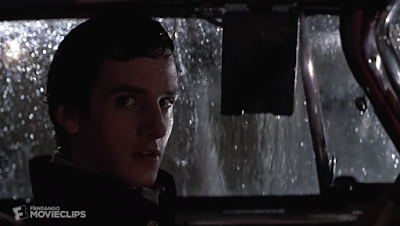
Arnie (Keith Gordon) clowns Roseanne (Kelly Preston).
Arnie clowns himself.

When we first meet Christine and her ill-fated, soon-to-be beau, Arnold Cunningham, neither one of them is anyone's concept of a hot date. Christine is a junked wreck slowly rusting to rot in her current owner's yard, Arnie is a classic nerd, his face a wreck of cruel, adolescent acne. Dennis and Arnie are childhood friends, joined at the hip, Arnie always with ideas on what to do with long rainy days, Dennis forever in the business of "keeping Arnie from getting killed." They're driving home from a summer job when Arnie spots Christine and harangues Dennis into going back to have a closer look at her. Dennis is less than enthusiastic. This is the nicest feeling he will ever have about Arnie's new girl, Christine.

Leigh (Alexandra Paul) gets the tour.
Bemis (Doug Warhit) and Dennis (John Stockwell) oogle.
Feather curls and argyle supreme.

The plot tracks across a field packed with adolescent and supernatural landmines alike, each with a touchy trigger and angled to explode. Arnie's parents hate the car immediately, Arnie must shelter her at the disreputable Darnell's Garage, and he soon runs askew the resident bully, Buddy Repperton, and his gang of miscreant mascots. As the school year begins, Arnie struggles with his parents, who are not accustomed to their good boy not only going against their wishes but continuing to do so while spending his college money on fixing Christine. Arnie and Dennis have a scary showdown with Repperton and his buddies in shop class, leading to the expulsion of Buddy and the suspension of the others. Despite everything going wrong for his friend, Dennis can see that Arnie is changing in some ways for the better. His face is clearing up, for one. And he stands up to Repperton in a way he never would have before.

But the biggest changes are yet to come. While Christine's refurbishment comes along back at the garage (in a sort of patchwork, wonky job where nonsensical things are repaired out of order, i.e. half the front grill, which is insane even to a layman), Arnie's face has cleared and he's even dressing better. He's got a new confidence and carries himself accordingly. In a turn of events straight out of high school fantasyland, Arnie lands the new girl in town, Leigh Cabot, a girl all the boys have lusted after ever since the school year began. It seems everything is coming up Arnie, even if his parents are forever in his shadow, even if no one seems to really like his car, not even his other girl, his new girl, Leigh.
 
Leigh unhappy in Christine.
Arnie irate.
Leigh really unhappy in Christine.

Things truly begin to turn darkward when Dennis Guilder is severely injured while playing football and is subsequently hospitalized for weeks, effectively "taking him out of the game" and life, and certainly dampening any efforts he may have made to keep Arnie from "getting killed" under Christine's dark eclipse of influence. Soon after Dennis is hospitalized, Buddy Repperton and his band of merry idiots trash the living hell out of Christine. Dennis and Leigh have already seen the shadowy side to the changes that have been happening to Arnie, but this is where the bottom drops out and the murdering begins.

Don (Stuart Charno), Buddy (William Ostrander), Rich (Steven Tash),
and Moochie (Malcom Danare) about to seal their fate.


Christine is one of the few King works I saw at the movies well before reading the book. My mom and her boyfriend took me and my friends to a wintery evening showing. The gaggle of giggling girls were all around eleven at the time, and I remember having a blast. The adults pre-gamed, buying popcorn and making fun of the premise, while we screamed, cawed, and cackled shrill and self-conscious, over-the-moon excited to see an R-rated movie about a demon car. We were still laughing and joking afterward, though solemnly agreed between hyperactive outbursts of unaccountable mirth that the chase scenes with Christine were very scary and very effective. There was spirited debate over whether a car could really squeeze into a smaller space to smush someone to death (we overzealously agreed it could not) and railed over how stupidly everyone in the movie behaved, like, Moochie, just jump up on the hood and tumble over the bitch? Buddy Repperton, don't run down the middle of the road? Climb a tree? Go high in a building???

A couple of years later, I was well into my King fandom when my aunt Sherry gifted me a worn-to-hell copy of Christine we just happened to find while garage sale-ing one weekend. The cover was nearly falling off and it looked as old and dilapidated as that first, early-eighties shot of Christine, but I didn't care. I was greedy for new King and thrilled to get my hands on it. 

Leigh and Arnie make peace.
Arnie sees Christine.
TRASHED. In the book, Arnie keeps her in long-term parking at the airport, 
but even within the confines of Darnell's Garage, you have to wonder why Christine
didn't leap to life the second they laid a hand on her. She's certainly more than 
capable of chasing down multiple targets and going to extraordinary lengths to 
kill her prey. Perhaps she knows that allowing Arnie to see her destroyed so
completely will forge their bond entirely, til death they do part.

The basic plot and outcomes are about the same from book to movie, but the method of death is different in almost every case. There's also a higher body count in the book. The biggest departure, by far, is the source of Christine's supernatural power and reach. In the movie, the LeBay selling is Christine is actually the brother (George) of the original owner, Roland LeBay. Roland LeBay's sad backstory remains the same (his kid choked to death in the car, his wife killed herself in the car), except he is haunted and hounded by Christine, trying at least once to get rid of her, only to have her find her way back to him weeks later. Eventually he kills himself in Christine, too, leaving her behind to his brother to do with as he can. It is George LeBay's great fortune that a starry-eyed geek lays eyes on her in passing one afternoon and never wants to break that gaze again. Christine's supernatural power to move on her own (and play very snarky, plot specific songs at people) started on the assembly line, "on the day she was born" to paraphrase the iconic song that introduces Christine at the beginning of the film.

The book is less clear on Christine's supernatural beginnings, though it seems she was decidedly spooky and could perform contrary to her construction from almost the beginning (four-wheel drive with no kit, the kid choking, the bad vibes). While she was probably imbued with some unnamable power, it was Roland LeBay's complete devotion to her that had lasting consequences, most critically upon LeBay's death, which occurs not long after Arnie purchases Christine. In the novel, LeBay's backstory is far less sympathetic, with the kid and the wife dying in the same exact way, and Roland seeming to care about little else than Christine. It is Roland who sells the car to Arnie, and it is from George LeBay (at Roland's funeral, apparently from natural causes) that Dennis learns the ugly history of Christine. Stories of an mean, violent childhood lead to one, enduring theme: Roland LeBay's "unending fury" and singular devotion to Christine.

In the book, Arnie's changes are the direct result of Roland LeBay spiritually taking over Arnie's living body. While Christine has always had some level of supernatural power, LeBay's "single-minded purpose" and "unending fury" make her into the self-healing, vengeful murder machine of every kicked and cursed teen nerd's darkest dreams. It is mildly annoying (and not at all surprising) that even a possessed car is not allowed the autonomy to be a fully realized, entirely competent she-demon from the deepest cracks of hell without some man coming along to steal her evil thunder. It's interesting to contemplate whether it was the moviemaker's decision to make Christine wholly empowered with vengeful avarice because she didn't need no damn man . . . or because it made the narrative simpler. Probably the latter, but it's fun to dream.

"Show me."
Christine begins.
Self-healing trickery.

I knew the adults found the concept of a possessed, killer car demented and silly, but I was at an age of spongey elasticity, with an imagination open to just about any weird idea. I loved the novel (and never thought twice about killer Christine's autonomy--I was 13 and completely unaware of my own). It felt somehow idealized and authentic at once, a picture of high school that fit my impressions of what it might be like, at the time still imagined from afar. Re-experiencing Christine now, the tropes are so very trope-y--the nerd, the jock, the beauty queen--but credit is due to that underlying authenticity, the voice of the teenager, that at least for the male characters, is dead on.

Do I have to rip King yet again for making a silly femme in Leigh Cabot? Nah. She's not the worst (see Firestarter, Vicky McGee), and while some her dialogue (both inner and spoken) is cringeworthy, she's not entirely flat. I also have to be cool about this because I listened to the audiobook of Christine this time around and it was read in a man's voice. We all know how I feel about the falsetto. It is just . . . no. More on the audiobook later.

When I was thirteen I did not care if Leigh Cabot sounded breathy or vapid or mildly idiotic. I'd seen Christine again on cable at a friend's house not long before reading the novel, and my impression of her had only solidified in the years between viewings. That first shot of Alexandra Paul walking down the hall with all eyes on her, shyly smiling at the boys staring as she passes, was forever locked in my mind as the epitome of Peak Validation. She was crushingly beautiful in her argyle sweater and knee socks, tall and athletic (my mind always translates bowed legs to athleticism), with hair so on-point perfect for the times I catapulted past green oceans of envy straight to the adolescent stars of idolatry. I wanted to be Alexandra Paul. I wanted her exact clothes. I wanted her high cheekbones, feathered hair, gorgeous doe eyes, pointy nose, pouting lips, and that dumbass O-expression of huh she brought to every confrontation with Christine. Reader, I practiced that shit. Gape-mouthed O with distressed damsel ditzyness. In the mirror. At school. In public. The shame.

Run, Moochie, run.
Cornered . . . but safe?
NOTSAFENOTSAFENOTSAFE.
Fuuuuuu-

The movie is well-acted, with some standard issue jokes and camp, and is far more sexist than the book, as was the norm for any teen-set movie in the 80s. While the movie retains some of the more memorable lines from King's novel, like when Arnie almost offhandedly tells Dennis how "part of being a parent is trying to kill your kids," a lot of the labor of crafting realistic teen characters gets flattened into those well-known stereotypes. Keith Gordon does a phenomenal job with hapless, scared, horn-rimmed Arnie, less so with avarice-stricken, demonoid Arnold held under the hypnotic glow of Christine's dashlights. John Stockwell is a believable Dennis, tending toward mildly amused, mildly annoyed, or mildly distressed. With Alexandra Paul adding that extra point to the teenage love triangle, they are visually and competently a perfect cast.

What the movie only skims is that tremendous churn under the outwardly mild waters of teenhood. Of course, plenty of parents would say "mild waters my EYE" to which I would plead patience. It is a wild time of rampant hormones and unhinged outbursts, but if you were anything like me and my friends, you know that you were keeping a lot of secrets and actively misdirecting parents and adults from what was really going on in your life and, most importantly, in your head. When Arnie makes the comment about parents trying to kill their kids ("As soon as you have a child, you see your own tombstone," he further elucidates), it is well before Christine's influence starts to infiltrate his personality. He's been dealing with overbearing parents his whole life. For the first time, ever, just on the brink of his last year of childhood, Arnie asserts his independence and refuses to budge. Later on, LeBay's personality overlays any independence Arnie had forged, but in the beginning it is his will standing against their once impenetrable front. The angst is well fertilized, deep rooted, and overdue.

Buddy outmatched.
Christine ablaze.
Easily the scariest shot of the movie.
One way or another . . .
. . . I'm gonna getcha getcha getcha getcha.
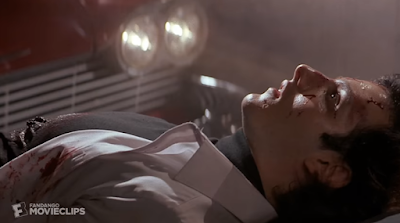
Buddy down. See the figure in the fire?
Char-broiled.

On the flipside, Dennis Guilder, the narrator of the beginning and end of the story, is a 22-year-old young professional relating events that happened when he was seventeen, just five years prior. Through his eyes the reader sees that inevitable, narrow track to which every child finds himself welded: grade school leads to junior high leads to high school, all the while stacking the rails with activities, clubs, and sports, resolving finally--in the middle-class world of Dennis, Arnie, and Leigh--to one, fated terminal: college. When Arnie threatens to drop his college prep courses if his parents do not allow him to register Christine, his parents--both college professors, naturally--see it as nothing short of leveling nuclear-grade threats at Arnie's future (and their status as parents). While extreme, Arnie knows it is the only thing that will get him what he wants from a strong-willed mother and a father who supports his wife unequivocally. 

For Dennis, the detonation and collateral damage that starts the day they bring Christine home has its own reality-shifting consequences. His closest friendship from childhood is strained, then fractured, and his relationship with the Cunninghams, a family he's grown up with and loves, becomes tense, sad, and estranged. His own well-oiled and dependable track toward a possible football scholarship is blown to hell when he is badly injured on the field, hospitalized, and essentially put on the sidelines of his friend Arnie's increasingly alarming circumstances, first with the wanton destruction (and desecration) of Christine, then with the steadily increasing and inarguably Arnie-linked body count. 

Dennis and Arnie have a heart-to-heart about true love.
"Let me tell you a little something about love, Dennis. It has a voracious
appetite. It eats everything. Friendship. Family. It kills me how much it
eats. But I'll tell you something else. You feed it right, and it can be a
beautiful thing, and that's what we have." (1)

Yet in the midst of all this stress, both mundane-but-future-killing and supernatural "but not in a fun way," Dennis Guilder is still a teenaged boy. This is most apparent when Leigh Cabot makes the scene. For all his smirking and scowling at ugly Arnie's instant obsession with double-ugly Christine, Dennis seems unaware of the fact that he is similarly smitten with Leigh from the start. King's young narrator spends an amusing-bordering-on-embarrassing amount of time extolling the angelic, perfect, too-perfect, beautiful, intoxicating, otherworldly attributes of Leigh Cabot. His eyes run lovingly over her curves just as Arnie runs his hands over Christine's fins. 

It would be easy to dismiss as overwrought and misguided "character" building, but to me it rang crystal true for that teenwired mind. In the midst of death, we are in Hornytown. Dennis Guilder may be experiencing some extraordinarily horrible things in this chapter of his young, middle-class, all-American life, but he's still got time to size up his best friend's girl and grow a boner.

The Final Showdown. Leigh is trapped.
Christine banged up.
This. I practiced this.
Dennis drives the dozer.
Arnie transformed.
Christine reborn.

There's also time to have awkward, half talks with parents who are just trying to understand what's going on with their son and his once-close, now so distant friend. There are wonderful respites of sibling torment, when Dennis steals his little sister's treats and teases her mercilessly as she volleys it right back. There is still time to be a teenager, which in and of itself can be an overwhelming journey, even without the possessed, murderous car full of gnarly ghosts riding shotgun. And there is still time to be short-sided, puerile, and flawed, as Dennis Guilder's entire narrative is threaded throughout with the unselfconscious fat-phobic shaming of a more narrow-minded, less mature perspective. You might try and say it was a sign o the times, but the ratio does not bear that out. By comparison to any other King work up to 1983, Christine's fat-bias is abundant and borderline embarrassing. I'd far rather believe this was a character device rather than some internal, self-hating manifestation of '83 King's subconscious.

Character flaws and unlikely villainous Plymouths aside, King's story of average American kids grappling with the homicidal rampage of a infernal Fury still bristles and shakes with hot thrills and guilty fun. 

Catapulted through Christine's window after another lunge for Leigh,
Arnie has one more jump scare in store for his ex.

One last caress goodbye. Y'all, there's a shot where his fingers linger
at the Plymouth's V and I seriously CAN NOT.

Teenage Death Songs.
Christine's odometer rolls back to zero.
But Dennis dozes her down. In the end, she ends up
cubed at the junkyard, finally defeated.


Or is she . . . ?


(All subsequent comments are reserved for the book)
Grade: B+ Classic King
Scary? (0-nope to 10-you will die): 6. It undoubtedly rates higher with other fans, and I do give a big hat-tip to the thriller aspect of the hunt-chase-kill scenes, but the scare factor is never going to exceed the mid-range for me as long as it has anything to do with "possession" or "devils." I am the person who laughs through The Exorcist and only gets mad that they made that little girl Linda Blair say and do those seriously horrifying things. I know, I know, I am only tempting the devil to possess me for my sass, but seriously, don't demons have more interesting prey to jump than me? Like, get over yourself no demon wants you. Also they aren't real. Except for the inner ones. Those effers are everywhere.
Warnings: Bigotry abound. Typical high school, mean-mouthed, dirt-kicking, low-class jibes. The adults do not fare better, with the low/poor and criminal class giving the high school kids a run for the money. All the terrible words are present, repeatedly. 
Artifact: The Internet Archive is under siege! As we speak, a syndicate of publishers is suing the IA for "copyright infringement," to which the IA has politely responded "bullllllllllshit." A brief summary of the conflict can be found here and the Internet Archive's full response can be found here. Wherever you fall on the open source spectrum (which the IA never has been, certainly not in the way the publishers would have you believe), it would be GREAT if everyone could finally and completely remove their heads from their asses and realize that we are in COVID TIMES, not to be confused with a brief squall, or a tornado that torpedos your cow across the county, or an earthquake that knocks over Aunt Rose's antique salt shaker and shatters it all to hell. Also not to be confused with a partisan hoax, an overblown disaster porn wetdream, or a worldwide conspiracy to ruin your good time. Covid is real and covid is SERIOUS. 

Suddenly finding the King selection on IA decimated, I reached out to the Wichita library to see what was being done with books during these "highly contagious but still so many people won't wear masks" times. They sent a prompt reply, detailing the logical, reasonable efforts they are taking to ensure that they do not contribute to the spread of Covid-19. The stacks are off limits to the public, minimal services are available, but groupings of folks are not permitted. Staff handle the returned books masked and gloved and essentially let the books sit for a spell, sort of a book quarantine, until they should be good and ready to be reshelved or set aside for the next person on the wait list. It was all very conscientious and wonderful to hear. The Terror Rat that scurries through the walls of my brain does not agree. 

Terror Rat insists that the particles are, in fact, everywhere. Everywhere everywhere. Terror Rat can barely stand to touch library books during normal times. Terror Rat's favorite word is contaminated. And while Terror Rat needs to calm the fuck down, she does have one very good argument that I just can't shake. By the time everything in Kansas was essentially "shut down," let's say April 1 2020, we'd seen just over 420 cases with 9 deaths from Covid-19. To date (September 29 2020), Kansas has weathered 58,629 cases and 637 deaths. Considering the nature of airborne, infectious disease and the insanely uneven and nonsensical public policies to mitigate the spread of coronavirus, is it fair to assume that there are many, many more active cases now than there were when we "shut everything down" in March? Terror Rat wants to know how "opening up" the country now, when there are more cases in more places, makes any kind of sense? Terror Rat is waiting.


In the meantime, I had to find some other way to read Christine. The free Audible trial beckoned, I figured beggars can't be choosers, and leapt. I am so happy I did.

First, let's get this out of the way right now: the narrator is that gawdam kid from Maximum Overdrive y'all. The kid on the bike, riding through the streets, seeing the hilarious carnage (remember the bloody ice cream truck). He was also a near-victim to a particularly homicidal soda machine. It's that kid! Who is a man now, but oh my God, I love the symmetry. And I love that he found a real niche. Holter Graham is a very talented voice actor.

It was such a delight to be able to really sink into the story and just let it ride, cruise if you will, until it was time to stop for the night. While I will likely never get used to that falsetto for the female characters, Graham handled it far more smoothly than my previous King audiobook experience. Let's face it, Leigh Cabot was always going to be especially grating with her repetitive "what do we do what do we do" dialogue, so I was prepared for that. It was clear that the shortcomings of the character were just as responsible for drawing my ire as any fakery on the reader's account, especially whenever Graham voiced Dennis Guilder's sister or Arnold Cunningham's mother. Neither took me out of the story the way Leigh Cabot's murmuring mopery did . . . in fact, it was really just that babyish tinge, missing from the other two female voices, that really set my teeth on edge. Just like it did with Charlie in Firestarter. It's funny because Alexandra Paul's voice was all breathy baby through much of the movie adaption. Guess I don't like men doing baby voices? The audience already has to stretch the accommodation for the suspension of disbelief when listening to an audiobook, particularly when each person has their own inner voice cultivated over decades of reading. Allowing some "other" into your headspace like that is more than a little intimate. The more unnatural or unreliable that voice (girl baby voices, per se), the more likely the listener is to reject it.

By far my very favorite quote from the book, made all
the better by Holter Graham.

If you are like me, still essentially sequestered, still cooking, baking bread, and you, too, have a germaphobe Terror Rat ripping around your skull, digging furrows in your circuits and sparking shorts and misfires through your synaptic ability to cope with This Covid Bulllllshit, I'd recommend giving audiobooks a whirl, especially ones narrated by Holter Graham. He does a fantastic job, especially taking the wheel as the narrator, slouched cool and sullen in the cab of Christine, to give this particular listener one hell of a ride.
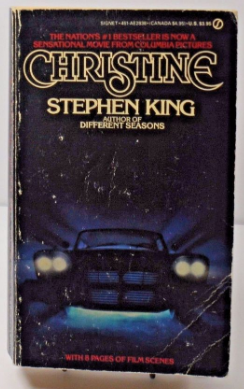
Terrible quality screenshot of a first edition, movie
tie-in paperback, the same edition I once owned.


(Movie screenshots via YouTube from Movieclips and Columbia Pictures. Artistic interpretation gif via tumblr with audio from Christine, Stephen King, unabridged audiobook, released 1/1/16, Simon and Schuster, narrated by Holter Graham.)

Friday, May 8, 2020

The Impossible Predicament of American Girlhood (Firestarter, 1980)

Firestarter (1980)

She'll burn you to the ground.

The month of September 2018 was a dark time for many, and while every person struggling during that period had their own reasons, their own stories to tell, I was grappling to put an easy label on my own, to get down to the marrow of it and figure out once and for all: Why did the Kavanaugh Supreme Court nomination and subsequent hearings bother me so much? I didn't personally know the guy. I didn't know Christine Blasey Ford. But the whole sordid affair was still somehow familiar, anyway, slimy and reeking with a musty stench from the past, so much so that I spent many of my waking moments of free time thinking about it, reading about it, and trying to get to the core of it, to the dark part of me that reacted so strongly to this particular moment in US history.

Once the assault allegation was made public, the testimony given, the details laid bare, it was impossible not to contextualize the events that transpired in the summer of 1982 with my own memories of that time. E.T. was the big summer movie that year, but that summer also saw the release of such teen-scene classics as Fast Times at Ridgemont High, The Last American Virgin, and (shudder) Zapped!; a slippery slope of angst-hijinks-sexcapades of varying levels of Cringe and Shame. Brett and Christine met in a adolescent world steeped in the lowball culture of under-aged partying, peer-endorsed grab ass, and Porky's.

In 1982, women were considered liberated enough to become professionals beyond secretaries or teachers, chain smoke Virginia Slims, take the pill, and have premarital sex if they so dared, but they were also under the threat of being branded with obligatory neon letter-A. Instead of banishment from town, such progressive women could hope to at least be labeled flirty, fun, a good time girl, but she could just as likely expect to be called a hussy or whore behind her back, if not directly, and unapologetically, to her face. These liberated choices belonged to women of age, of course, while girls teetered on the precipice between modernity and tradition, inundated with ads for Barbie, Strawberry Shortcake, Jem if you were "edgy." Unicorns, rainbows, and Lisa Frank aesthetics were all the rage. In 1982 (and some would argue even now) a girl's potential might include non-domestic ambitions, like being a teacher or even a doctor, but the conditioning always included the roles of Wife and Mother. It was never either/or, it was always either/and.

Part of that conditioning required deference to men, obedience to men, gleaning some sliver of validation from men. If you were lucky, Prince Charming would recognize what a shiny little diamond you were, treat you accordingly, run the ramparts with you against the world happily ever after. Perhaps he would buy you a two-story home with a chef's kitchen and a master bedroom. Unfortunately, receiving reverence barely earned can create little monsters who take that doting deference for granted.

When Kavanaugh cried during his testimony, recounting his daughter's words that they "should pray for the woman," in my heart I knew this man. The multifaceted hypocrisy of the man who could easily have been the boy Christine Blasey Ford was pinned under almost forty years ago, terrified and suffocating. There are, after all, so many like him. The nasty boy who hid behind his "faith" all while behaving like a depraved lunatic on Friday and Saturday nights. The president of the Fellowship of Christian Athletes cracking jokes about the fat girls in gym, which girls he'd "do" only with a bag over her head, which girls gave the best head. The boy who was "owed" that deference, whose moral center slid effortlessly in whichever direction allowed him to behave in whatever way he saw fit. The boy, if ever called out for his bad behavior, who cried immediate foul, the boy who was always "just kidding around," even if the people he left in his wake were crying, avoiding school, developing eating disorders, practicing lethal knots.

Sure, I'd met him before, plenty of boys just like him, during my own harrowing journey through adolescence just a few years after those fateful events in the summer of 1982. We all had. There's at least one pack of them, if not several, sniggering their way through the bitterly long days of school, the hazy, daze-y nights of shooting pool, cruising, partying.

Do I not believe that an act of pure Christian kindness could move Brett Kavanaugh to tears? I do believe it. But I also believe the testimony that brought him to tears was a calculated maneuver to bolster his character. I believe Brett Kavanaugh was overwhelmed with a lot of other emotions that day, and all the days leading up to his testimony, most of which would have easily led to tears, fury, and childish outbursts. He was frustrated, incensed. He believed a great injustice was afoot. And I believe he cried because he got called to task for something that was once the status quo. The slap and tickle, the chase, Russian hands and Roman fingers, just bros being bros. Hardy har har. They were just kidding around. 

How could Brett Kavanaugh be held to account for something he did in the panty-raid days of the early 80s? It was, to him, an outrage. I believe this in my bones.

And this is where I settled in to the memories, let the incidents rack up, one by one, the petty little indignities, the outright assaults. I was alive in that same timeline. I went to parties, gatherings, witnessed the immaturity, the infantile games, and saw how fast "fun" could turn ugly and sour. And I'm alive now, alive and furious, but also basking in the glow of the new generations of women who witnessed the lazy sexism, the glowering fat-baby puling of men no longer allowed to treat women like objects, moving predictably from crying spoil sport to NOT ALL MEN, and said, unequivocally, Fuck that. It's glorious. A true balm on the burn, salve for the scars.

But the wounds break open when these 1982 "bad boys" rear their sneering little preppy heads, as the privileged so often do, first when their rich, spray-tanned Cool Dad got elected president of the United States . . . then when their Bro-in-Chief got nominated to the Supreme Court . . . only to be outrageously held accountable for alleged horseplay when he was but a wee, church-going lad. As so many of us watched the Kavanaugh hearings play out from the sidelines, we shook our heads, reliving our own memories, remembered the clamoring trolls of our youth. I set my eyes on that frown line between Kavanaugh's brows and could almost hear the echo chamber of every animal house in America through the decades: not fair, not fair, not fair . . . 

It would almost be funny . . . if it wasn't. Ask a woman if that neon letter-A fades as life evolves, relationships catch fire and fizzle . . . marriages, children, careers. Is it a club stamp from a regrettable night that soon disappears? Or is it embroidered into the skin of your chest, the bloody scabs breaking open as you howl? And even as women's rights in this modern world seem better now than they've ever been, the branding remains. Don't forget the PTSD, baby, the things you thought you dealt with but didn't really, the memories you thought you scrubbed still slinking around the shadows to jump out and give you a real scare when you least expect it, the moments in American history where people who have no connection to you are testifying to events that happened almost forty years ago still you find yourself sitting in your car listening to CNN with a crawling stomachache and just the slightest tremble in your hands, scarlet letter-A burning a hole through your chest.

Because it isn't just women who are held to a specific standard--be lady like, cross your ankles, smile--it's teenagers, too. It's preteens, too. It's little girls, too. It's babies with a pink bow tied to the only lock of hair they have on their bald little heads. The coding starts immediately, to be of service to others, to please and be pleasant, to smile without prompting, to submit to innocent hugs, kisses, pinches, the lighthearted "flirting" from grown men at picnics, church, the grocery store, be nice to the stranger who's a "friend of the family." In the new age of body autonomy, parents are thankfully beginning to better understand how a lack of boundaries can be scarring and may pave the way to a child being abused, a teen being raped, a woman being locked in an abusive marriage for years, decades, a lifetime. Nevertheless, the traditions persist, forcing kids to hug Uncle Bob and kiss Aunt May, shaming and punishing children for resisting--trying to set boundaries--and grooming them for potential violation later on.

As a kid, I was pinched, hugged, tickled, and relentlessly evaluated over every physical attribute and change. My apple cheeks, chubby cheeks, pretty hair, unruly hair, beautiful eyes, "bedroom" eyes, lovely smile, buck teeth, long legs, chicken legs, pretty face, pimple face, lean arms, hairy arms, big ass, stupid walk, lose some weight, wear some make up, too much make up, be quiet, slim down, stop taking up space. I was poked, prodded, kissed, grabbed, tickled, shaken, yanked, and hugged. I got labelled "the Dragon Lady" by my family for being impudent, so by the time I was a teen and put a stop to all that touching nonsense, I figured they could just stay mad about it forever since my own kin thought I was a raging dragon bitch, anyway. But it was too late. The damage was done.

I didn't learn that it was okay to set boundaries until I was well into my thirties. My thirties. This is also when I finally understood that it was wrong to be made to feel guilty for withholding hugs and kisses. Unfortunately, I did not escape childhood without those boundaries being violated far beyond "innocent" displays of affection. I did nothing wrong and did not deserve it, but I blamed myself for decades. This is how the mind works when your boundaries are soft to non-existent and all the anger and helplessness you feel gets directed back on yourself. And this is why I felt so furious and sick listening to the Kavanaugh testimony, the conservative politicians, the witless pundits. Very much like Firestarter's Charlie McGee, I wanted to incinerate the lot of them with my absolute, concentrated rage.

We were blue collar, at the best time (literally 1982-84) lower middle class and just barely, but for the most part poor to poor plus. If growing out of clothes was an Olympic sport, I would have at least medalled, especially in middle school. You say "slutty," I say "no fucking money, honey," because that's literally what was happening. I would live and die for those brief periods of galvanic joy when there was cash for clothes: new, fresh, nice-fitting clothes. I wasn't zipping up my old Jordache's with pliers because I was fat; I was eeling into them because we had no fucking moneyyyy, honeyyyy. In the middle of puberty, no less.

When I turned eleven, the catcalling from strangers began. At the mall, the gas station, just walking down the street. There were scary incidents with rowdy men in trucks, sleazy men in hotels, grown-ass men baring down on me for existing in their world with my faded Duran Duran t-shirt pulling tight against my chest and my second-skin jeans which I roll-pegged to hide the fact that they were also high-waters. I didn't shake my ass, give them leering, come-on looks, tie a cherry stem in my mouth while leaning provocatively against an ice machine. Still they hissed and tsk-ed, made wet kissing noises and hey babied me up one Quick Trip and down to Dillons. I kept my head low, walked like a shuffling robot, and flushed red with humiliation. It was gross, embarrassing, and more often than not, made me physically sick to my stomach.

But I was told that this is what every woman endures so I should just suck it up. Family, friends, even the shitty counselor at my school all parroted the same thing. Stop whining, let it go, this too shall pass. Yet another lesson in weak boundaries. I was a thing to be treated in whatever way any random man decided I deserved. I was told to be grateful that men found me attractive at all, that not all girls got that kind of attention. People I trusted actually said that to my face. On multiple occasions. What a lucky thing to be complaining about. How lucky I was. So ungrateful for my luck.

Oh millennial girls, gen z girls, thank God for you. You are burning this entire patriarchy to the ground and I am LOVING IT.

Underneath that blanket status of womanhood, the one that grants half the population the right to act upon you in whatever fashion they see fit while you are expected to smile demurely or, I don't know, bend over(??) . . . there is that other layer, the deeper, black-slimy layer, the one where someone, somewhere has to finally admit that poor girls are less than, even if they are innocent and "pure." Poor girls, by virtue of their scrubby, fast-food existence, truly do "deserve" whatever they get. Poor girls are never really pure. I won't even get into racial Othering--first, because I can speak only from my own experience, but more so second, because it should be fucking KNOWN by now. And if you don't know, you need to know.

People feel entitled to cross your boundaries, to cut you down to your marketable parts, to stamp you generic and sell you wholesale. Just look at working-class victims of serial killers and marvel at the lengths people would go to create distance between themselves and the women murdered. They were too trusting, too exposed, they were drunk, stoned, provocatively dressed. They were at the wrong place at the wrong time. They were peripheral people living dead end lives. In some way, they must have had it coming.

It is demeaning, infuriating, and entirely societally contrived. We see what happens even to good, upstanding, well-off girls when they dare stand up against the "harmless fun" of meanmouthed boys. We saw it unfold, in all its insidious, black stinking ichor, from the mouths of politicians, pundits, and the Honorable Horndog himself over the summer and fall of 2018 . . . with my own entirely shameless translations and comments in parentheses, bold is mine.

"This has been a drive-by shooting when it comes to Kavanaugh . . . I’ll listen to the lady, but we’re going to bring this to a close." - Lindsey Graham (Little lady can say what she wants, but he's getting confirmed.) 
"I am not questioning that Dr. Ford may have been sexually assaulted by some person in some place at some time, but I’ve never done that to her or to anyone. Dr. Ford’s allegations stems from a party that she alleges occurred during the summer of 1982. 36 years ago." - Brett Kavanagh (So long ago, how could anyone remember, so long ago, why should it matter now, so long ago . . . ) 
"She and I did not travel in the same social circles. It is possible that we met at some point at some events, although I do not recall that." - Brett Kavanaugh (She wasn't one of us.) 
"Some have noticed that I didn’t have church on Sundays on my calendars. I also didn’t list brushing my teeth and for me going to church on Sundays was like brushing my teeth. Automatic. Still is." - Brett Kavanaugh (I go to church and am therefore unimpeachable.) 
"One feature of my life that has remained true to the present day is that I’ve always had a lot of close female friends. I’m not talking about girlfriends. I’m talking about friends who are women. That started in high school. Maybe it was because I’m an only child and had no sisters. But anyway, we had no social media or text or email and we talked on the phone. I remember talking almost every night, it seemed, to my friends Amy or Julie or Kristen or Karen or Suzanne or Maura or Megan or Nicky." - Brett Kavanaugh (I cannot be a racist because I have many black friends.) 
"There is a bright line between drinking beer, which I gladly do and which I fully embrace, and sexually assaulting someone, which is a violent crime. If every American who drinks beer or every American who drank beer in high school is suddenly presumed guilty of sexual assault, it will be an ugly new place in this country. I never committed sexual assault. As high-school students, we sometimes did goofy or stupid things." - Brett Kavanaugh (Post Hoc Ergo Propter Hoc, but nice try. By the way, the "stupid things" comment is as close as you will ever get to the truth of what Kavanaugh may have done to Christine Blasey Ford . . .  or any other incidents, like say shoving his penis in someone's face. Boys will be boys.) 
"I never had sexual intercourse or anything close to it during high school or for many years after that. In some crowds I was probably a little outwardly shy about my inexperience. I tried to hide that. At the same time, I was also inwardly proud of it. For me and the girls who I was friends with, that lack of major or rampant sexual activity in high school was a matter of faith and respect and caution." - Brett Kavanaugh (I was an inexperienced teen boy who went to church so therefore could never had done anything wrong, i.e. more fallacies in logic.) 
"The committee has a letter from 65 women who knew me in high school. They said that I always treated them with dignity and respect. That letter came together in one night 35 years after graduation while a sexual-assault allegation was pending against me in a very fraught and public situation where they knew—they knew they’d be vilified if they defended me. Think about that. They put themselves on the line for me. Those are some awesome women, and I love all of them. You also have a letter from women who knew me in college. Most were varsity athletes. They described that I treated them as friends and equals and supported them in their sports at a time when women’s sports was emerging in the wake of Title IX. I thank all of them for all of their texts and their emails and their support. One of those women friends from college, a self-described liberal and feminist, sent me a text last night that said, quote, 'Deep breaths, you’re a good man, a good man, a good man.' A text yesterday from another one of those good women friends from college that said, quote, 'Brett, be strong. Pulling for you from my core.' A third text yesterday from yet another of those women I’m friends with from college said, 'I’m holding you in the light of God.'" - Brett Kavanaugh (Some of my best friends are black.) 
"How did you get home? I don't remember. How'd you get there? I don't remember. Where is the place? I don't remember. How many years ago was it? I don't know. I don't know. I don't know. What neighborhood was it in? I don't know. Where's the house? I don't know. Upstairs, downstairs -- where was it? I don't know -- but I had one beer. That's the only thing I remember." - Donald Trump ("Locker Room Talk" Aficionado) 
"When you see Sotomayor and Kagan, tell them that Lindsey said hello to them, because I voted for them. I would never do to them what you’ve done to this guy! This is the most unethical sham since I’ve been in politics, and if you really wanted to know the truth, you sure as hell wouldn’t have done what you have done to this guy." - Lindsey Graham (I voted for you womyns and look what they're doing to our boy.) 
"I don't think she's uncredible . . . I think she's an attractive, good witness. . . . In other words, she's pleasing." - Orrin Hatch ( . . . ) 
"I know I am a single white male from South Carolina and I am told I should shut up, but I will not shut up if that's okay. Because I got here the same way everybody else did. The people in South Carolina voted for me and senator Scott to be their voice, men and women, and I'm going to try to be their voice today." - Lindsey Graham (Letting women and POC speak is exactly equal to telling me to shut up.) 
"Now all of us know from human experience that if someone is a sexual predator, if someone is committing the kind of actions that have been alleged, that it is very rare that they're a one time offender. That if someone is carrying out this kind of conduct, they typically have a pattern of doing so over and over and over again." - Ted Cruz (fuck u zodiac killer)

The pundits were worse. But that last quote from Ted "Not Bundy" Cruz is perfect example of something that we all struggle to recognize. You've no doubt heard it stated somewhere: people can be more than one thing.* It is a logical fallacy to pretend as though "bad guys" lurk through the deviant years of their lives doing ever more dastardly deeds as time progresses. On shows like Criminal Minds, profilers often say serial killers won't stop until they're imprisoned or dead . . . but they absolutely do. Hometown freak of nature BTK is a prime example. President of his church council, even. Simultaneously a serial killer, even though he went to church. Religiously. Imagine.

People are not either / or. They are heterogeneous. They are multifaceted. Sometimes they are Legion. At one point in the shitshow hearing to confirm Brett Kavanaugh, Lindsey Graham said, "Are you a gang rapist?" which Kavanaugh easily denied. As if that was the beginning and end of it, as if that had anything to do with the allegations in question. Kavanaugh would have passed that question on a polygraph, too. But with that one act of diversion, the perspective shifts, doesn't it? Because people feel safer in a binary world . . . at least until their own indiscretions are brought into the light. Then we're all complex little snowflakes, aren't we?

It is easier on our societal projections if we believe that Brett Kavanaugh could never have pinned Christine Blasey Ford to a bed, snorting beastly laughter with his bud in a drunken melee of Will They or Won't They because he is a churchgoing, married, father of two. Because he graduated from Yale and Yale Law. Because he served as a US Circuit Judge. And now because he's a Supreme Court justice. The mind resists the correlation, insists it can't possibly be true. Especially when you don't want it to be true.

It's funny, then, that Blasey Ford's testimony failed to compel a meaningful shift in the Senate's partisan vote to confirm Kavanaugh.  She was a girl who benefited from a well-off upbringing. She earned advanced degrees in psychology and epidemiology from Pepperdine, USC, and Stanford. She was a professor at Stanford and Palo Alto University (1). It still didn't matter. Once Christine Blasey Ford dared to cross that line, making accusations against the upstanding judge at the pinnacle of his career, she became "the woman." Against this lauded justice's unshakable recall and scrawled notations from his diaries ("36 years ago"), the woman's memory was simply "mixed up." And we should feel sorry for this woman, pray for this woman, have pity for her confused recollection of a night that never happened.

Even Christine Blasey Ford is reduced to a misguided, broken nothing, who is either tragically wrong or a complicit Democrat grenade (they never decided on which, so she was somehow both). If someone like Christine Blasey Ford can't get justice, if she is not a valid witness, then what hope do the rest of us have? When you dare to stand up to the patriarchy, especially the politically powerful patriarchy, they will tear you down to the ground. Welcome to the scarlet letter club, babe, we're wearing red every-fuckin-day.

One of the things Christine learned as a young girl who just suffered a world-tilting shock was to immediately suppress her humiliation, negate the gravity of the situation, and never, ever confess her sin to anyone. After all, she was drinking, underage, with boys . . . she managed to get herself cornered by two of them . . . her body, her weakness, something about her invited those boys to set upon her like two clambering, immature trolls, so clearly she was at least equally to blame. I can tell you from experience that those self-defeating thoughts do not spring up from nowhere in a victim's mind. It's cultivated, tenderly cared for, and shoots up through the soft earth of her soul, thick stemmed and vining, pegged with curved thorns, and tended by every invalidation of her boundaries, devaluation of her worth. It's misted in petty, throwaway comments, enriched to the root by every involuntary touch.

The Kavanaugh hearings took me by the neck, those vines of bad touch and self hatred, and I was yanked rudely back to the bad ol' days, much the same way as post-election night. And as much as people who refuse to empathize might try, I wasn't looking for it, I wasn't asking for it, and it just fucking happened. When you see a man and a woman with similar backgrounds and impeccable credentials play out "He Said, She Said" in front of the whole world and everyone knows that the man will come out ahead even if people admit they believe her (that it happened, maybe, but not with him, oh no), it's hard not to take it like a crack to the jaw and just cave inward. First, a president. Now, a Supreme Court justice. It's vile.

 Which leads me, finally [MASSIVE SIGH], to Stephen King's Firestarter. You wondered if I forgot what the hell I was supposed to be writing about, didn't you? Alas.

This was the exact same edition I owned since
high school. It was so cool to find a scanned
copy on the Internet Archive!
This is maybe the third time I've been through Firestarter. According to my research, the first time was no earlier than 1981, since I found the same edition I had back in high school scanned in on the Internet Archive (more on that later). I think I read it at least once more in my twenties, then never felt compelled to read it again.

I never found the story particularly interesting, sort of a different riff on the whole Carrie idea, but I usually like to re-experience all of my King books. Some more than others, but those I've abandoned are usually well remembered as to the reasons why, like hating Salem's Lot for the hokeyness and the boring, over-tread vampire thing. I remembered the basic plot of Firestarter but not much else. What was it? Had I just avoided Firestarter because of the retreaded premise?

It turns out: No. Nnnnooo. It just sucks. So hard. There are little blips and bits that resonate, but I mostly found the writing laborious and the characters offensively flat. Not a lot of heterogeneity going on in Firestarter. And while I've always understood why many critics of King's early work take him to task on his female characters, it's almost a relief to finally realize that THIS is the one they were probably thinking of most. It has to be. The women are just . . . terrible.

I can smell this book through the screen. Mmm decaying paper.
There's one "authoritative" female figure in the postscript, but she's little more than a carbon copy of Everyman McPowerhungry, just another fascist antagonist but with boobs. There are various secretaries following orders with backstories you could read in an obituary in the newspaper. There's an apron wringing farm wife who is told to "hush, woman" at one point. And there's Vicky McGee, the firestarter's mom, a flat, cardboard-cutout suggestion of a person who's sad fate evokes exactly zero sympathy from the reader. She is an idea of a dream girl/hot wife who is merely acted upon for the sake of the plot.

I would blame this breathless adulation on publicist necromancy
or the drooling fanaticism of simpler times, but I am in the minority
when it comes to Firestarter. Lots of people love it. It's probably
best not to chase that rabbit. Might get bit.
Then there's Charlie McGee. King does better with her, but she's still an outline of a person, all predictable, family-fare TV tropes of what it means to be a Girl, let alone what it means to be a Pyrokinetic Girl. She cries, she doesn't want to do bad things, and she feels guilty about the destructive, unwieldy nature of her powers. At the start of the book Charlie is about 8-years-old. It is critical to remember that she is no older than ten by the end of it because what ruins Firestarter above all else--and what brought that whole Kavanaugh business to the fore of my thoughts--was the despicable, nauseating objectification of Charlie throughout the novel.

The most grotesque assessment of Charlie filters through the character John Rainbird, an operative of The Shop, a secret governmental agency devoted to psychological and pharmaceutical experiments to perfect modern warfare. Rainbird is duplicitous from the start, first secretly tranquilizing Charlie at her grandfather's cabin in order for The Shop to safely kidnap her and her father, later pretending to be her orderly when she is imprisoned at The Shop's headquarters. Upon first learning of Charlie, Rainbird is immediately intrigued by the possibility of her alleged power and muses over "what it would be like to kill a child" (King, 134). Rainbird, a veteran assassin, has made it a practice to look into the eyes of the person he's killing, apparently to find some truth about death that continues to elude him. In the conclusion of his thoughts about this girl and her pyrokinetic powers, "[h]e felt very tender about her, very protective. . . . the girl would be his" (King, 135).

The copyright page says the first Signet (paperback) edition printed
in August of 1981 and, if the crite page follows the same logic our
publisher did, this would have been the twenty-first reprint. I'd
imagine SK reprints were far bigger than any I've ever done (thousands!)
so the math tracks with the paperback of The Tommyknockers
included on the order form page (1987 hardcover pub, so maybe 88
for the paperback?) - gotta love those prices, though.
A reader could stretch her head around that last statement: Sure, she's a child, he feels for her as only a cold blooded murdering psychopath might feel for a child. Sure, he's completely insane, stares into his murder victim's eyes to try to understand death but has thus far come up empty, so why not crack open a magical fire child and see if her dying eyes illuminate anything. SURE. In that obsessive, controlling way that serial killers love, perhaps that is what he means when he says she will be "his," like a trophy or a chapter or a good luck charm . . . but no. The innuendo only gets worse from there.

When Rainbird lays down his ultimatum to the man in charge, Captain Hollister (Cap), he insists he be given Charlie "'for disposal'" once The Shop is done with her and further elucidates, "'I want to know her intimately'" (King, 194-5). When Cap reacts the way any normal (albeit morally and ethically deficient) person might--with horror--Rainbird dismisses his reaction and clarifies "'[n]ot in the biblical sense'" (King, 196). When pressed to explain why, Rainbird, in peak killer-creepy pedo fashion fondles a picture of Charlie, looking at it "almost tenderly," and says, "'She is very beautiful. . . . And very young. Yet inside her is your Z factor. The power of the gods. She and I will be close. . . . Yes, we will be very close'" (King, 197-8).

As the plan is afoot, with Charlie imprisoned and Rainbird playing her orderly, he realizes that her affect on him has had unexpected benefits, that he feels "better, more alive, than he has in years" (King, 214). He rhapsodizes over this dreamily as he's on break, how he's grateful for the girl, the challenge of knowing her, the feelings he hasn't felt in so long, and how "once the dance was done he would kill her and look into her eyes, hoping to catch that spark of understanding, that message, as she crossed over into whatever there was" (King, 214). Charlie, a child, is a thing to be used, siphoned, expended, and disposed of at the whim and collaboration of an amoral agency and a psychopathic murderer.

Simple copyright page and dedication page.
Rainbird finally gets his chance to play Charlie for the lonely little kid that she is during a freak rainstorm that knocks the power out across the entire facility, locking them alone together in the dark. He feigns fear--shares war horror stories conjured from half truths and easy soft spots--and Charlie breaks, believing his ruse and listening to him relive his post-traumatic lies, offering comforting words and hugging him in the darkness. Between tall tales, Rainbird imagines "how it would be to slip his hands around her neck." He muses that he actually does like her, that "[h]e might even being falling in love with her," but that "[t]he time would come when he would send her over, looking carefully into her eyes all the time. . . . if her eyes gave him the signal he had looked for for so long, perhaps he would follow her. . . . Perhaps they would go into the real darkness together" (King, 240).

Before Rainbird can "have" Charlie, he must convince her to submit to The Shop's tests. They are fairly certain she has pyrokinetic powers, but they don't know how strong they are or whether she can control them. Charlie refuses to speak to The Shop's agents, mother stand-ins, and other functionaries, but as a lowly "orderly," Rainbird has an advantage. Once their friendship in kindled during the night of the thunderstorm, Rainbird starts to work on Charlie, gently, co-conspiratorially, coolly focused. At one point he realizes that if The Shop's intuition that Charlie's psychic talents might expand much further than simple pyrokinesis (mind reading, perhaps), he might find himself in mortal trouble. In Rainbird's mind "[i]t added a certain spice to the proceedings . . . a spice that had been missing for too long" (King, 261).

But Charlie isn't just a disposable salt and pepper packet, or promising key to Rainbird's death puzzle, she is also a sexy baby (TM), akin to those pedo-provocative Love's Baby Soft commercials from the 1970s--the same decade that King put this creepfest to paper--because, don't you know, "innocence is sexier than you think." It gets predictably problematic when they are alone together. In the midst of the mind games, he's waxing the floor while she's standing at the refrigerator "pretending to linger over her selection of a snack"

One clean, pink foot was cocked behind the other so he could see the sole--a pose that he found curiously evocative of mid-childhood. It was somehow preerotic, almost mystic. His heart went out to her again. (King, 262)

This is the best line from that whole book. Sorry, Ray Bradbury.
Everything after it is a big, slobbery snnnnorrrre. I said what I said. 
If only that was where the weirdness ends. Later Charlie is rewarded for allowing the tests to proceed: excursions outside, visits to the stables to see the horses, and finally getting to ride her favorite horse, Necromancer, and all along the way with her trusted "orderly" by her side. She begins to have dreams of escaping The Shop on Necromancer, through woods on fire, riding bareback and naked, all the while yelling faster, faster, oh please, and faster. A figure blocks their path, the horse rears and she falls, but the dream dissolves before she can discover who the figure could be (though we know, don't we?).

This whole scene is borderline at best--the horse is a known symbol, both in terms of freedom, generically, and power, sexual or otherwise, whether bridled (controlled) or unbridled (wild, out of control). She's nude, which in the context of the dream could be seen as both free and vulnerable, though she cannot "tell where her her thighs ended and Necromancer's sides began . . . they were one, fused" (King, 301). While it's certainly clear that the dream is meant to evoke breaking free, the feeling of power, and the looming threat of an (un)known aggressor, there is no way--IN HELL--that a reader isn't going to pick up on the sexy baby subtext and wonder, Like, what the Fuck, Steve?

There is a point in the dream sequence when Charlie and Necromancer come upon a deadfall and things get decidedly un-subtext-y:

Wild with lunatic joy, she kicked at Necromancer lightly with her bare heels and felt his hindquarters bunch. They leapt it, for moment floating in the air. Her head was back; her hands held horsehair and she screamed--not in fear but simply because not to scream, to hold in, might cause her to explode. Free, free, free . . . Necromancer, I love you. (King, 301)

It does not help that the word "faster" is repeated with ever increasing urgency twelve times throughout this two-page scene. It helps even less that I re-experienced Firestarter not in book or e-book format, but via audiobook, my very first. Seriously not a good start, audiobook realm. Not a good start at all.

I love the title page after the full title page, especially since there's sort of
a preliminary title page in the praise pages. This is Firestarter. Did I
mention this was Firestarter. Look, Firestarter.
The actor who read Firestarter for the audiobook edition is Dennis Boutsikaris (Better Call Saul, Billions, Quantico) -- you've seen him because he's been in everything. Once I looked him up, I immediately recognized him from my serial viewings of the Law & Order franchises, but honestly, he's been in freakin ev-er-y-thing. Before I even started, I made a deal with myself not to peek at the audiobook's narrator, so that any knowledge of their previous work would not color how I perceived the reading. Over the course of the audiobook, I came to the conclusion that it might be Harry Shearer of Spinal Tap (and The Simpsons, and A Mighty Wind) fame. Now, imagine a mellower version of the Ned Flanders voice doing a falsetto, breathlessly repeating faster, faster, oh please while narrating a fiery woods/freedom horse/naked dream of a ten-year-old (at most) little girl. Go ahead. Imagine it.

From a childhood spent conditioned to believe my pain was my own fault, either by my own actions or because I was "too sensitive," I've also acquired a solid knack for denial. Surely I'm not seeing this, that can't be what he means, I must be overreacting . . . and so on. I've had years of therapy now. Once the dream sequence was done, so was I. Fuck this book. Let Rage stand and ban this motherfucker, Steve. Firestarter ssssuuuucks.

The last page and inside cover of the paperback reprint of Firestarter, c.
1987, maybe 88, featuring a big ad and order form for the audiobook(!)
editions of The Gunslinger and The Drawing of the Three. Cassette
tapes! Read by the author! Thirty-five freaking dollars?! And that's the
cheapest of all the options, though limited edition signed audiobooks in
cassette form have to be worth something now, right? More than $125,
I hope. But who could listen to them? Do tape decks even exist anymore?
They're not going to come raging back like vinyl, I guarantee you that.
Oh I miss how you have to rewind and fast forward a hundred times to
find the start of a song. Oh remember that delightful snapping feedback?
Oh and the teeny tiny liners with every lyric written in 1 pt. font??? 

They did smell good, though. Like sweet, sweet electrified music chemicals.
I am willing to concede that it is possible my impression would have been slightly less Offended had the narrator been someone else (or if I'd just read the damn thing), but Firestarter is ruined now and for always. No offense to Dennis Boutsikaris. Loved you on all the Law & Orders.

The rest of the book plays out as you'd expect. Dad and girl conspire to escape, plans get thwarted, Rainbird gets his bitchass incinerated and good riddance. Dad dies, Charlie gets away. Eventually she makes her way to New York City and the main library where a 26-year-old male librarian sees her smile and "[f]or a moment . . . was almost in love" (King, 400) -- naturally. Puke. He sends her on her way to a trusted news organization (Rolling Stone, it turns out), where she's going to tell her story and perhaps burn all surviving minions The Shop down to the ground alongside its smoldering headquarters.

I saw the movie way before reading the book, so
Charlie has always been Drew Barrymore to me.
That likely intensifies my hostility toward the
source material. I doubt I'm the only one from my
generation who feels protective of Barrymore, from
her dear beginnings in E.T., her early successes in
Irreconcilable Differences and Firestarter, to her
shocking early addictions and growing up far too
fast. Her (semi) normal life and wonderful work
since then has been a delight to watch over the
past few decades. GO DREW, a true firestarter.
Do I believe in pure love, the love that parents have for their children, teachers have for their students, reverends have for the tiny little lives in their flock? Of course I do. Am I so jaded, so twisted from my own experiences, that I see perversions and violations where there really are none? No. In this case, the skin-crawling awfulness is woven throughout the book. Charlie isn't the only female objectified, commodified, minimized to the barest nothing. Little plot devices everywhere. Rainbird is easily the sickest psycho in the story, but never forget that a large portion of the book is devoted to the government's pursuit, capture, and subjugation of two free Americans, one of whom is a child, the other who did nothing except participate in an psychological experiment in college. Not to mention the fact that paper doll mama is straight up murdered when two overzealous functionaries of The Shop are torturing her to get information on the whereabouts of her child. Charlie, whether she'd been born a boy or girl, was doomed from the moment she was conceived. The fact that the representatives of The Shop were never able to see her as anything more than a commodity sets the bar for distortion of self incredibly low.

Do I believe Stephen King is a perv for writing Firestarter? No. Wait until we get to It, foolios. Even if it could be argued that the pedo-razor's edge innuendo was relegated to the Rainbird point of view alone (it wasn't), I would still say King was a product (and perhaps victim) of the times, just like everyone else. Love's Baby Soft ads may have been the outermost of provocation, where even the people within the time period were like not groovy, man, but the subversive sexualization of little girls was going on way before the free loving 60s and the dirty birdy 70s. Eventually, people started talking about the dark things they wished never happened. By the time the 80s rolled around, the milk carton kids had come to town, rumbling in on a haunted old milk truck, their innocent faces grinning gap-toothed from the last pictures they would ever take. People's heads were finally, begrudgingly, being pulled out of the sand. Serial killers hunted young women, good girls, bad girls, all girls. They took all children, did unspeakable things, buried them unsanctified and lost forever, and porch lights lit across the land like fireflies, exponential, keening stars, left to burn day and night for weeks, years, decades.

And maybe it was because some of the people started to understand that "innocence is sexier than you think" wasn't just falling on like-minded ears, where we all stand shaking our heads and laughing uneasily because that's inappropriate and I can't believe they got away with it. And maybe some of those people figured out that every bogeyman wasn't some dark figure in a trench coat skulking round the garden with a boner and a butcher's knife. And maybe some of those people realized that objectifying young girls, teen girls, young women wasn't really doing them any favors except setting unrealistic expectations, at best, and, at the very worst, planting a bullseye on their backs. And NOT because those girls are weak, stupid, too trusting, too vulnerable. The age of blaming the victim must end.

Internet archive audiobook! Despite my unfortunate experience, I'm
tempted to try again with Cujo . . .
Thank God for those Millennials. Thank God for those Gen Z babies. They saw our raging Animal House mentality, our Sixteen Candles privilege, our Porky's pedagogy, and Just Said No. It is not to say that everything was, in fact, Terrible. It's just that The Whites were running amok, getting away with just about everything, and rolling in the decadence of free will on the pill. These shenanigans have not stopped, but they've gone underground: sometimes elusive, insufferably persistent, interminably complex. Women are still dehumanized, compartmentalized, bartered, sold, and flattened into two-dimensional receptacles for misplaced rage and rampant oppression. But the kids are leading us all out into the light, globalized and realizing we have a human problem that requires a human solution. One of which is not placing a man with dubious character with a legitimate assault accusation against him on the Supreme Court of the United States.

. . . because this time around I looked up the person who read the
Cujo audiobook and I'm more than a little intrigued to hear it. Who
didn't love Drag Me to Hell? The reader is Lorna Raver, the terrifying
old lady who doesn't get a mortgage extension and hexes the loan officer.
She's so good . . . I can't imagine what she'd do with Cujo!
Charlie McGee would have been a Gen-Xer, one of the forgotten generation, the do-nothing glumdrum first-gen gamers that wallowed in grunge music and still somehow managed to find jobs, gain assets, and grow 401k's. I'd like to think a real Charlie would not be the dumb-and-doe-eyed doll her mother was. I'd like to think she'd have shaken the ashes of the world into a better "new world order," given a different origin story to the term "fire crotch," led us down the path sooner and faster than we have been, stumbling blind, stupid, and lost into the insipid, beery light of The Real World.

* People can be more than one thing. I've searched in vain for the reference, but cannot find it despite using every iteration of the gist. Perhaps it is more ubiquitous than I previously thought, though I swore there was a gripping, very recent study of it in some form of entertainment, either a movie or tv show. If you know what I'm trying to remember, drop it in the comments!

Grade: D
Scary? (0-nope to 10-you will die): 2. The scariest thing about Firestarter is the depthless evil of The Shop and, by extension, the American government. Considering that I am writing this in early May of 2020, in arguably the worst era of American cynicism and depravity in the midst of the global, Covid 19 pandemic, the straightforwardness of The Shop's bad acts is almost . . . endearing. Charlie's pyrokinetic talents are more impressive than terrifying, though there is a moment when she sort of offhandedly considers that she could do something to the sun if she really tried which is, I will admit, thoroughly chilling. Otherwise, the scariest thing about Firestarter is the objectification of Charlie, a CHILD, which is a horror story of its own.
Warnings: Yay, the n-word is back. Worse yet, it's used by the primary antagonist, Rainbird, to describe himself. Take note that he is also a disfigured Native American veteran, none of which I could bear to get into since I wasn't about to spend one more minute thinking about this mess. Paper women abound.
Artifact: Oh boy oh boy, this is the part I'm most excited to talk about because it was a new discovery and has opened up all kinds of reading/listening options while the libraries have been closed. The Internet Archive is The Coolest. It is also free, though you are of course invited to donate, which is understandable considering the resources available. I had my pick of so many different editions of Firestarter that had been painstakingly scanned in, plus the audiobook version that I eventually (regrettably) experienced.

It's odd that this is the very first time I've listened to an audiobook, considering how long they've been around, but I liked how freeing it was, leaving my hands and eyes open to play videogames, sketch, do chores. The flip side is that you're stuck with the voice provided and it can (and did) make it very hard to get into the flow of the story. Every time poor Dennis Boutsikaris would say "Daddy" in that baby voice I would just about DIE. Charlie says "Daddy" a lot.

One of the first things I hated about ebooks was the lack of Bookness. Sure, they're techysexycool, little buttons, realpaper screens, etc., but they read like shit. There are no "real" pages since it all depends on the settings . . . and those early ebooks were so badly formatted sometimes. Woof. It's completely contrived, but there's more than just weight and depth to the artifact of a book, that spicy smell, the glint of the pulp, the idiosyncrasies of the printing. A book in your hand is real, it is authored, typeset, and printed. It is legitimized by it's very existence. An ebook is a nebulous inconstant. It can conjure every single vampire book imaginable, from the boring to the criminally boring, or Moby Dick, or the complete works of Shakespeare, or Taken By Swarm: Seduced By Werebees. It can make itself into literally anything. But the heft of the machine never changes. Which is amazing, of course . . . but you lose something. I suppose this is why I found the scanned books on Internet Archive such a delight. You get to see the book as it was, with all the weird ad pages and order forms necessary in an age gone by, the yellowing edges, the turgid type beaten into the grain. The next best thing would be the book itself, but at least they've got the visual remnants, if not the tactile embodiment.