Sunday, November 3, 2019

GET HER, or How I learned to Stop Worrying and Love Shelley Duvall (The Shining, 1977, 1980)

THE SHINING (book - 1977, movie - 1980)

The Torrance family winters at the beautiful, isolated, historic Overlook Hotel. In thanks to this once-in-a-lifetime honor, they blow it up and let it burn to the ground.*

Shelley Duvall should never have been cast as Wendy Torrance. There. I said it.

Sad, pleather loneliness. For want of a
dust jacket, the kingdom was lost.
I've said it many times. Over many years. And in many ears, both piqued and bored. Why should anyone care who plays Wendy when Crazy Train Jack Torrance is played by Wild Child Jack Nicholson and he's the "main guy," anyway. The character of Wendy Torrance is simply a tool, a device, a whining obstacle. And the survival of little Danny Torrance is all that really matters, in the end...the sweet baby child with the enormous supernatural gift who must somehow stand and face his beloved, sick, frustrated, failure of a father, weakened by untreated alcohol addiction and compromised by malevolent forces in the hotel whose only interest is adding one special, psychic boy to their cast of misfit, murderous party guests, the white hot fuel to their ethereal existence. Wendy's just some puling ninny flailing a bat as she's backed up the stairs by a mean mouthed dull boy who calls her darling (light of my life) in one breath, then threatens to bash her brains in at the next.

Except she's not. At all.

I believe this started as a glossy yellow
stamping, but it very well might've been
yellow matte, gold matte, who knows.
The years have taken their toll.
That was Kubrick's vision for his classic movie version of The Shining; a vision that departed quite critically from King's novel in many ways, both minor and major. I could pick apart every last one of them (hedge animals vs. hedge maze, explosive fire vs. freezing in the snow, the fate of Hallorann, the downplay of the history and supernatural elements of the hotel) but the one decision I could never respect was turning struggling, depressed, hopeful, imperfect, protective, and strong mother Wendy Torrance into the lilting, mealy-mouthed, placating, weak, helpless sad sack who just happened to get lucky with the swing of a bat.

The Shining was the first Big Person novel I ever read. I consumed it like anniversary cake over a few breathless, hot August days at the end of a summer packed with crushing transitions. For the previous two years, I'd attended a miracle of modern education, a place so completely different from the usual public school routine, it was literally a dream come true for someone like me. Isely Alternative was a primary school for gifted students grades 4-6. The classes were mixed, and much of the work was completed on each student's own self-managed time via contracts due every week. There were focused sessions for math, music, and other subjects (lost in memory), but otherwise it was a fairly easygoing learning environment with non-traditional classrooms and a motley crew of crunchy, artistic, wild, and winsome teachers piloting the ship. Each class environment was primed for free thinking, with lounge-y lofts, bric-a-brac study tables instead of uniform rows of individual desks, beverages for sale by the office and a canteen out of Mr. D's classroom window during recess. We could listen to our Walkman (if we had one), eat a big pickle, read sci fi graphic novels from the fun bins by the windows, and even converse if it was low and respectful of others. The time was ours to learn and grow. There were no grades. No As, Bs, and Cs on report cards--we were just expected to complete the work and concentrate on areas for improvement.

As shameful as it is to admit it, with maybe one brief
reprieve, this book spent the entirety of my alcohol
abuse stage being kicked around the floor, jacketless
and severely devalued. It should be no surprise at all
that I could barely keep up with a simple
Entertainment Weekly subscription, let alone tackle
whole books during this period of time.
Unfortunately for me, my primary area for improvement was completing contracts at all. I had all the time in the world for the things I enjoyed (reading, writing, music, art), but struggled with pretty much all the rest of it. I even got a Talking To by the principal in front of my whole class--humiliating--and was excluded from Track and Field day--liberating, but still humiliating. It was one thing to get to rewrite all the dialogue for my character in our traveling performance troupe (the original script was written in the groovy language of the 60s/70s and needed updating to the totally gnarly 80s), but Math? Science? History? Ech. Not remotely fun, even to the groove of Hall and Oates' H2O boppin through the headphones. Fer. Sher.

I didn't get kicked out (thank goodness, and Mrs. Terrill) and made it all the way to the end, when on the last day, during the last half hour of school, all the kids were allowed to go out into the halls and say one last goodbye to each other. Let me tell you something: This was a Scene. Every year, without fail, a Major, Whole Scene. Imagine all these little kids in their Jordache jeans, Lacoste shirts (then known as Izods), rainbow heart shoestrings in their hair, the boys all briny and yodeling, the girls bawling like it was END of EVERYTHING. Imagine the little faces, boys embarrassed shuffling, tracks of black mascara running down the babyfat cheeks of those so-grown sixth grade girls, red little noses, hugging as though Death itself was waiting outside those double doors and not the usual fleet of buses that would take us safely home, just like any other day. It was wrenching to be in, and the very pinnacle of preadolescent ends of innocence, so endearing and bittersweet.

Gnarled, but still all in one piece. I cannot overemphasize how amazing this
is. The binding has stood the test of time (and my kicky foot, so so sorry).
Of course for the sixth graders it was the end of the world, more for some than others. The transition to a new school is challenging for everyone, but graduating from grade school to junior high is a whole other level of trauma. So many seventh graders really are still just kids and are in no way prepared for the hormonal storm broiling on the horizon. If you're not getting harassed into a corner by some friendly fingered Lothario, you're getting shouted into the mud by friends (or foes) that you're a Prude, a Tease, a Baby, etc., and should get on the same sticky Hustler page as everyone else.

I knew the kids at Isely were definitely at different stages of sexual interest and experimentation, and there was certainly a lot of Big Talk out of little lying mouths in the schoolyard during recess or on the rowdy bus home every day, but it was a largely innocent place with starched little problems that were kept civil and in the light, so to speak. I think the biggest controversies my sixth grade year were The Slap Heard Round the Quad (an African American girl had it up to Here and smacked a very entitled white girl who also happened to ride my bus and acted like the Queen of the Scene which she was not) and Let's Play the Choking Game and Try to Die (popular boys who tried it at school of all places and of course got caught so that we were all subjected grave talks about it afterward because the adults were hyperpissed). That was it. Things were cliquish, sure, but I don't remember fistfights or hair pulling in the halls. And I was never touched without consent. No awkward come ons, either, let alone verbal assaults. I think I held my sixth grade boyfriend's hand once, for like three minutes. Ooo la la. Scandale!

Rough cut sexiness does get a bit mushy over time
and use. Still looks pretty good, though.
So, transitions. I cried my eyes out on the last day of school at beautiful, idyllic Isely, got on the bus and went home to our modest neighborhood on the east side of town. A couple of weeks later, at my birthday dinner at Chi Chi's no less, I was told that my mother was about to be laid off from her job. Not long after that, we learned that my best friend and closest confidant would be going to Venezuela on an extended stay with her mother, three months max (it was ten, but who is counting? and she only came back to visit, so more like 2-3 years?). I spent the summer watching my mother sell off some of our irreplaceable, one-of-a-kind furniture, shopping with my friend and her mother for fun clothes for their grand tour, boxing up what was left of our belongings to soon be moved to another part of town, and cleaning this simple, most beloved little home to, most memorably, the premier of a new song called "Drive" by the Cars (now forever imprinted as a terrible, horrible, no good song, at least in my mind, world without end, amen). Even now I can't hear that horrid song without falling into a mean sort of melancholy, where I feel both sad and slightly homicidal. Being a child is a helpless sort of thing is so many ways; your choices are limited your fortunes are completely out of your hands. Adults ask a lot of questions, but they rarely care what you think, especially when it's not what they want (or think they want). King has a keen sense of the helpless fury of teenhood, coming up soon in Christine...but more on that later.

My friend left in July, and in the days beforehand, her mother's family decided to throw an anniversary party for their parents, the lauded maternal grandparents--a kind, wry old gent and the Meanest Grandma on Earth. In the chaos of the party and the packing, all that was left for our last nights of giggling and gossiping and general goofery was a tv and betamax, a mattress on the floor, and a freezer full of cake. We watched Grease 2 and similar cinematic fare from sun up to sun down, lazed about the pool, laughed, tanned, stole cigarettes and smoked them around corners, forever giggling, and ate white cake with white icing until even we could only beg No More. Then she was gone. No internet, no cell phones, not even an address to reach her. It was several months before I got a letter.  Just gone.

Dueling bookplates. The first is my mother's--the true owner; the second
was mine, full-fledged fancy pantsin. Names blurred to protect the
folio foolios.

Soon afterward, my mother and I moved to the little dark house with a tiny fenced yard in an unfamiliar neighborhood. A shadow of unhappiness clung to everything, every day. Once a thin rail of a thing, I started eating to create pleasure. Especially sugar confections. I wandered through the annals of my fledgling teenage obsessions--glossy magazines full of British bands, scrapbooks pasted with lyrics and mementos, things once cherished beyond price--but the bands were all breaking up and the songs on the radio had all changed. The unknown quantity that was middle school was on the immediate horizon, and I felt both excited and fearful at the same time. How it turned out--far worse than I ever imagined--was probably a major cornerstone to the catastrophic thinking I battle to this day.

Half title simplicity.
I spent that summer in a constant state of low dread. Dreading the move, dreading losing my friend, dreading the new school. There was an ever present pit in my stomach...except for those glorious days I spent reading Stephen King's The Shining. It was completely immersive and engaging, fascinating, and intense. It was profoundly disturbing and unblinkingly terrifying. I was wrapped so tight around the plot shifts in that book, I could barely stop to do anything else. I belonged to it, lived in it, felt the cold of the snow, the low terror and cloying claustrophobia of being trapped in a place with monsters, both unknown and piercingly familiar, even beloved. I was wrecked. But good wrecked. Someone else's dread, someone else's horror, somehow soothed my own. I didn't get it then, but I get it in the full 360 degrees now.

But the moment that got me the most, the passage that imprinted on me so hard I can still feel the dent in my bones, is the real showdown between Wendy and Jack Torrance. There's no need to embellish. She didn't reload a shotgun with one arm like Sarah Connor in Terminator 2. She didn't strip to her Amazonian battle suit and charge through a field of gunfire like Wonder Woman. But she sure as fuck didn't totter up the stairs bleating "stay away from me" while whimpering and crying and swinging the bat with no real intent at all. No. In the book, he comes for her and they fight. It's horrible. It's violent. It's painful to read and to imagine. Through all of their tenuous hopes for the future, the brittle past, the outrage, the desperation, the shame, and the love--real, devoted love--it all breaks down to this. A brawl on the staircase, blood, bone, a butcher's knife, a roque mallet, sweaty, grunting, growling, screaming.

At the start of it all, Wendy Torrance is a lovely housewife with a five year old son and a troubled, struggling husband. Her son is prone to trances and talks regularly with an imaginary friend named Tony. He knows things he shouldn't know, says things that are beyond his wisdom, and scares her badly. Her boy loves his daddy. She loves her husband. She is committed to the marriage, sees signs of hope, goes where they need to go to make a new start, even if it means being trapped in a hotel up in the American Rockies while swells of snow bunch up against the doors, potentially isolating them from the world for months. She nags, she worries, she dotes. She's as good as a female character gets in the early King works. And you know what else? She argues. She gets angry. She gets in Jack's face, throws a mask from a ghost party that should not be possible but somehow is (bringing the hotel alive in fits and starts in the middle of the night) and screams at him. She doesn't speak in light, baby tones of ever present acquiescence. When things start to get crazy, Wendy states her mind. And when Jack finally comes for her, she fights.

I absolutely adore these first edition ad pages. There's
so much more to come. It is hard to imagine the
depth and wealth of worldbuidling just over the
horizon. I mean...my heart?
That's Wendy Torrance. And it stuck with me. Reading The Shining didn't save me from the ugliness that happened in my personal life over the next two years, but it helped. I was never happy when my mother made her various stands (because so often the showdown happened on shaky ethical ground, e.g. fighting with chattering moviegoers in a theater we snuck into without paying I shit you not) but I did know right from wrong, and I certainly knew that no man (or little greasymouthed middle school boy, for that matter) had a right to touch me without my permission. How many times did I say "no" or "stop" and practice my Karate Kid parrying moves in middle school? Infinity. Infinity times, that's how many. How many times did I wish I could Wendy up, so to speak, and knock some handsy kid's teeth in? Not as many as you'd think. Because I desperately wanted to be liked...and didn't have the advantage of adulthood, driving destiny, completely in control of my Self. Wendy Torrance--and even the brass knuckle that was my mother--was aspirational. In the haze of preteen hormone glaze, I could only hope to someday lift my head and try to do half as well as Wendy Torrance did on that staircase of the Overlook Hotel.

I used to direct all of my vitriol in the wrong direction, but I'm older now, better now, and genuinely sorry that I ever bad mouthed Shelley Duvall. She shouldn't have been cast as Wendy Torrance. But she was only part of the problem. As we all know now, Kubrick verbally herded her into submission, and in an act of truly toxic "method" directing, psychologically and emotionally abused her into the cowed, puling idiot that so much of the world knows as "Jack Nicholson's wife in that horror movie" [1]. It was Kubrick and co-writer Diane Johnson who decided to rewrite King's character into the wet mop so many are familiar with today [2]. You can forgive many of the changes (animated animal hedges would have been impossible in 1979 without looking exceedingly claymation-dorky and probably would have come off more silly than scary no matter how they shot it) but shortchanging the Wendy Torrance character is the truly unforgivable decision. You can argue that shooting a psychological breakdown is more relatable and convincing than allowing the hotel the full force of its supernatural influence. You can say Hallorann had to die so that the stakes would be that much higher (but...no). You can even justify all the joyful hamming that Nicholson brought to the character of Jack Torrance (sellz ticketzzz?). The mood and cinematography are LIT, but bareass truth be told: the only dialog I have ever enjoyed in Kubrick's The Shining has been (and will always be) the scene on the goddamned stairs. It's true. Because I've divorced the two works in my mind. I had to. Every movie made from (or inspired by) a book is just an interpretation in the end. They rarely follow the exact events of the book, and sometimes have almost zero in common with the source material (ask Stephen King how he feels about Lawnmower Man). Sometimes the reinterpretation is successful, sometimes it's just a goddamned shame. In this case, the book and the movie are about a man who takes a job as a winter caretaker for a ritzy mountain hotel and brings his family along for the season. And it goes just awful. The end. Best keep the details separate.

Full title matches half title and that's how
you do it.
I can enjoy the scene on the stairs because I am a sick, sick individual. I also believe that this was the intent of Kubrick all along. Duvall's Wendy Torrance is not sympathetic. Certainly not in modern times, but I'd argue it was a stretch even in the olden days of "the traditional family," e.g. working pop, homemaker mom, 2.5 kiddies in crisp, clean clothes and a dog named Spot. Even if you can stretch your mind around that image, where daddy is the only adult and mommy is a sort of sub adult that obeys her husband and follows his every lead, you still end up yelling at the screen "For God's sake woman, do something, you've got the bat, knock him out, fight for your child, fight for yourself, what are you dooooooing?" To which Duvall swings ever so lightly and says she wants to go to her room and take...a...nap? It's an outrage. And a dirty trick.

I rarely danced as a child and totally flunked out of ballet when I was six, but ask me how much I danced at my eighth grade graduation. All. Night. Long. I had no idea how "over" it was about to be (so many kids dropped out between middle school and high school it should have been newsworthy), but I must have sensed that transitioning out of my nightmare middle school and into the unknown (but at least familiar) high school was going to improve my situation at least...enough. And in that very summer after I left the horror of middle school behind (all play and no work make Jack a sick boy), something incredible happened.

On July 18, 1986, James Cameron's Aliens was released in theaters [3]. My mother and I watched it at the old Twin Lakes cinema (RIP), old standard seating, speakers turned up to eleven. It was electrifying. First, let's just state facts: Aliens is a first-class action movie and a rip roaring horror romp. It is a fantastic film jammed with harrowing plot twists, thrilling slogs through dread and racing shocks of terror, characters you jeer for, cheer for, and will love for frickin evermore, and a  take-no-shit, suffer-no-fools, badass, kickass, knock your ass to the ground and step on your crying little head heroine extraordinaire, Ellen Fucking Ripley. I sat in that theater with my hands clenched to the rests, careening with every turn of fate that woman endured, managed, and just fucking handled. It was galvanizing.

Aside from the credits, another spare copyright page,
direct and to the point.
When my mother and I recently discussed sad Wendy Torrance in Kubrick's The Shining, the subject of believability came directly to the fore. In a novel published in 1977 and a movie released in 1980, would audiences believe that a simple housewife could go toe-to-toe with her roque/ax wielding, completely psychotic husband? Maybe not. I was a kid growing up in a one-parent household. I never saw my mother acquiesce to anyone, let alone some Dull Boy with crazy eyebrows and an over-inflated sense of self worth. But she was an adult during this period, navigated the tempestuous waters of women in the workplace during the 60s, 70s, and 80s, and knew firsthand how demoralizing and flat out dehumanizing the experience could be. So maybe Kubrick believed that King's version of Wendy was too much for the average moviegoer. Maybe they wouldn't buy it, or maybe he thought she would be somehow less sympathetic if she fought back in earnest, spoke her mind so readily, and didn't mince around the kitchen heating soup and asking everyone if everything was okay and let's all be nice to each other. Maybe Kubrick himself didn't believe Wendy was a realistic representation of a late 1970s American housewife. Yet a mere six years later, there stood Ellen Ripley, hipshot and exhausted but holding tight to sweet little orphan and survivor Newt in one arm and the Biggest Fucking Gun in the History Guns in the other, quietly considering a literal field of monster eggs, with the biggest, most terrifying xenomorph Queen in the universe hulked, hissing and all teeth bared, above them. With one greasy crack of an egg and and one "Oh Fucking Well" tip of an expression, Ripley laid waste to the future of the Queen's hive with a flamethrower and ran, Newt and Gun still clutched in her arms, for their very lives. A mere six years later.

And I'd argue that there have certainly been Very Assertive Women in media since forever. Scarlett O'Hara (Gone with the Wind, 1939) in that ruby dress with blue eyes shining, just daring anyone to say one goddamned thing as she walks her tricky ass into that party. Could you ever imagine Margo Channing (All About Eve, 1950) being backed up those stairs by smarmy-mouthed, snothead Jack? She would no doubt have given him a very bumpy ride. And it would be remiss not to mention that Ripley herself was fighting sexism and space aliens on screen a year before Kubrick's The Shining debuted [4]. So what gives?

Maybe Kubrick needed more than a haunted hotel, isolation, cabin fever, and a bloviating, mentally unstable dry drunk to justify the murderous conclusion of The Shining. And what's the one thing all miserable married men can relate to? He asks them to imagine being snowed in a freaky hotel with a creepy kid, a burning addiction that thirsts forevermore, and a whimpering, simpering, weak nag of a dreary wife that just...won't...back off. A mewling cunt that dares to read his non-manuscript without permission then pleads her excuses up, up, up the stairs only to tap him on the head with a bat and lock him in a pantry. Well, any man could relate. Any man might not pick up and ax and here's Johnny his way through an apartment while his wife is screaming bloody murder and his son--a baby, a tiny five-year-old child--has what amounts to a seizure in the next room. Any man, whose flaws are badges of honor--the drunken father, the alcoholic chaos, the good times rolling until crashing to a discordant jangle of a wrecked job, frightened and vulnerable family, and a stalled writing career--who is truly not responsible for what life has unleashed upon him. If not for the kid, if not for the boss, if not for circumstances, if not for that godforsaken NAG.

Still one of the best first lines, ever. Also note the last line
included in the picture...need I really say more? 
Think about it. Maybe Kubrick wanted everyone to look at Duvall's Wendy the same way I always have: with contempt. She starts off grating and just gets worse and worse. Once you've got her on the stairs, it is difficult not to see it as high comedy. Sick, but still. I've even yelled "Get her" at the screen, because I wanted her to shut up, too. Stop being...that. And later when he takes an ax to to bathroom door, are her shrieks not a carillon of deliverance? Get. Her.

But he doesn't, neither in the movie nor the book. Hallorann comes to the rescue via snowmobile. In the book, all three make it out alive. In the movie, only Wendy and Danny escape. We cheer when they rumble off, as the croaking shrieks of "Danny, Dannyyyy" get weaker and weaker as Jack flails through the snowy hedge maze, lost. But I was never really cheering for Wendy, except for the fact that she was the tool necessary to get the boy to safety. In King's book, you're cheering for everyone...even Jack at one point. Alas, that aspect of the character would have been too complicated for the "average" American audience to understand (though they seemed to get it just fine from the bestselling book, but whatever)...or maybe it didn't fit into Kubrick's vision, either. So little did.

[All subsequent commentary will be directed to the book only.]
Grade: A
Scary? (0-nope to 10-you will die): 8, you legit might die.
Warnings: Casual bigotry, n-word, mean dandies, magical negro, fledgling jive talk, redrum detpmetta.
Artifact: Beaten to hell hardcover, black leather(ette) casing, glossy yellow stamping, no headbands, rough cut, white endpapers, thick cream stock. The jacket was saved separately in a folder for decades but has now gone missing (possibly in that NYC landfill, oh well). Examples of the design can be seen here. I have read this edition into the ground, but the spine adhesive still holds strong, if not a bit wobbly, which is a testament to the quality of the craftsmanship.

*Horace Derwent wrote this intro lol. Medoc says hi.

Friday, October 11, 2019

Stephen King Redux

The Great Unburdening (a.k.a. Preface a.k.a Purpose a.k.a not really about libraries but certainly about things you find in libraries so just chill and come float with me for a minute or ten)

Almost three years after offloading nearly all the books in my personal library, I've decided to re-read every Stephen King book in chronological order. I used to own them all, but not anymore. I still have a few King titles that I simply could not part with, but the majority were sold to the Strand for nickles. I spent years growing my King library, but the more stuff you have, the more you are anchored to the ground. Personal libraries are great--I wouldn't be opposed to having one in some unknown future--but you pay for them many times over, especially if you move a lot. There were many things I used to value above all else (you should have seen my extensive photo album collection), but after recovery I took a good, hard look at all of my Things and found that the majority of it meant very little to me. I got rid of just about everything save a few truly treasured pieces (and yes, I still own a whole damn box of pictures). I've had few regrets since. It is nice to be eely free. I could pack up my car and jet within an hour. Will I? Probably not. But the option is delicious.

I do regret giving up my tattered paperback of The Bachman Books since King has allowed "Rage" to go out of print (for personal reasons, more on that later). Luckily for me, the library has a copy in storage. Here's hoping it is the complete Bachman books and not the revised version currently pissing off Amazon customers, a version that very deliberately omits "Rage." Some trick on Ebay is selling the same exact paperback copy I had for fifty bucks. Ugh.

But I am looking forward to the journey, especially watching as King's craft sharpens, the stories tighten, and his voice becomes stronger, more natural, deeper. There will be some wrecks along the road (o the horrors of his early female characters) but it will be my first sober read-through from start to now, and more than a few are works I've read only once or twice, which is good (I'm looking forward to reading On Writing again) and horrid (O God, 'Salem's Lot). It will be something else to revisit the King works I read to tatters, too, especially the works close to my heart (looking at you, IT). And there's no denying the pleasures of frolicking in good, solid horror during the Halloween season (which will of course continue on through the rest of the holidays, a great distraction from All That Mess).

Let the good times roll...

CARRIE (1974)

Tormented teen unleashes powerful telekinetic vengeance on a bloody "Night to Remember."

"Just like the white winged dove / Sings a song /
Sounds like she's singin..." unintentional Stevie
Nicks-inspired design. Dust jacket is doing what
dust jackets do--see the scarring?
Things get a bit muddled after the first few, but I do recall that Carrie was the second Stephen King book I read, and at the very green age of thirteen, right in the middle of my own tornadic maelstrom of pubescent horror. My mother's library--a large, lumbering python sandworming all around the house--consisted largely of sci-fi and fantasy novels: Heinlein, Asimov, Herbert, Jordan, Card, Cherryh, on and on. As a typical preteen, I rejected anything that Mother liked, so sci-fi and fantasy were bleh, westerns were phhpt, and soul music was ugh. But in packing and unpacking boxes over the years (we moved a lot), I did have a general sense of the inventory. One deeply bored day in the summer of 1984, I thumbed through her dumb library of space operas and fantasy bodice rippers and found one book that rung a bell. Wasn't this...a horror book? A scary, R-rated movie horror book? I don't recall asking for permission, but I probably did, and set about the breathless endeavor of reading my very first "adult" book full of sex, violence, f-words, and REDRUM. It was wild.

Back of the dust jacket, nice and chewed up from
too many moves across cities and states. 
Life in the early teen years being what it was--tortured? pubescent? the difference is?--it took a year for me to figure out that mom had yet another King gem hidden in the copious stacks of pew pew interstellar gang bangs and half horse immortal archers of destiny and whatnot: a slim little novel called Carrie. At the time I knew next to nothing about the movie (and was completely annoyed and grossed out the first time I saw it), so it was an entirely new story to me. And could I relate? Well, yes and no. I could relate just like every preteen girl could relate, but some girls could feel Carrie's pain far more personally and keenly than others. It is a delicate time, transitioning from a kid to a pre-woman, and while there are challenges for both boys and girls, there is something deeply sinister that rides along on the girl's experience, smoking rudely, flicking ashes, and leering without end. Sure, boys are super short for the longest time (cute! smol!), and some even acquire a yodel (adorb! squee!), but imagine being commodified like a car (at best) or meat (at worst), a thing to be treasured on a pedestal (two-dimensional, inauthentic, trapped), or rendered chum to be consumed at will, by eyes, hands, mouths, worse (objectified, cheapened, bound, chewed up, spit out).

Trashed jacket edges and a faded spine. In my days, the most
common (and cheapest) stamping was gold or silver metallic,
so it is possible that this started out as a shiny gold, but it's
a simple, ghostly yellow now.
For me, puberty was a thoroughly upsetting experience, often terrifying, completely gross. I came to hate every square inch of my body, this thing that had somehow beckoned unwanted advances from boys my own age to men old enough to know better. Walking down the sidewalk, out of convenience stores, grocery stores, shopping at the mall, the cheap shots came from any direction: wet kissing noises, whistles, various catcalls, indecent proposals, groping, massaging, and even assault. All of which were experienced under the age of fourteen. I may not have had a religiously deranged mother, but I knew the hot poison of Attention; the unkind gaze, drilling assessment, the snorts and giggles, endless whispers. And we all knew some real-life version of Carrie, too. Girls who were duly commodified and deemed unworthy, to be terminally teased, tormented, and devalued sexually. Where all women are expected to at least pass, break even, find some equal to weather the storm of conformity and tribalism, these lowly Carries wandered the clanging halls of public education alone, marked, stinking of rejection and suffering. I don't remember the target of this unrelenting cruelty at the junior high stage--I was frankly under siege in a very real sense, on a daily basis, and had little time to extend a thought or compassion to anyone else. But I remember the high school Carrie. She mostly tried to keep low and as far from the barking, dogging, flogging, sneers and jeers as she could, but the anger in her face was clear. She was trapped in enemy territory. No matter what she did, how she dressed, styled her hair, walked this way or that, it was wrong. And there was always someone ready to tell her exactly what a piece of shit she was.

I love a good design ethic, taking the same fonts and flourishes from the front
cover and putting them on the spine stamping and title pages. It is a truly lovely edition.

Why are people like this? Lots of reasons. Preteens and teens, though, are the worst of the worst when it comes to othering. They pull no punches, hit below the belt, scratch and blind. Reading Carrie for the first time was a balm on my spirit in so many ways. King got it so right. Are kids really that cruel? Yes, they are. In many different, highly inventive, deeply hateful, infinitely cruel ways. Are all kids like this? Of course not. Not all kids and not all the time. So many play the Sue Snell, at least laughing along in the moment, flushing with embarrassment in reflection. Is it because we are more like apes when in groups of like-minded individuals, flinging shit and screeching incoherently? Adults are literally doing this now in the in realm of politics so yeah, of course kids are capable of the same and worse. The mob rules.

But this is why Carrie's murderous revenge is so glorious, especially to a preteen reader living under one or many thumbs. I was too scared to fight back and didn't have telekinesis to launch my foes into the sun, but I did have my mighty pen. While it is no coincidence that I started writing the same summer I read The Shining, my foray into vengeance writing is the direct bi-product of reading Carrie for the first time. These mean little stories were short, unflinching, and brutally violent. Eventually I ended up tearing those stories up and setting them on fire. In the moment, though, furiously pouring my own rage and terror onto the page, it felt profoundly uplifting, even godlike. I used their real names. Unspeakable crimes were committed. For a bitter minute, there was some glimmering ghost of justice. A little time passed, I read and reread what I wrote, and grew frightened for my soul. I was still very young, incredibly impressionable, and ninety percent certain I was evil (remember, the self-hatred was fully formed by then), so that fact that such thoughts had come out of my head was too disturbing to bear. So adorable. I wish I could hug 13-year-old me, but she'd probably say NO HUGGING and I'd have to respect her prickly wishes.

No headbands but that's predictable for a first novel, first print. I can't
tell you when headbands transformed from an integral part of the
binding to a mere decorative flair, but I do know that publishers will
skip them as an unnecessary (if not utterly whimsical and fun) expense. 

Rough cut pages, super sexy trade level flair.
I wonder what my grandparents would have thought had they read one of those stories instead of the sexy song I composed during church and directed most heavingly toward a boy in the first pew. They were livid about the sexy song (there was touching and kissing and "knowing" in it, pant, wheeze) so I imagine they might have been apoplectic about the murder story. I was well into adulthood before I realized it was me who should have been mad as hell for having my privacy violated. Parents, don't do this. Because here's what: Throughout my teen years I was writing constantly: songs, poems, stories, journaling. I had many notebooks and always had one on me if the urge to write struck. I wrote some predictable shit, crazy shit, sexy sexy songs and poems, songs about witches and damnation and storms of justice and comeuppance and what have you, rhymed "love" with "up above," "glove," "dove," and so on...and I wrote straight up torture porn that scared even me. But in reality I was a good girl. I toed the line, I rarely talked back, and I was a people pleaser. Moody? Yes. Whiny? Sometimes. Smoked secretly for years? Sure. But I was a "good," "nice" girl. Your kids' writing might tell you something or nothing at all. But reading it and yelling at them about it (or having a third party yell at them because you are too much of a coward to confront the child yourself) is not helpful, ever. It destroys trust. And I must say, to be perfectly clear, that my mother never violated this trust. Ever. What a mensch.

Gorgeous full title page.


And totally see-through copyright page. This
may be a first print, but I honestly can't tell.
This may be the most scant copyright page
I've ever seen. No cip data, no publisher
data, and no edition or printing data. So I'll
just pretend it's a first edition, first print!
Carrie's mother, on the other hand, what a wench. King loves a crazy mama, and clearly relishes a big crazy mama blowout showdown, rumble in the jungle type thing, though it's usually in a parlor of some sort. I can think of three straight off: Eddie Kaspbrak's mom in IT, Frannie Goldsmith's mom in The Stand (you have to read the unabridged version for that showdown, though), and of course Carrie's mom, who is a living confrontation, ready with her tracts and bible, screeching damnation at pretty much anyone anywhere. Imagine being harangued and threatened both at school and at home, no safe spaces, toeing a line that is forever in motion, especially during the formative years of childhood. You'd set fire to the whole town with your mind if someone dumped a bucket of pig's blood on your head, too. Especially if you were a teen still under the thumb.

Carrie was never one of my favorites as much as I enjoyed it the first time around. Once I got into the larger catalog that existed by 1985 (some thirteen novels under his own name, five novel(lla)s under Richard Bachman but recently attributed to King at that time), there were far meatier meals on the table and his universe was expanding exponentially. At first reading, it seemed breathless and fast-paced, jumping from third-person narrative, to news reports, to testimony, to first-person autobiography, and back again, whipping from the present to the past and a colorful array of voices and tones. At this most recent reading (an estimated fifth since 1985) the cracks in storytelling are evident, but understandable. The first half of Carrie is more fleshed out and evenly paced, but as the narrative flips from one source to another as the events of prom night unspool, the pace becomes more and more frenetic. It's funny that it read so much more naturally when I was thirteen, almost as if the book was paced like the mind of a hormone-soaked teen girl under fire. Reading Carrie now reminded me of another King character, a writer of course, remembering coming out of his first novel "scarred and shaking" (or similar). I'll have to tag back to that once I come across it since I can't remember who said it in which novel or story (but I will!).

The "Book Club Edition" stamped in the lower right hand corner of the front
flap is the only real clue I have that this might not be a first edition and is
very likely not a first print, either, but I'll live in denial until someone tells
me otherwise. 


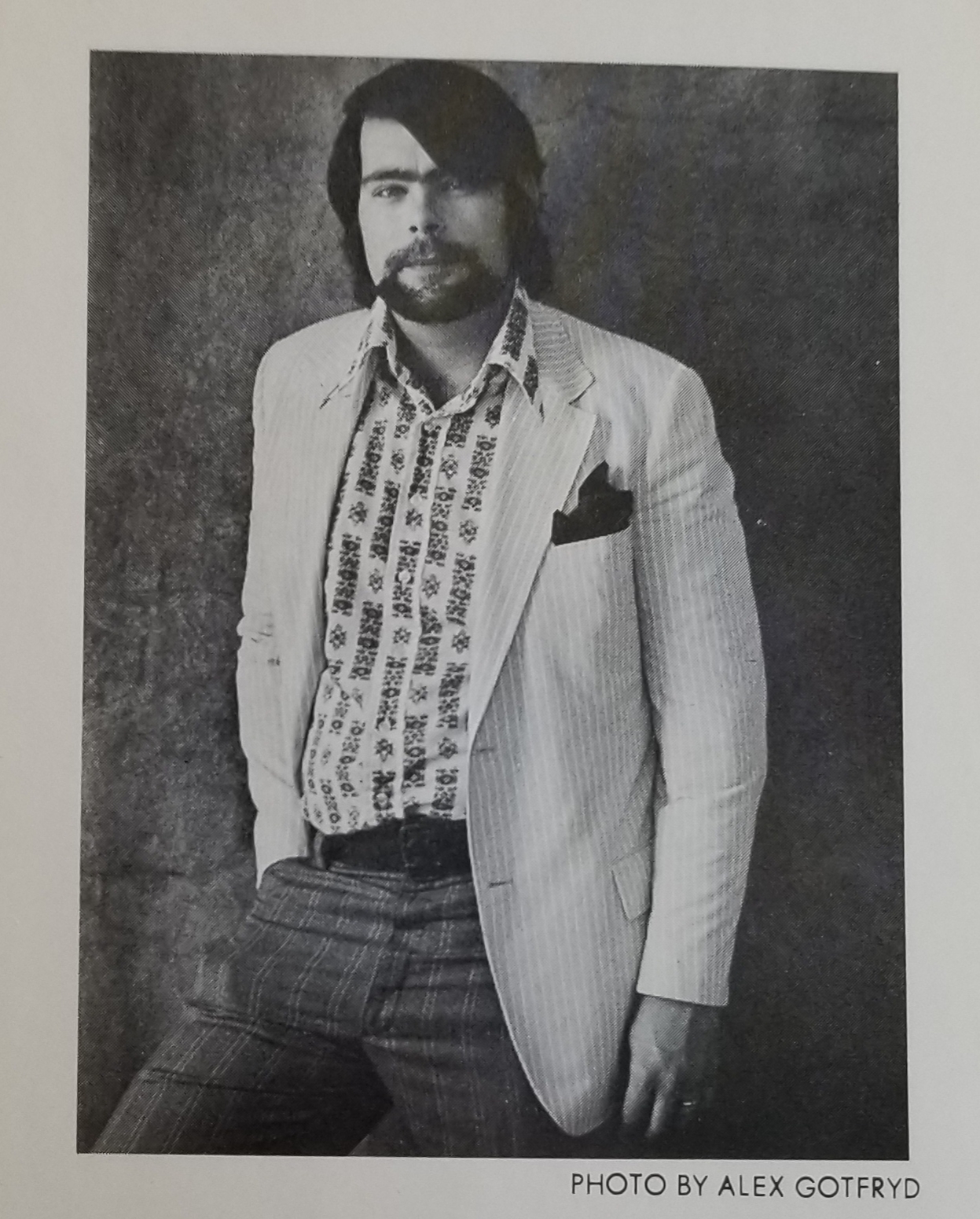
I nearly fall dead every time I see this author photo. It is
just...everything. The white jacket. The print oxford. The
Cool Dude Stance. The Bob Seger Werewolf styling. That
one lush, wild, gorgeous eyebrow. It is transcendent. Why is
this not always his author photo for every work forever??
(Author photo and cover design by Alex Gotfryd.)
This is why reading Carrie is so important to me right in this moment of my life. I don't know if it was the first novel King ever wrote, but I know it was the first novel he published. I am currently deep in the pages of my own first novel, feeling a bit bruised and a lot scared, but still invested, still digging the story, and wanting desperately to do right by it. Carrie has its flaws, but it's still a compelling story and a genuine page-turner. I hope that my own efforts will be even half as good.

Grade: B
Scary? (0-nope to 10-you will die): 3, so not really. Unless you have no sense of what teenagers can be like. I give it a three for the suspense factor, which is very high. Even though you know what's going to happen, it builds.
Warnings: Dirty birdy words, n-word, casual bigotry, Aunt Flo, ohuh, lots and lots o'death, general human shittiness.
Artifact: Beautiful early edition (print number unknown). Hardcover, red paper casing, glossy stamping, no headbands, rough cut, white endpapers, medium white stock. I always half loved, half hated the jacket: the type and artwork are very "70s-80s Stevie Nicks, white witch, watercolor"...but the woman featured is frankly too striking and objectively beautiful to be Carrie. This is the first King novel to jacket disconnect...and is unfortunately not the last. There have been some truly terrible misfires over the  years. Overall, it is a lovely, very well-made edition.


'SALEM'S LOT (1975)

Wildly uninteresting windbag gets the girl, loses the girl, speaks in long monologues about Stuff. Also there are vampires.

Woof.

If I were to make a list of every Stephen King book from very favorite to biggest butt barnacle, 'Salem's Lot would win the worst prize.

I have now read 'Salem's Lot three times. My first read-through was between 1985 and 1990, or between the ages of thirteen and eighteen. I hated it. It stayed pristine and untouched in my library, moving from one place to another, bookcase to bookcase, duly dusted but uncracked, making it all the way to New York City before I decided to pick it up again. Maybe I hadn't given it a fair shake? After all, I had only ever read it once and could not remember a thing about it, save that it was about (yawn) vampires. Maybe it's actually good! But no. Second reading completed (est. 2005, mid-thirties, still not into it) and back on the shelf it went. Ultimately it got sent off to the Strand with the rest of the library. I'm not even sure I got money for it.

Look, I LOVE an irreverent vampire story. There was a spate of silly vampire movies and books that dappled my teenhood with bloody glee: lots of whimsy, humor, gore, and cheap scares...bring it on! We all read at least the first two Anne Rice "Lestat" novels (I gave up after the second, but most didn't), laughed at the goofy idiocy of Once Bitten (I can still remember the chorus from the dance scene song, "Hands Off," God help me do not watch it unless you want to die of secondhand embarrassment but definitely watch it's so terrible), screamed and howled and immediately rewatched Fright Night (more vampire dance trance silliness here), and swooned hardcore over those sessy sessy Lost Boys (seriously, what's with all the dance/music scenes in the vampire movies, like literally all of them? Though I must admit "I Still Believe" has been on my permanent playlist since 1987). But there's a limit, ay? I can't really watch the Twilight movies, though I like the part where Edward looks like he's going to vomit the first time he sees/smells Bella. That's high comedy, son. But standard vamp? Yawwwwwn. (Oh, but we loved Grace Jones in Vamp, another funny, totally irreverent, terrible but memorable 80s stripper vampire movie.) But Dracula in a cape? Vampires in general? Vampires living in haunted houses on a hill? Meh. It's just not my thing.

On Point. Jacket photo collage copyright 1993 by Thomas Holdorf. Jacket hand
lettering by Craig De Camp. Jacket design by Peter R. Kruzan.

All the fancy endpapers.
Before proceeding, I must state that 'Salem's Lot still kicks the shit out of many, many bestsellers over the decades up until now. Easily. It isn't a bad book. It's a fledgling novel from a very talented, megastar writer. You can actually see him flexing his skills throughout, sometimes nailing it (so to speak), but frequently sweating out those metaphors and similes like he's trying to meet a minimum imagery requirement. It is very much a second novel sort of work. Not bad, not great, just is. In addition, if I am completely fair, I'd already read other blockbuster, titan titles by King by the time I read 'Salem's Lot. It didn't stand a chance in vampire Hell.
Ad page (or, Previous Works) updated to c. 1990.
What did strike me this read around (where again, I did not remember any of it, other than the fact there would be vampires, including a baby vampire) was the world building. It is one of the things I love so much in King's strongest writing: He can create whole, real worlds that you can smell and taste, places that you grow fond of, think about, wish to visit at least once if not forever. There is a real effort to create a place called Jerusalem's Lot, to render it real off the page. It is not as successful as later creations, but the work is evident. 


'Salem's Lot, like any aged novel, does grate in unsurprising ways, e.g. more casual bigotry, standard countryfried homophobia, and the Silly Smalltown Girl Who Lives to Be a Chapter in Some Man's Book. And of course the Hero Who Talks Down to Her. Upon reading through the first meeting of Susan Norton and Ben Mears, I stomped out of my room and announced to the house in general, "I remember why I hated this gd book." I'm not sure who King is attempting to create in his hero, but he reads like a more mature, less obnoxious version of Harold Lauder from The Stand. This is not a compliment. Condescend much, Ben Mears? UGH.

Now this is a copyright page. I was a reprint
manager eons ago. If memory serves, the
bottom line indicates this was the 28th
printing. At the next reprint, they would
remove the 29, and so on. Most mere
mortal titles feature a simple 10 count
(eg. 10  9  8  7  6  5  4  3  2  1).
The vampires themselves are an uneven bunch. For a very long book about vampires, there is very little vampiring going on. The best rendering, by a mile, is the first vampire Ben and co-hero Jimmy Cody confront at the morgue. She is a mother reborn, calling for her dead child under a mortician's sheet, and King's description of her supernatural strength and carnal malice is incredibly effective. The main baddies, Straker and Barlow, are mere bookends to the stronger, world building element of 'Salem's Lot. There's a lot of hinting around them, with brief though memorable appearances from Straker (an obvious predecessor to Leland Gaunt in Needful Things, shop and all) and a belated, fumbling introduction and exit of the Biggest Bad of the book, the unknowable Barlow, he of the slicked back vampire do and the most sassy burn letter ever written. I could not help think of Duncan Regehr (babe) in The Monster Squad (another 80s great, though you flinch when they say the "f" word), overacting his little Dracula heart out and having the time of his (undead)life. It's all just a bit...silly.

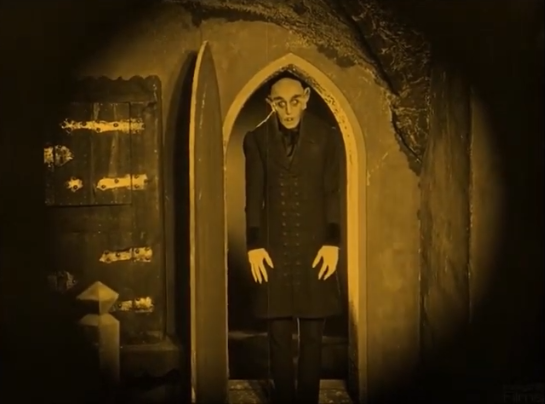
I have never seen Nosferatu in its entirety. I probably never will. At this point, I'm not sure why I'd need to except to check it off some nonexistent list, a.k.a. "100 Classic Horror Movies to See before You Die (Of! Fright!)". But I'll tell you what: Nothing in the vampire genre has ever scared me as badly as those flickering frames of Max Schrek as Orlock, especially when he's just STANDING THERE being a terrifying, otherworldly WEIRDO. I've always been a sucker for the Slow Chase (see Halloween, It Follows, so many others) and Max Schrek is like the Originator (Ain't No Imitators) of that creepy shit. To this day, it freaks me the hell out. If I'd seen Ol' Orlock as a kid, I would have had legit, yelling for mama nightmares. It would have imprinted.

80s Buzzcut King (Photo by Tabitha King).
Barlow could have been a lot of things, but in the end he was much ado about little if anything. And not very scary to boot. (Sorry, suckers!) Maybe if King had written him a seductive dance scene...

Grade: C
Scary (0-nope to 10-you will die): Solid 6. Others have claimed it's the "scariest Stephen King book everrrr" but it isn't. Very little vampire action and a "hero" who is very hard to like. If you don't much care what happens to the main characters, it's hard to get worked up about what happens to them.
Warnings: casual bigotry, homophobia, dead babies, undead babies, misogyny gone wild, sex scene where a certain someone says "Oh Susan."
Artifact: Library Book! According to the copyright page, this is the 28th printing of an edition put out sometime around 1993 (based specifically on the cover art credit cited above). It is a mighty hunk compared to my slight little Carrie volume and could easily knock a vampire into next week if you chucked it just so. Hardcover, black paper casing, metallic red stamping, red headbands, flat cut, red endpapers, heavy cream stock. It's hard to tell through the heavy plastic film that protects the book from unsavory elements (patrons! o susan!), but the cover appears to be 5-color, CMYK plus metallic. I am probably remembering that wrong, but either way, super fancy for what comes out looking more sepia than anything. In any case, the cover art itself is truly inspired, spooky and beautiful, with the back cover imagery clearly evoking the Catholic Church juxtaposed against the front cover's haunted Marsten house, both ensnared in deep thickets. A lovely and fitting artifact, indeed.

Up Next: Come play with us, Danneeeeeeeeee...


But seriously. This Guy.

Gah.

GAAAHHH.

Nope.         No.

[dead] [un]

Thursday, September 12, 2019

Five Years

Time is relative. We all know that. If you don't know it yet, you will. My aversion to shopping is based on many things, but the foundation was laid during shopping excursions when I was but a wee babe being figuratively (sometimes literally) dragged from one boring store to the next, no one to play with, nothing to do, no end in sight. Can't play in the clothes racks, can't play with the jewelry stand, can't play behind the register. Just sit still, be quiet, and behave. Is it any wonder kids consistently melt all the way down to the core on shopping trips? I can remember the boredom, the horrible keening inside to just GO, LEAVE, do something else, anything else, even run screaming into traffic maybe, just get me OUT of this SEARS store NOW. It was interminable.

And yet, here I am, aged. Kids will be kids, ever in the present, but the older you get, the closer you come to understanding the fickle pickle of Time. How it crawls at an uninspiring job, how it races at a roller rink. Pick your own, those are mine. How many times did I stand at the edge of the skating rink and beg for just one more lap pllleeeeaaaaase mom please, two more, three more. And how infinite time must have felt for her as she sat there and watched me zoom around again and again, music bopping, lights dancing, the acrid reek of concessions hot dogs in the air. Interminable!

So you will have to take my word for it when I say that the last five years have been the longest and shortest of my life. I have experienced highs no drug could mimic, and I've weathered lows beyond my imagination. Losing my job of over fifteen years was a part of it, and in any other timeline would have been the headline, but it was a minor blip in comparison to the real challenge. I am grateful that the timing worked out the way that it did -- being "made redundant" (chip chip cheerio, that's how the Brits do) earlier might've been too much for me to handle...and staying there longer would have been, well, interminable.

Five years and a little over two weeks ago, I was working from home (as I often did), laboring over an email meant to deal with author mismanagement that had led, inevitably, to author meltdown. I was stuck, unable to find the right words for the circumstances, and something terrible was creeping up from inside. I had experienced many panic attacks in my life at this point, so was keenly familiar with the symptoms. At first I believed that this godforsaken email was sending me down the same path. Heart palpitations, labored breathing, feelings of impending doom, all check. But the tunneling was severe, my hands were icy, and something at my core just felt...wrong. I felt poisoned. I felt short-circuited. The systems were going haywire.

I called a car service and signed off from work. From the chair, to the door, grabbed my purse, grabbed the keys, locked the door, on down the hall, into the elevator and down down down, I floated. Just floated. I was here and not here. It wasn't exactly the same as feeling faint, but in the realm. I'd never experienced anything like it. The drive was swimmy and hypersaturated. Everything--the trees, the cars, the people--seemed threatening and close. The urgent care center was mercifully empty. I sat and waited and thought about what I was going to say. I had a feeling I knew what was wrong, but wasn't sure if I could say the words out loud.

Ten months before, I'd suggested there might be a problem to my fleeing doctor. He'd already addressed the one thing I'd come in for, so he was irritated that I was bothering him to ask another, unrelated question. He said, I don't know, I don't know, I think there's information on the back of your insurance card. Then he was gone and I was sobbing alone in the little antiseptic room.

But before that, and certainly after, well steeped deep in a drunken hole, standing half in my kitchen, smoking, I'd certainly whispered the truth to myself. I would lean into the doorframe, lips close to the paint, and whisper it, a tiny secret: I'm an alcoholic. It would hang in the air for one hot moment, almost real, then I'd shake it off, stub the cigarette, and find my way back to the living room to continue drinking. Easy to ignore the nagging voices when you drown them in wine. Which I did, every night, for years.

The first time I tried to ask for help--the busy doctor--I stammered the question about whether or not rehab was covered by insurance, tears in my eyes, and broke down as he left with his unhelpful advice. The second time I told anyone the truth about my drinking was that day at the urgent care center, the poor medical assistant, who had to wait out my braying sobs to get to the core of what I was saying. My blood pressure was way too high--188/98--and policy required that they call up an ambulance to take me to hospital. By the time I talked to the EMTs, the fourth and fifth people to hear the truth about my drinking on that day, I was no longer sobbing, just crying. One of the EMTs asked me how much I drank. When I told him, he made a face and said, "That's not so bad. My mom drinks about the same." Which led to an uncomfortable end to our vaguely friendly acquaintance. When I waved goodbye to them at the hospital, I still felt scared...and he looked troubled. How much is too much? Who decides?

That early evening I got an EKG and a chest x-ray. I talked to one doctor, several nurses and technicians, and it was determined that I wasn't having a heart attack. I asked if they had any idea what might be causing the symptoms. They said that in this case they could only tell me what wasn't wrong with me. Apparently nothing in the blood tests alarmed them much, either, though later tests would confirm both kidney and liver damage. I was set free. I clung to that non-diagnosis like a life raft. If the doctors that checked me out didn't see anything wrong, then I must be fine. If the EMT's mom drank just as much as me and he didn't think it was a problem, I couldn't possibly have a problem. I went back home and went back to my old ways. I promised myself I would skip nights, drink less, try to wean myself back--not off, oh no--but back to the "socially acceptable" level of drinking. For funsies, NYC party party, after work drinks with the girls kind of thing. I wasn't broken, just a little out of whack, maybe.

For years, the NYC social life I'd know had fallen away. I rarely met friends for drinks anymore, rarely went to happy hours. When I did, I would drink club soda with lime, bide my time, then flee within an hour, annoyed that I had to surrender my real drinking time to keep up appearances. I'd tried imbibing at happy hour in the beginning of my descent, downing a couple of beers over a couple of hours, then making the hour long subway ride home to pick up drinking in earnest for the rest of the night, but found that the buzz would die and I would just end up tired and angry. A wasted high. So, seldom attendance and soda and lime, please. My objectives were hardwired and clear. I would leave work before six, make my way home, and drink until I had to go bed, usually midnight, sometimes one. On the days I worked from home, I would only commence drinking after I'd signed off from work for the night, relying on my ability to refrain from drinking during work hours as a clear sign that I was not an alcoholic. I would drink all night, sometimes beer, sometimes liquor, but more than anything red wine, usually cabernet sauvignon. I was a steady customer to a local, family owned liquor store who delivered without judgment, even when I answered the door looking like the actual crypt keeper.

The last year I imbibed in alcohol, they sent over a $100 case of wine as a thank you for my business. I was overwhelmed by their kindness and profusely thanked the person who delivered it. Then I stood there alone in my foyer just looking at it, realizing I could tell no one of my good fortune. No one could ever know. There would be far too much explaining to do.

On a Sunday night about two weeks after my ambulance ride and brief stay at the emergency room, I was attempting to have a "dry" night when the same symptoms started rolling in. I knew immediately that it was the same thing as before, the Phantom Ailment. I called the car service and told them to take me directly to Lutheran hospital. Within five minutes of checking in, they had me hooked up to the EKG yet again, the quiet bustle of 9pm Sunday at the ER filtering around me. I stared up at the ceiling, tears flowing, alone in a row of beds. It never occurred to me to call anyone.

Again, I cried every time I talked to a doctor, walked through my symptoms, spoke the truth about the amount of alcohol that went into my system every night. This time around, Lutheran decided to give me the full ramalamadingdong: echocardiogram, stress test, the whole nine. All told I was there for just over 24 very long hours, mostly waiting to be rolled to the next test. I spoke to several doctors over the course of the night and day, each one coached in kindness that was evident but appreciated all the same. Each time I talked about it, my tears were less severe, I was more forthcoming, and the picture was getting all the more clear.

The last doctor was a psychiatrist, a beautiful African-American woman with perfectly coiffed hair and flawless makeup. She was gentle and kind. We talked for a while. Finally she put her hand on my arm and said the words I was waiting to hear, "I think it's time. I think you know it's time. Are you ready to do this?" My eyes filled with tears and I nodded, lips in an ugly twist as I fought sobbing yet again. I finally managed to sputter out a yes. She gave me a slip of paper with name and number on it and told me she'd called ahead and that they would expect to hear from me the next day.

After I was discharged, a ghoulish, resentful part of me took the reins. I got home and poured a big glass of wine. I drank as much as I could that night. By definition, I got drunk, but it was a shitty drunk, an exhausted, thick, stupid drunk where it felt like there was a fist grinding into the back of my neck and my skin felt tight and brittle. The next day, September 9, I showed up to my rehab intake hungover, chaste, and terrified. As I answered her questions, all I could think was how foolish this was, how it would never work, how I would fail, and what a loser I was for being there in the first place. The self hatred was flowing freely and flooded out every rational thought in my brain. I knew only one thing for certain: There was no way I could do this.

September 10, 2014 was my first true day of sobriety. I haven't had a drink--or a smoke--since. Some days I can't imagine how I got here, but more often I can recall all too well what it was like to get through it, how fucking hard I fought, and I've got to take a breath and just bask in it. There's no victory dance, no one's going to run a flag up a pole, we're never going to close down the set, pack it up, and call it a day. I will have to remain vigilant for the rest of my life, but by degrees far less challenging than before, back in September of 2014, October, November, and on. I mean, it took months just to acclimate to the night. I would sit in quiet terror, unable to focus, unable to function, my appetite shot, sometimes just shaking. I told my rehab counselor that it didn't seem like withdrawal so what the hell could it be? Because it's nighttime, sweetie, she said. You drank all night every night, you don't know how to be. You lost your best friend and you associate that comfort with nighttime. I spent those first nights thrumming and humming, waiting for the world to end, the comfort of alcohol and cigarettes never far from my mind. These days, I can go for weeks without thinking of either at all. They just don't have the same terrible influence and charm.

I was the only "voluntary" at out-patient rehab. Everyone else was court ordered and functioning at different levels of resignation or Big Mad. Many did not think they needed to be there, some were definitely correct. While it was a dysfunctional arrangement (they told me at the end of my stay that my involvement taught them that they needed to separate the involuntaries from the voluntaries) I learned a great deal and gained vital skills to combat the lingering challenges of alcohol addiction. While the rest of the participants were annoyed (or dismissive and unimpressed), I delighted in learning that criminal thinking and addict thinking were very similar. Some of my biggest takeaways:

Your Addicted Brain Is Not Your Friend. It is forever trying to get the candy. It wants the candy. It needs the candy. It will lie, cheat, steal, and hurt anyone who gets in the way of that, including you. Now, this makes sense on a physiological level, considering what alcohol dependence does to your brain and, frankly your whole system. Remember the Phantom Ailment? Once I started getting myself back, I also came to the conclusion that I was a whole person, worthy of being treated as such, and dumped that shit doctor, Mr. Running for the Door, triple booking his patients, wait for 2 hours to see me Mr. Bullshit doctor. My new doctor, also Lutheran affiliated, went over my charts and confirmed what I suspected but was never confirmed until that moment: Alcoholic withdrawal. Because my body had decided that drinking for only six hours a day was no longer acceptable. It wanted more. So it really was a breaking point for me: Either get sober or start dying in earnest.

The physiological side of alcohol dependence is serious (in withdrawal, you can actually die--seizures, etc., it's messed up) but the psychological part is insidious and scary as hell. One of the things they drilled into our heads is to stop focusing on the failure. It's a common fear. What if I relapse? Then I've failed and I'm an even worse piece of shit than before. Woe is me. Might as well drink until I can't feel and maybe stop breathing. This! Right! Here! Is your BRAIN trying to GET THE CANDY. It works the same for smoking, too. I've smoked a cigarette, I've failed, fallen all the way off the wagon, oh look the wagon is already too far from here where I sit in this pity puddle, might as well have another. And so on. You can apply it to any vice, really. Didn't go to the gym, missed a day, already I'm a loser, might as well stay in bed today, too. And tomorrow.

They taught us to take the power away from the act of relapsing by saying it loud: I will relapse. I WILL RELAPSE. So what. It doesn't make me less of a person if I do. And it's not an excuse to wallow in it, which is what BRAIN is trying to get the addict to do. This probably sounds scary to loved ones standing on the outside looking in, but it shouldn't. This is the addict controlling the problem instead of the problem controlling addict. We're taking away its magic. It's still there--always will be--but it's not capering in the darkness, beckoning us to give it up, you know you can't last, you're a weak nothing who would feel so much better if you just had a drink.

Addiction Is More Than Substance Abuse. It changes you. You become a darker version of you, a sicker, sadder, paler version. That's my story. For others, they break laws, hurt people, they brawl, they destroy. Most of my destruction was inward. One of the major signs that a person may be abusing is LYING. To yourself and to others. No one in my life had any idea what was going on and that was by very careful design. I lived far out in Bay Ridge and never invited anyone over. I certainly never admitted to the level of my drinking and laughed along with everyone else at the hee haw drinkity drunkity jokes in movies and television. I dated no one during my abuse for fear that they would discover or impede my secret (nothing was more important), and for the darker fear that I would find someone like me and we would drink ourselves into the mire. Except for work and yearly jaunts home (where I white knuckled it for a week then fled back to NYC and my wine), I was isolated. My face started changing, too. It seemed to spread, dull. My skin was thin and flawed. The pigment on my lower legs got spotty and dark from liver malfunction. I gained an enormous amount of weight.

People knew something was wrong. They just didn't know what was wrong. I lied when I needed to lie. I deflected when I needed to deflect. My life grew gray and opaque. My ability to feel anything was stunted and still. I won't go into detail, but when I think back to the worst of it, my heart breaks for that person. It was me and it wasn't me. The suffering was immense, immeasurable, deep. While it was apparently frowned upon to get too personal, one of the counselors told us a story about his own journey on one of my first days in the program. He'd been using a cornucopia of narcotics, running the streets, thieving and using and getting up to no good. He had potential, had teachers who told him he'd had potential, but had squandered every opportunity to run with his boys and get high. It had gotten bad, he wasn't running the drugs so much as the drugs were running him, and he'd finally gotten caught red handed. He told us that once the handcuffs clicked, all he felt was a rush of relief. Thank God, this is over. I can rest. 

Like, what?! Right? But I sat there gobsmacked because I felt that so hard I could barely breathe. It changes you. You get pushed so far adrift from what you were, and it's so insidious how it happens, how more and more equal less and less and suddenly you're not having fun so much as medicating to keep from flying to pieces. I would watch shows like Lock Up and think maybe it wouldn't be so bad...I could eat that meat/bread/vegetable cake they serve in solitary. Sure! Yes! Because there would be a lock on the door and I would have no other choice than to sit there, sleep there, keep me away from my vice there, and rest. Just. Fucking. Rest. Because abusing breaks you down at every level: physically, mentally, emotionally, spiritually. I believed I would've happily eaten the Solitary Cake if someone would just save me from myself.

It's Not a Competition. This is a sad one. Because some of my fellow participants couldn't get past that, either to win the prize (Biggest Boozer?) or prove that they shouldn't have to be there in the first place. Everyone's "bottom" is different. And some people have to hit different depths multiple times until they either get help or die. The human animal is far too complex to ascribe one set of rules to apply to every single individual. It's not a "you must be this tall to ride this ride" kind of ride. This loops back to the Addicted Brain Who Hates You lesson -- because an addict's brain can and will convince the addict that she is totally fine if her behavior mirrors someone else's, even if it's just measured in liters and everyone can ignore that Bob seems fine, has a clean house, good job, etc. etc., while the addict is licking dust off the floor under the bed and contemplating ending it all. But we drink basically the same! Kind of! Believe me, when that EMT seemed to pshaw my alcohol intake, I suckered onto that like a beached fish to a splash of water. Gimme gimme gimme -- I will take anything. Just tell me I'm not broken.

But I was. And I don't need anyone else's validation to know that. I was there. Despite my flaws, and the millions upon millions of brain cells I cabernet sauvignoned into oblivion, I'm pretty smart. I had a serious problem and needed help.

Last but Best: Clarity Is REAL. You've heard people say it. They go to ashrams or church or 7-11 and stare at the fluorescents and Get Clarity. You've certainly heard people in recovery say it. Just like you've heard "one day at a time." Ugh, right? But Lord Almighty is it different when it happens to you. One day at a time sounds tedious, stupid, and simpleminded, but it's a fact, Jack. Primarily because I became so very cognizant of the passage of time. Those first months were slow, slow slogs of merciless sobriety, steely splinters of sun, counting every breath, awake all night, shaky all day sobriety, man. It sucked so hard. But I would get through it, tick it off the calendar, one more day. Those days, one day at a time, were earned.

As time progressed, that cloudy gray life started to gain color. I once told my therapist it was like I'd been living my life looking through a dirty window, everything skewed and apart from me, muffled and remote. Imagine what it was like when the color started seeping back, the window warped and thinned, then blew away like some wisp of cellophane. I never want anyone to know that darkness, but clarity? Full-color Clarity? I wish it on everyone. And yes, it can hurt, like when I realized that while I tried my best to keep my alcohol abuse away from my family, it still snarled out of me in not so subtle ways. The last few times I went home to visit during my abuse phase were prefaced with increasingly hostile emails to "just let me relax" and "don't grill me about how I look or what's going on with me," and a blanket excuse that work was so stressful and I didn't want to be hassled, etc. because it would only make it worse. These emails were semi-hysterical and clearly desperate. And basically screaming that something was very wrong with me and I was being manipulative as hell to frighten away any nosy nancy business. I actually remember the moment I got clarity on that one. It was in rehab and our counselor was talking about manipulative behaviors that addicts and criminals similarly employ to get what they want. I sunk into my chair, deeply embarrassed, never realizing until just that moment how terribly I'd behaved. At the time I wrote those emails, even during the "sober" hours, they seemed maybe a little curt, but that was all. What a difference clarity makes.

And of course clarity hurts when you get to the core of the Why. It's different for everyone. There's no need for me to get into it, but I will say that while it was painful (and humiliating, and infuriating), it was ultimately liberating. More importantly, these revelations laid the foundation for the self worth I have now. I'll never say I'm "grateful" for the reasons (fuck them and the bowlegged horses they rode in on) but I'm grateful I came out of it alive...and changed for the better.

Clarity. I was deep under, depressed, opaque, and fading. I was miserable. Then sobriety, the fledgling, dappled light of clarity. And one day I broke a candlestick and felt something I'd never felt before: Unbridled Joy. Even now, almost five years later, the memory of that day gives me goosebumps. I'd only just found my iPod Shuffle (it is tiny and I lost track of it constantly) and had hooked it up to some speakers to see if they were working and worth keeping. They were garbage speakers, tinny computer speakers with barely a hint of base, but I hadn't listened to them in years and figured I should test them before chucking them. While navigating the twisted cables and pushing the click wheel on the Shuffle, I somehow managed to knock an old, glass candlestick to the floor. Months before I would have flown into a fit of rage, but I just went and grabbed the Swiffer and started to sweep. Then Mary J. Blige's "Family Affair" started playing and something happened. I felt music. I felt Music. With all my feelings. Not stunted, dulled, depressed non-feelings, but real, live, genuine, CLEAR feelings. I danced, I Swiffered, I sobbed, and I cackled like a freakin LOON, round and round. The neighbors probably thought I'd finally blown my circuits but I couldn't stop. It was Glorious. I was overwhelmed. And for the first time in that shaky start of it all, I felt full up. Joy joy JOY. Rediscovering music was transformative.

I had a lot of little moments and big moments in those first six months or so, and from time to time something will still get to me and I'll have to stop and smell all that Clarity. It's transcendent, you can't force it, and it rolls in when it wants, but hot damn does it ever make it worth it. The last big moment was sitting by the lake looking out over the Tetons just shaken to the core that I was there, really there, and I had gotten there all on my own, clear headed, sober, and a functioning adult once more. And of course I cried. There was a time I believed with all of my heart that there was no getting out of that hole. I would just drink until something changed, lost my job, out on the streets, God knows what...or they'd find my body and it would just be...over. Big deal.

That was five years ago. FIVE! At once so long ago and yet just yesterday, depending on the day, the memory, and the varied and unpredictable levels of clarity. I am deeply proud of these five years and I am grateful for the support I've received from my family and friends in the aftermath of all my revelations. Those first confessions were difficult, even terrifying, but I received nothing but love and kindness, which was exactly what I needed. In those first days, those first confessions to medical professionals trying to help me, I never would have believed how far I have come, how much happier I am, and how easy it is to talk about my past alcohol abuse. One fucking day at a time, man.

I am also deeply grateful for the NYU Lutheran Medical Center (now renamed NYU Langone Hospital) for their kind, patient, and thorough care (and after care). The Resource Counseling Center was vital for those first months of sobriety. They taught me how to manage my trickster brain and supported me through every whiplashing stage of early recovery. My therapist, who will remain anonymous here, took up the reins after rehab was completed, and set to work on many of the deeper issues that required excavation, study, analysis, and care. I'd drop her name here if I could, but it wouldn't be prudent. All I can say is that I hope every person seeking therapy gets someone as amazing as her. I don't regret leaving New York, but it was damn hard to leave her expertise, guidance, and excellent treatment behind.

This should never be necessary--Universal Healthcare NOW NOW NOW--but I am incredibly grateful to my company at that time, whose coverage of drug and rehabilitation treatment totaled 100 percent. Read it again. One Hundred Percent. I remember standing at reception at the Resource Counseling Center, having just turned in my first pee cup (yee haw), sick to my stomach with worry over the bill. How would I pay for this? How bad was this going to be? I was drowning in debt and barely able to pay my bills every month. I was crossing my fingers that the money I saved on wine and cigarettes would cover the expense. When the receptionist told me that it was covered, I genuinely did not understand her. I asked her to please clarify. She looked at me patiently and stated that my insurance covered the cost in its entirety. I would not need to make any payments, ever. I said okay, thanked her, and headed for the elevator, eyes filling with tears. God knows there were so many tears and a lot of anguish and fear, but those happy tears? When you just weep for joy? Incredible. Because here's the thing that's been getting better but still has a very long way to go: Stigma. The amount of shame so many of us feel is impossible to explain. There are plenty of understandable reasons why addicts are judged and shamed. I get it. I was a child growing up around alcoholics. Addicts hurt people, often in ways that leave permanent scars, inside and out. Many, many scars. At the very best, it is a big joke, the capering grotesque, smeared lipstick, Meredith Palmer, Arthur, Ozzy Osbourne snorting ants kind of joke. But at the very worst? We are stupid, destructive, Evil. Lock em up, throw away the key. And the sodden drunk, bruised and reeling, will agree that everyone would be better off without him. It is, after all, a goddamned depressant. Some will never recover. They will abuse and hurt and steal and wallow until they finally succumb. Everyone knows someone, many of us know generations of someones, one right after the other, sucked down into the abyss. But there are people like me, too. Not entirely a demon, worthy of some absolution, and one chance (if not many) to crawl out of the depths and back into the light. With help, of course.

I cannot express to you how I felt sitting across from Connie in HR (last name redacted, but some of you will know) and telling her what it meant to me to learn that our company covered drug and alcohol rehabilitation entirely. It was a moment in time, so I can't speak for later, when we branched off to another mothership and then changed altogether from a merger, but at the exact moment I needed that support, it was there. No words can honor it.

Before I sign off, one last thing: If you think you are in trouble, seek help. There are resources, and it doesn't cost anything to do some research. Start online--there are plenty of websites, articles, and even quizzes to assess if you are in need of help. Don't be scared. I know that even this step can seem too difficult to bear. There are various symptoms of alcoholism and alcohol abuse (not exactly the same, but both can and will receive treatment)--you don't have to have all of them to qualify. For example, in my case, I

  • craved alcohol, 
  • drank alone and in secret, 
  • lied about my drinking, 
  • felt ashamed of my drinking,
  • put my drinking above everything else, 
  • had to drink more to achieve an "acceptable" high, and
  • drank to deal with stress and drown out issues I didn't want to face. 

Some believe that you have to drink every waking hour to truly have a "problem" but that is just not the case. Remember, not a competition.

Leave your shame behind and face your challenges head on. Be honest with yourself. Don't live in fear of failure or relapsing. You are worth saving.


Tuesday, September 10, 2019

The Gift of Libraries: Requesting Items, Part Deux


The Wichita Public Library stocked Idiocracy. My cup runneth over with BRAWNDO: The Thirst Mutilator!

Look, Idiocracy is mean. Even now, it still comes off as mean, but I've been called tenderhearted in the past and I'll begrudgingly admit that it may or may not be sort of true. The movie depicts a future when idiots outbreed nonidiots and society slides into supreme stupidity living in a ruin of unending garbage, broken automation, droughts, electrolytes, and rampant, unblinking dipshittery. Everything comes from Costco (including law degrees), Starbucks serves sex acts, and an average 21st century man can outwit just about everyone on the planet.

Idiocracy's take on the surviving government is where the movie really shines. And it's where some relief can be found for our current woes...though I suppose it could have the opposite effect, depending on your political inclinations. It certainly did me good to watch it again. It seems less mean and just a squidge more prophetic these days, with the normalization of buffoonery on the daily menu and no end (or bottom to the pit of shame in DC) in sight.

Thank you. WPL! And for future viewers who have never seen Idiocracy (there are so many), fair warning: you're probably going to get offended at some point. It's lewd, crude, delights in the worst stereotypes, and drops the f-word gay slur more than once. And this is coming from the mouths of lawyers, doctors and, of course, your elected officials to the highest offices in the land.


Thursday, June 27, 2019

The Gift of Libraries: Requesting Items


It's been too long, hasn't it? I'll blame the book--when in doubt always blame the book--but it isn't all about the book. Right now I'm only managing editing what I've written thus far, and part of that is to get the taste of the story back in my mouth again, less to do with producing anything new (other than the inevitable rewrites that walk hand-in-hand with editing, regardless).

I would love to blame the holidays (since we all blame the holidays for every egregious act of procrastination), but since the latest was flag day, probably not, though I did coast like a ghost all up and around that period of time between November 2018 and January 2019. Since then? We've been working on our fitness in the household, primarily cardio, with some dabbling in planks which have been quite hilarious and also seriously achy and also breaky. Excuses! Though I would like to be nice and fit for my eventual visit to Lawrence, Kansas, and the beautiful, expansive, and very hilly University of Kansas campus. I'd like to spend time in the libraries, for sure, but would also prefer to do it right, walking as much as I am able and really taking in the sights. For those who think of Kansas as an entirely flat plate of nothing except for maybe fields of wheat, the KU campus can be quite a shock. There are some legit, brutal hills to traverse.

So why stop now and finally revisit the library/travel blog? To celebrate the glory of the library, specifically the Wichita Public Library system. Having been back in town for 2+ solid years, I can say with authority that they work hard to provide quality service to the community. The website is fantastic, the branches are vital to the outlying neighborhoods, and the central, advanced learning library is a true gem, still gleaming new and shiny, with abundant, electrified seating options, airy stacks, phenomenal views, and helpful, friendly staff.

I've been a bit "checked out" (eh heh) with other life events, so recently came back with a vengeance, checking out books, scanning through the DVD selection, and revisiting some old searches I'd started back in 2017. After my initial return to Wichita and setting up a new account in the library system, I created a list of books I wanted to read, which can be done via the website and exists, I'm guessing, as long as your account exists. I accrued the list from old Entertainment Weekly book reviews circa 2007-2016 and "Best of" lists via the internet. Why EW book reviews of all things? Because that was basically all I could rally myself into reading during the worst of my alcohol abuse and subsequent recovery. For all intents and purposes, after leaving behind the heavy burdens of NYC and all that had happened, I was only really ready to read books, cover to cover, when I returned home in January of 2017. Sounds weird, right? Like, how many novelists are known as both voracious readers and voracious drinkers? So many. But that wasn't my alcoholism story. And as we all learned in rehab, everyone's story is different. So, with my appetite and focus for reading finally restored, I searched through the lists of reviews looking for vaguely remembered synopses, stories that sounded intriguing, books I truly wanted to read at the time, then forgot as soon as the next tumbler of wine was drained. I doubt I found them all, but I was able to create a considerable list.

There was only one title the Wichita Public Library system did not have in stock at any of the branches: Blood Meridian by Cormac McCarthy. This was garnered from the online "best of" searches, but I didn't need much prodding to seek it out. McCarthy's The Road was one of the few titles I did manage to read during those dark times--near the beginning of the dark times when I was still mostly human--and while it did nothing for my depression (dear God, the darkness of it??) it did everything in terms of inspiration, awe, and creative energy. If you've never read McCarthy...just, no. Stop what you are doing. Immediately. Go to the Barnes and Noble. Go the the library. Find the fiction, under McCarthy, Cormac. They'll have at least one copy of something. Get it, buy it, check it out, read it tonight. He does things with language, incredible, impossible things. He turned me inside out, for real. Round and round. His is a national treasure and one of The Greats.

The WPL website had a record for Blood Meridian, but no copies available, not checked out or on hold, just non-existent. I figured it would be restocked at some point considering the author and the easy-to-find, "best of" status of the book in general. I checked back to the record (and my list: updating, adding, subtracting as I knocked those long desired tomes out, one by one) from time to time, but Blood Meridian remained zero of zero available in the system. I kind of forgot about it. Until this recent resurgence of reading rainbow vigor, that is. I checked it again and nope, still no Blood Meridian. Finally, after two years, I was done waiting. I figured if I wanted to read it, I'd probably end up having to buy it. There was one option to exhaust before breaking down and making a purchase: Cant find it? Suggest an Item! via the WPL website...


I clicked through to the order form, filled it out with all the requisite information, and found myself at that last question (How did you learn about it? Any notes to add?). I debated skipping the question and leaving it blank, but figured laying it on thick might help more, so I did. Librarians, I am sorry. Truly. I know you know your shit. But I was swinging for the fences. So I might've said it was wrong for any major library system not to carry at least one copy of every Cormac McCarthy novel available because he is one of the greatest American writers, living or dead, and also how dare you. Honestly, it wasn't quite that snotty, but maybe verging on it a little. I wanted that book. And also, seriously, stock your Cormac McCarthy, ya libraries.


I did not think much would come of it...and if anything did, it would be months before I held a dilapidated, second hand copy in my hand. And I would have been glad for it, too, because I really want to read it. Instead, less than a week later, I get notification via text and email that Blood Meridian is on hold, waiting for me to pick it up at my neighborhood branch, Rockwell. You will have to imagine the various cockatiel-dolphin noises that frightened my cat friends and woke the cemetery. YAY MY BOOK, but also whaaaat? 

Like most, I always assumed libraries got stingy stipends in the form of rolled nickels, perhaps via an old sock, handed out yearly, maybe bi-yearly, surely not quarterly, and only to be used on the most urgently required (e.g. new release, big name, bestseller) materials. Certainly there were no nickles to spare on my 1985 wishlist paperback? My initial thought was that maybe the library system stores books with little or no traffic for safekeeping offsite somewhere and that they'd just pulled it from there. I'm not even sure if that is a thing, but I thought it was possible, so much as libraries are like museums where not everything could possibly be displayed at all times. Assuming the story was something along those lines, I hoppy skippied over to Rockwell in the Rogue, overjoyed and ready to pull the old, dusty copy from the hold shelf to finally--gleefully--check it out.

But it wasn't old and dusty. It was pristine. Protected by a brand new, completely unscuffed plastic cover. As I wondered over it, cooing and acting a general fool, I made the guy at circulation check to see if he could determine when it was acquired. Sure enough, this copy of Blood Meridian had been put into the system just a couple of days prior. I was GOBSMACKED. The good kind.

So let's review: I filled out the request form for a 1985 paperback and about a week later the as-new, never-read condition book was somehow in my hands. Purchased, acquired, cataloged, plasticated, and ready and waiting for me at my branch. Not the central, learning library, either. It was ready for me at my branch. I mean, COME ON, y'all. That is FREAKING AMAZING. I even checked the record afterward and sure enough, Blood Meridian is no longer zero of zero available, it's now zero of ONE. Because I've got it! Thanks to the efforts of the Wichita Public Library system and the taxes we pay for the privilege of having such a fine service for our community. YAY!


Post-script: I also requested they add at least one copy of Idiocracy to the collection as a healing balm for these trying times, but no dice as of yet. I'll try again soon, and add more electrolytes.