Showing posts with label brutalism. Show all posts

Monday, July 26, 2021

Saving Century II: The Irreplaceable Saucer of the Midwest


When I moved to New York City twenty years ago, I promised my family that I would try to return home at least once a year. As my work responsibilities grew and my personal life expanded, coordinating these trips became more complicated, but I kept my vow for the most part. Save the half dozen times I chose to fly straight through to Kansas City, renting a car to complete the trip to Wichita, I primarily flew out of LaGuardia at the crack of dawn with connecting flights to tinier airplanes through Atlanta or Chicago, finally landing sometime around noon Central Standard Time at the old Wichita Midcontinent airport. No matter how tired or frazzled I might feel from the hustle and jumble of air travel, I always looked forward to driving the flyover span of US 400 toward my mother’s home on the east side of town. Past the flat boxes of retail, through old neighborhoods thick with trees, the proud spire of the Friends University clocktower, then a curve, a sweep upward, and suddenly, to the north, the singular skyscape of downtown Wichita.

It has always been a comfort and a thrill to see it, the color wheel cross-section of light, bright blues, the monolithic flight control tower of the Garvey building, the black glass hulk of the former Bank 4, the improbable brutalist Lego transformer that is the old library, and that bodacious saucer, somehow futuristic yet still mid-century modern and forever too cool for school, the Century II Performing Arts and Convention Center.

The old, brutalist library at night.

The first, informal whispers that the old library and Century II might be leveled for downtown redevelopment was met by many Wichita natives as far-fetched and, frankly, unthinkable. Buildings are not paper cups to be tossed after use, and buildings as architecturally significant as Century II and the old library are certainly far beyond mere "structures." This wouldn’t be like tearing down an old Costco or Wal-Mart. These buildings are works of art. With a little refurbishment and a bit of repurposing, they have decades of life still left in them. Unfortunately (and completely unsurprisingly), the same minds that shoehorned the uninspired Intrust Arena downtown--with little regard to aesthetics or parking, it seems--are at it again. Populous, as part of the deceptively named Riverfront Legacy Master Plan coalition, promoted a rigged “community outreach” by means of a push poll, and initially proposed a selection of five plans for redevelopment on the river, only one of which kept Century II. It is clear that little to no effort was put into using the buildings we already have. Why refurbish, repurpose, and rebrand solid works of art that were built to last when you can build new, prefab, cheaply constructed boxes that will be ready to tear down in less than thirty years for yet another money grab?

Back in her library glory, full of stacks.

The corruption at the root of Century II’s possible demise has been remarkably slow and unabashedly deliberate. While Wichitans lived their lives, paid their bills, grew their gardens, and raised their kids, the city’s plan for Century II was to simply let it go to seed. Instead of caring for this remarkable building, an irreplaceable piece of architecture, the city manager decided to just let it rot. Paint and power washing was put aside, improvements were not made, and only the most critical of broken things were fixed. The plan, it seems, was to let it slowly deteriorate, allowing the facilities to become so rundown, outdated, and under resourced that the city manager could finally point to it and say, See, it is “no longer viable.” The citizens would look upon the faded, dirty structure and think “yes, we deserve something better.” Something shiny and new. They would forget that Century II was properly maintained for decades, a lovely, strange, one-of-a-kind centerpiece to Wichita’s skyline and treated thusly. Not all of us have forgotten.

Rendering 1. Screenshot from the Downtown Wichita website.

Using the word “legacy” to describe the pre-fab, mini-mall village the Riverfront Legacy Master Plan coalition has in mind is particularly galling. Unless, of course, the lowest bid, aesthetically inconsequential strip mall mediocrity littered across the country is anyone’s idea of a suitable “legacy” for their beloved town. There is a reason that the three “concept” images featured on the RLMP website are vague and almost comically misleading. The first focuses the Arkansas River, depicting it in a decidedly bluer hue that it has ever been this century (or last, or ever, maybe). There is an inset swimming area that should run chills of horror down the spine of anyone who learned canoeing at North High, or has ever braved the river in a kayak, or has ever just walked by the river and caught a heady punch of its aroma. Even in this rendering, the “dream” river dominates, and the rest is obscured by trees and mobs of Wichitans, apparently wild to get up close and personal to the dank and dirty in the proposed river pool. What great works of architectural genius are slated to replace our beloved Century II and library? What daring design is just over the horizon?

Rendering 2. Screenshot from the Downtown Wichita website.

The second concept image features more Wichitans enjoying the expansive park space that would stand in place of where Century II is now. The park layout is flat, plain, and uninteresting. It is, for all intents and purposes, a glorified suburban lawn. We already have a glorified suburban lawn downtown in the desperately trendy, oft-hyped Naftzger Park. Likewise, Wichita already has downtown-adjacent parks that follow the river and offer far more than bland views. The rendering primarily shows people and park space and very little of the structures that the RLMP coalition plans to make or break our city’s lasting “legacy.”

Rendering 3. Screenshot from the Downtown Wichita website.

The last concept image shows the grand design of the new structures, sort of, depicting a generalized, very preliminary version of what the new development will have to offer. There will be two separate venues to replace the one Century II—a performing arts venue and a convention center—two vague rectangles of space that beg the question that if Century II was not fulfilling the entertainment needs of Wichita, why was the Intrust Bank Arena not conceived and constructed to meet those needs back in 2010? The rest of the structures and spaces in the rendering are either park space or the grimly labeled “mixed use,” which brings to mind the fate of the once-lovely little downtown park of my childhood, the aforementioned Naftzger Park, which has now been reduced to an overrated median strip next to mass-produced, derivative commercial buildings. “Mixed use” will likely be restaurants (great) and retail (maybe great depending on what ends up there), but will also likely include office and residential space. Since existing commercial and residential areas downtown are nowhere near maximum capacity, one wonders just who will be utilizing this new, “mixed use” development in the long run? Or are these just short-term goals with no long-term plans?

Winter CII

It would appear that the coalition at least has a dark sense of humor, where their deliberate use of the word “legacy” in their name could easily be construed as petty trolling. One of the proposed parks, which appears to be right in the demolished footprint of Century II, is named “Century Park.” Why? As an homage to the beautiful structure that once stood there with its cool, curved lines, bold and stark and extraordinary? Or is this just a placeholder name some snarky designer thought appropriate, akin to dancing on the grave of ingenuity and creativity, “so long as we get paid” sort of thing? What I do see when I look at that last concept drawing is a whole lot of boxy boxes of no consequence or value replacing buildings that have history, meaning, depth, and beauty.

Night angles of the old library.

Whenever I’ve traveled to popular destinations—New York, London, Seattle, Paris, New Orleans—what always strikes me first is the heft of History all around me. The stalwart permanence of the place. There is always new mixed in—new light fixtures, buildings, parks, ideas—but the old remains. People might go to New York to see a particular show at Madison Square Garden, but they do not go to New York to visit Madison Square Garden for the sake of Madison Square Garden. They do not go to see a single glass skyscraper, though they might appreciate it in the plethora of so many glass skyscrapers. And they certainly do not go to New York to see mini-malls, Super Targets, or Applebee’s. They go to see those stately brownstones lining the old neighborhoods, the elegant spire of the Chrysler Building, the handsome art deco wonder that is the Empire State Building. They walk miles to see the city in all her grandest splendor, the remarkable craft of mason work by hands folded generations ago, the beautiful, etched grace of a city cobbled together by competing interests, compelling stories, and the wearying sweat and toil of our great-great grandfathers. The city’s structures are its legacy in this world, the mark of the human hands, and minds, and hearts who created them, and the history, the story of our human permanence, that even though we pass on, our carefully crafted structures, built ever upward and outward, remain.

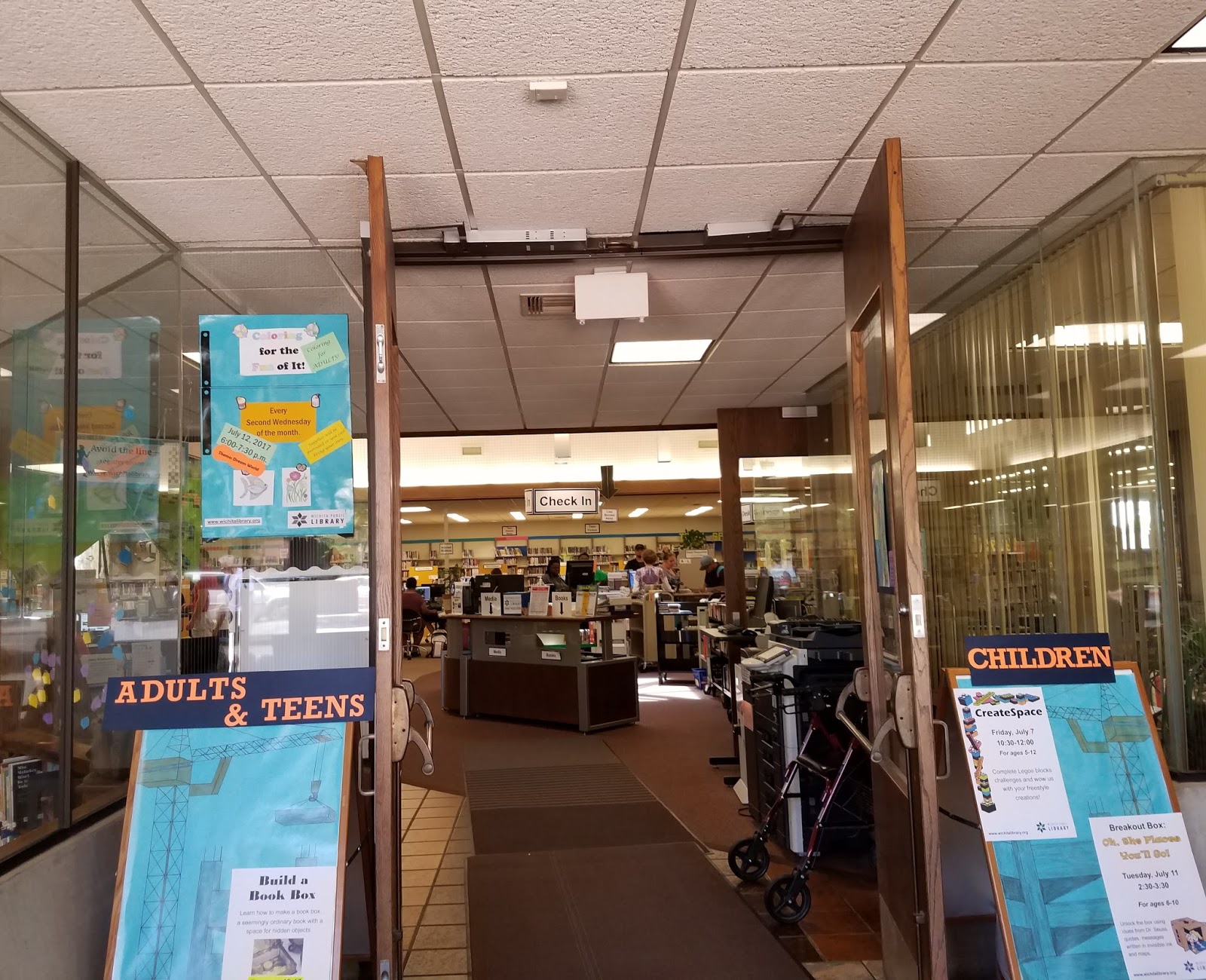
Main entryway of the old library at an angle.

It’s been suggested that the whole middle of the country suffers from a sort of vague identity crisis. We are the “flyover states,” the great, blank expanse, the parking lot to the Rocky Mountains. We are small town, small minded. Our cities are stopovers to better places, run through with train tracks, a gas station hub to anywhere but here. Compared to aged cities like London, or ancient cities like Jerusalem, our settlements are mere blips on the timeline, of no consequence, maybe just one bad drought away from ghost towns run flat to dust. We don’t have the alluring seduction of Hollywood, the primeval forests of the redwoods, the shining, dangerous lights of Las Vegas, the breathtaking awe of the Grand Canyon. We are not a destination. We have only scraps of history. And what we do have, too many of us are eager to take for granted. Why is there never room for nostalgia when we speak of public spaces? Is this not one of the ways we create a sense of home and belonging? Arguments to delegitimize nostalgia as a worthy aspect to saving Century II and the old library are disingenuous, dismissive, and critically flawed.

What the city government of Wichita seems to have forgotten (and the Riverfront Legacy Master Plan coalition could care less) is that the revitalization of downtown Wichita managed to take place using the existing structures that had been there for decades. Oldtown is called “Oldtown” for a reason. The brick streets, the old buildings, the sense of history, place—a true destination—made the revitalization of downtown what it is today. Ticky tacky, pressed board construction was never the answer. It is not the answer now. Nevertheless, the bulldozer of progress is chugging on. The old Wichita Eagle building (never a beauty contest winner, even in her youth) was replaced by the standard issue modern aesthetics of the new Cargill building, a similar mishmash of styles and “flairs” not unlike the new library (also near, but not on the river). Similarly styled buildings are rising up where the old Mead’s Corner used to stand and, most irritatingly, a new Fidelity megabank has gone up behind the quirky “Ho Ho” shaped Broadway Autopark, formerly the Knightly Parking Garage, on South Broadway, which was only just recently refurbished and repainted to now be obscured by yet another boxy box of boxness.

In a time when the world is on a precipice of survival, where we collectively seem to only half understand the need to re-use, re-source, and re-cycle, it is all the more tone deaf to tear down perfectly usable, perfectly astounding structures to replace them with stunted, cheap mediocrity. There is no time like the present to prove we are not locusts ever consuming, never building to stay, to stand, to commit, and not just to persevere but build true monuments to our audacity, our midwestern spirit to forge grain and stand into the wind, immovable and bound together. Do we leave crumbling detritus in our wake, choking the river, clogging the banks, or do we make a real effort to prove we as a people value beauty and art, and understand that we have already created something enduring to memorialize our grandest dreams in the name of our greatest virtues, institutions of learning and community? Our library, our Century II. Can we collectively say, Fly over us if you will, but we choose to leave something permanent and indelible, extraordinary and sublime. We dreamt big, wild, and limitless and shouted proudly that we loved this ground, these winding forks in the river, and wished to make our mark, leave sign of our daring, and state unequivocally that We Were Here.

Century II and the old library are worth saving. Instead of taking for granted the things that we have and striving for the banal, we could embrace a new century’s worth of science, education, arts, entertainment, work space, green space, community gathering place, and for a fraction of the cost of a hyped-up strip mall next to another bland park. We already have a sense of place, a monument to our community and generations past, but we’ve got to invest in it to make it prevail, otherwise we commit to a future of waystation grayness, the anyplace rest area in between more enticing destinations. Have your “mixed use” boxes, plan your grand monument suburban lawn maintenance—there are plenty of places around Wichita in desperate need of some investment and invigoration—but do not tear down the two buildings that make our skyline more than just vaguely memorable. Do not erase our identity—what makes us both identifiable and inscrutable—only to build nothing special at all.

All CII and old library photos are mine. If you want to see some truly gorgeous, professional photographs of these magnificent buildings, check out Mickey Shannon Photography and Drone-tography.


Tuesday, July 3, 2018

Wichita Central Library, 1967-2018, In Memoriam


Century II looms in the background,
 not acting in any way like a flying saucer.
Upon hearing that the Wichita Central Library would close its doors forever on May 6, my sister and I decided to take one last tour around the place, snapping final pics, and swapping stories of yore. She and I share similar sentimentality for the Ol' Brutal Beast, and more broadly seek to defend old, worthy structures and deflect the notion that newer is somehow always better. I do not believe that just any "old" building deserves reprieveafter all, every era births its own special, cheaply made, poorly planned monstrositiesbut truly special elder buildings deserve extra care and consideration. The former Wichita Central Library, now retired, is one of them.

When you look at downtown Wichita from the raised vantage of US highway 54/400, the Central Library appears quite small, embedded at the fore of larger bulks of the commercial buildings that make up downtown proper. Wichita's version of skyscrapers, squat little buildings for the most part, reach their highest peak with the so-called "Epic Center," which takes the bragging rights for tallest building in Kansas (22 stories, 385 feet to the tippy top). I remember when they built it, how much I wanted to like it (it was !EPIC! after all), but even at that young age I knew it was a flawed thing. Aside from the plain face of it and tiny windows, the building is shaped like a stunted fountain pen. There's something about a short-tallish building with a reaching, pointy little tip, so desperate to seem bigger that it really is. I'm sure there's a metaphor in there somewhere...

Broken light.

Information.

North Stacks, 1st floor.
From that higher vantage, driving East/West, the Epic Center is to the north, the farthest of the skyscrapers from the main core of downtown Wichita. Much closer stands my favorite building of all, the Garvey Center. I grew up with my eyes always tilted toward its strange, aquamarine heights, the octangular cap, a thousand antennas spiking out the top, glowing little red blips at night. It is an air traffic control tower with delusions of grandeur. Garvey Center is somehow garish, absurd, and ordinary all at once. I can't think of a better representation for Wichita (save one) and would honestly mouth-kick anyone who dared suggest that it be changed in any way. Apparently the Garvey Center now has "luxury apartments," and let me tell you this is something that will keep me awake at night. WANT. TO LIVE. IN AQUA TOWER.

View eastward from the North Stacks.
The former central library and my sister's bike.
But from highway 54/400, the real colossus that dwarfs the Central Library stands just west of it, the iconic Century II, an ancient derelict spacecraft that crash landed in downtown Wichita around the same time the library was built. Oh sure there's plenty of "documentation" and "legal paperwork" claiming its origins are terrestrial and completely mundane, but we all know the truth, just look at the thing. Given the terrible, terrible things city leaders have done over the years (or allowed to happen, lookin' at you Twin Lakes horror show), it should come as zero shock that people want to tear Century II down. These local trendsetters would knock down the Coliseum to install another squaty brick "clock tower" Commerce Bank branch if given enough capital to do it. It's my firm belief that this is what has saved some of the architectural jewels of Wichita over the yearsno money. Which is sad. It is my profound hope that Century II and the old Central Library are spared the wrecking ball, but in a world where Madison Square Garden was allowed to happen, I'm not holding my breath. If they did knock it down, the singular, most defining landmark of the Wichita skyline would be gone. Then we really would be basic bitches. Mark my words, city leaders!

Down to the basement to learn about local history and genealogy. 

View up to the 1st floor from the basement.
It is strange that this now outdated librarydwarfed by the buildings surrounding it, strange in design, sparing in constructioncan seem so cavernous and overwhelming once you pass through the doors, the foyer, the security and circulation desks, and enter either wing. The north and south sides of the building are completely open two stories high, with stacks around each perimeter and communal desks set in rows at the center. When I was a kid, the stacks on the south side were arranged so that some of those desks were lined up against the east window walls, but it hasn't been like that in years. I always assumed it was a security thing, but it was a loss nonetheless. I worked on book reports at those desks, read Asimov, and giggled whispers to my friends.

There is no getting around the fact that the interior is dated. The primary carpeting, a horrid eyesore meant to cause blindness and brain damage, has definitely been replaced since I grew up here, but much of the interior is exactly the same. The desks are the same, the chairs are the same, even some of the lounge furniture is the same. You can see the wear and tear, but for at least some of these objects, it's fifty years of wear and tear. Considering this, the old brute is actually holding up remarkably well.

I cannot help but think of that beaten-to-hell library back in Utah, Magna, how it was so new, so similar to many of the other new libraries I've visited, and yet how it clearly had been abused by patrons over a very short life span. And it wasn't just an errant clipping of a desk edge that split prefab from cheap vinyl, it was worn edges on furniture that was not meant to outlast the average span of securing a bachelors degree. Communities with money to burn, please listen to this if nothing else: Do the math! One of the biggest takeaways from my trip around the country is the prevalent unwillingness of decision makers to invest in hardy, sturdy, rough-and-tumble, quality materials not only for the construction of the library itself but for all the necessary interior materials, including fixtures, furniture, carpets, and so on. It's safe to bet that carpet will have to be replaced fairly regularly in any well-used common space, but outfitting libraries with rickety, clicked together, IKEA-standard furniture will end up costing a community more in the end. Hear me, peoples! Invest in your common endeavors. It is worth it!

Despite rolling with the punches and enduring fifty years of patronage, the Wichita Central Library simply could not keep up with technology. It's not wired for the times, and in such a sparing building, there is no acceptable way to retrofit it to meet the needs of the twenty-first century. I worked in the Flatiron building for over a decade, and loved the envious comments and hungry questions about the interior. Was it as beautiful as the outside? What's it like to work in such an iconic building? Well, drafty. Creaky. Leaky. Squeaky. Many of the offices are weirdly angular and ill-fitting for rectangular desks, file cabinets, square chairs. There are legions of "water bugs" (which look suspiciously identical to cockroaches HMMM) skittering high above workers' heads day in, day out. One dropped from the ceiling right next to my friend as she was working late one night. Dropped. From the CEILING. Almost in her hair. She was traumatized. Wonderful building, beautiful building. Old building.

Seating in the South Stacks.

And from whence did yon water bug drop? Well, from the drop ceiling of course. Because that's how you retrofit a building built in 1902. We saw the actual ceiling once. There was a mighty flood after an icy, long weekend ruptured the pipes above our floor and the calamity wasn't discovered until water started leaking out of the elevator shafts on the first floor. It disintegrated the drop-roof tiles completely. It also ruined thousands of dollars worth of equipment, computers, fax machines, copiers, and God knows how much paperadministrative, manuscripts, books. It was a disaster. But we got to see how far up those walls really went (far!), the aged and peeling paint from Ago (lead!), and thousands of wires weaving every which way, bound in bunches and intersections with zip ties.

The allure of the Flatiron is the hard spade shape thrust against the flood of humanity flowing at its intersections, Fifth Avenue, Broadway, 23rd Street, that lovely, carved sandstone, and large widows set all throughout. It is a giant ship from the beginning of a new era in the modern world, slim, tall, improbable, sublime. A little bit of ceiling space could be spared, and was, to make it a modern(ish) office space. The same could never be done for the Wichita Central Library.


South Stacks, delighting in the lighting, shot from every angle, 
and one caney plant in need of pruning (years ago).


South Stacks, a view of the main stairway.
Those wings, those glorious wings! The breathtaking space, spanning high and far. No drop ceilings allowed. When we visited the library for the last time, I marveled out how easy it was to get caught up in those wings, all that light streaming in, the intoxicating smell of books everywhere. I swear I could still smell the old card catalog, even though it is years gone and God knows where. If you had spent a significant amount of time sifting through those cards, opening and shutting those drawers (carefully, for fear of getting stern looks from library staff), you would know that the card catalog had a similar smell to booksit's paper and wood after allbut there was also a tinge of something else. Strong and creamy and spicy. And I swear it lingers still, somehow, despite the years between. There's no place in Wichita that gives me a more jolting sense of recall than the old Central Library. As we all know, smell and memory are inexorably linked.

One of the things I never appreciated about the Central Library when I was a child was the lateral slats of light pulling patrons forward from the relative dark of the front foyer into the library proper. There sitting central and adrift alone under those running cleaved segmentsthe fluorescents blurred, the optics bent, bouncing off the wood sections to create a kind of light that seems almost natural, like sunlight where none could possibly existthe information desk sits forever unmanned. When I was young, there was always someone there, but recently, more often than not, it stood empty and seemingly without purpose. This always struck me harder than anything else, whether it was due to the upcoming relocation to the new library, shutting down old services or redirecting resources, I don't know. But than unmanned information desk unnerved me and set my stomach all aquiver. Quiet little deaths.

Southwest corner, windows from floor to ceiling. 

To the left of the information desk (or south) is the main stairwell up to the second and third floors. Just past the desk, after a wide swatch of open floor where the card catalogs used to be, is another stairway leading down to the basement, and another quirk in an already quirky space. Growing up, the basement space was there, but the majority of it was not for public access. I have no idea what was going on down thererecords, conspiracies, seancesbut I never had reason to explore it until recently. This is where genealogy and local history is housed. It is also the only place in the library where drinks are strictly forbidden. It's a fun notion, descending to the ooky-spooky basement to look through our collective past, but honestly whoever thought to carpet the stairs in blue and the basement in red deserves a wet kiss on the mouth. It looks so damn slick, so damn cool, so utterly sexy and WILDASS. And such a groovy departure from the seizure-inducing, emetically inspirational carpeting elsewhere in the building.

You wanna tell me these chairs didn't see the Johnson administration? Get outta here. This is the little seating area between the elevators and the main staircase on the second floor. The "view" behind the seating area has always been a weird space, since it is basically the flat, unattractive roof above circulation, "Friends of the Library," and the front foyer. It's really just a broad swath of parking lot for bird crap and trash. I always thought it would make a nice permanent garden space if they could figure out how to do it wink wink nudge nudge. Like seriously, grass and trees. Something other than tarry gravel?

A view of the North Wing from the second floor.

A view of the South Wing from the second floor.
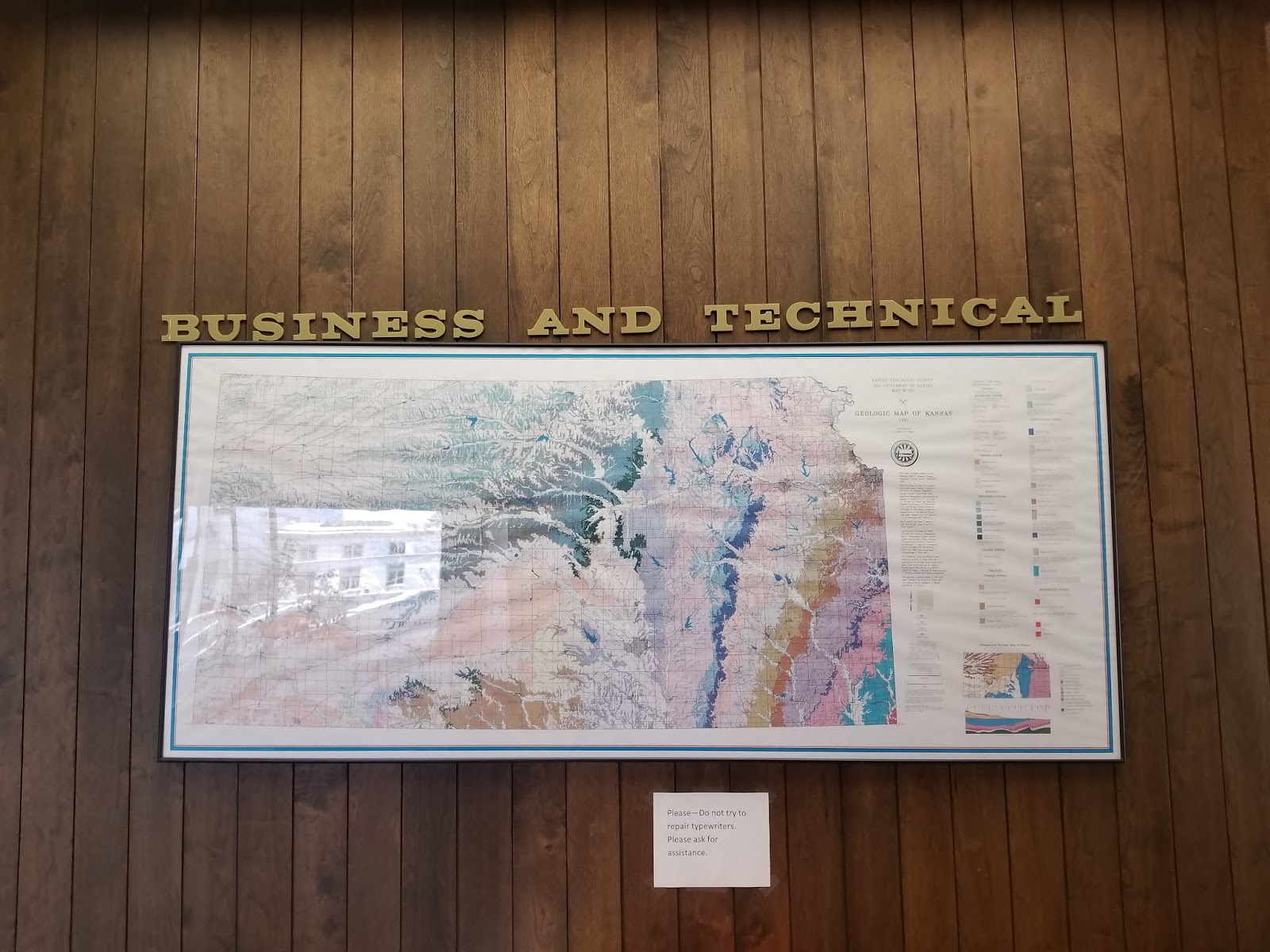
The second floor is basically within the same space as the main foyer on the first floor with open views over the north and south wings. This area houses the hilarious and beloved "Business Center," mostly unexplored by yours truly other than to fawn over the old timey typewriters and find an open desk with an extension cord/power strip. These desks, which featured work spaces, chairs, and shelving for periodicals and reference materials relating to all things work (jobs, finance, resume building, etc.), were largely taken up by people charging phones and other electronics. I worked there successfully once, not so successfully other times. It wasn't a quiet space. But it afforded great views over the vast wings...and those typewriters!

South wing and concrete brutalism appreciation.
(Addendum: Our typing teacher in high school was an efficient, serious older man with white hair and a mustache. I wish I could remember his name. He insisted we practice not only on the humming monsters that were the electronic typewriters, but on the horrid murder weapons, heavy as anvils, sharp and wicked and cursed, that were the manual typewriters. Yes, we had actual manual typewriters in typing class. Just a couple, for learning and suffering and character building. I am not sure I got much out of the exercise other than a sincere appreciation of technological progress. I'll never type like a possessed monkey all fingers flying whilst texting on my phone, but hey, at least I don't have to stand on the damn keys and stomp to put one simple word"halp" probablyin faded ink on blue white paper ever again.

Anyway, that's who I think of whenever I see that Business and Technical sign and the lonely electric typewriter poised waiting and ready to serve should its time every come around again. Thanks for the character building, Mr. Typing Teacher Man!)


Groovy waiting area outside of Admin, 3rd Floor.
The third floor, though. I lived on the third floor. All those books about celebrities! The cork wall! The haunted piano! When I was a kid, there was no such thing as DVDs and barely such a thing as a videotape. And you could not check any such things out at the library. Though it wouldn't surprise me to learn that audio vinyl, 8-tracks, or cassette tapes were available for loan (or at least listening on-site). If that ever was a reality, I wasn't cognizant of it.

The third floor also features the poster and paintings loan section--something I thought I wasn't quite understanding until I saw something exactly like itexcept worse and therefore so much betterin Bismark, North Dakota. It's not a crazy notion to loan artwork (or a facsimile thereof, anyhow) but the fact that both Bismark and Wichita had some seriously dated, incredibly tacky and ollllld offerings was indeed charming and silly and so wrong it was right. In those last days of the Wichita Central Library, they had those items on sale at the "Friends of the Library" section of the building, a makeshift space housed opposite circulation. Some pieces of art were old in a way that made me wonder if they were actually quite valuable...or would be sooner than any of us is really prepared to conceptualize. The 1980s were so chic, so pastel-and-black, so Nagel, but really so awful. Awfully gorgeous? I don't know...and may never have the perspective to properly assess such a thing. But they had some 80s prints for sale, gold plastic frames and all.

3rd Floor Chic.

This blog entry is loaded with references to the past: what I saw, what I heard, what I smelled. How things were in the olden days, how they persist in existing in the present days, and how I love the Central Library for what it was, what it still is, and hope that others can see past its technological shortcomings to find a way to give it a second life. Clearly there's a connection to my second life somewhere in there (ahem) and I am not too deluded to see that.


All of the above: Third floor stacks.

Third floor foyer.
But there is also a connection to memory and public spaces, how we come about a sense of history. A sense of purpose and permanence for us all. And that is, without a doubt, banked in the design and construction of permanent spaces, building something useful and memorable, a place that people not only must go to, but want to go to, spend some time, forge some memories, make it part of their oral histories, someday into written histories, and passed down from one generation to the next. Not every public space can live up to such lofty ideals, but we should want them to. For certain spaces, it must be a consideration. Libraries house our histories, our dreams. They are monuments to our hopeful permanence on this planet, aware that we are so momentary as individuals, but in some ways eternal in the halls of repositories, written in words, documented in historic occasions, our fingers on the pages.

A cork wall (left) and a stylish lounger with metal framing and corners 
so sharp you could extract an organ if you fell just right. PROBABLY 
ORIGINAL TO THE BUILDING. Also, located directly outside the 
Children's section. Where else?

Looking down the main stair case
from the 3rd floor.
I loved the third floor, "Hollywood" section of the library for the same reason I love the rest of it. Connectedness, a sense of history, little sparkling filaments pressed to paper and made indelible. Notions noted, imagination inked, made permanent, cataloged, and shelved. And legitimate because we say it is, given permanence in a world that feels like anything but. A space reserved just for that and nothing else. And doors open for anyone to come inside, travel the aisles, and lay hands on that one thing that will light them up. Maybe it's Song of Solomon, maybe it's A Brief History of Time. Hell, maybe it's the World Book series, still in publication despite the, you know, Internet (and featuring Will Smith's AI nightmare for the 2018 edition, apparently? I love seeing the World Book in libraries, I'm not gonna lie. It's like a big FU to Wikipedia and the insane amount of data available in the average person's pocket these days but SO WHAT we have a cool series of real paper BOOKS that make a whole picture from the spines when you place all the volumes together on a shelf so nyeh).

 A handsome display in the 3rd floor foyer.

And when I pass the old Central Library now, I cannot help but feel a hollow rooing at the moon inside; wistful, sad, but understanding that it could no longer live as a library...for now. Who knows, someday we may laugh at the idea of wired-anything, much as we do now when we relate stories of talking to our friends on rotary phones, wrapped around the cord, picking at the wallpaper nearby, bound with boundless energy nowhere to go except screeching "no wayyyyyyy" into the receiver, out into the ether, to reach the ear of a similarly imprisoned compatriot who also agrees no wayyyy. So the old library sits, an old rotary phone, her stacks gutted, her furniture sold or donated, her purpose unknown. I hope the City of Wichita does right by her. There is so much potential if you just open your eyes and see it.

Up next, my Initial, Highly Opinionated, Completely Biased and Unfair Review of the New Advanced Learning Library (a.k.a. the new central library)...

One last look. Brutal to the end.

Tuesday, September 5, 2017

Westlink Branch Library, Wichita, KS

[NOTE: All Wichita area library posts will be in chronological order of each initial visit, though you should assume I've visited some if not all multiple times over the course of the summer.]


While I busied myself with watching judge shows (get. a. promissory. note. people), feeding kittens, swimming my frog laps, and lazing about ever since returning home in May, it took months for me to finally walk into a Wichita branch library and score a real, live library card. In the Grand Shoveling of my former life, I probably threw out the one from my childhood, which featured the careful cursive of my fledgling signature. I definitely still had it and recall smiling down at that awkward penmanship before either chucking it in the trash or tucking it away for safekeeping. I believe I got my first card when I was 7 or 8, and I still recall the disbelief and wonderment at the fact that they were just going to let us take the books. For FREE. I've held on to some mementos here and there, but things I never thought I'd let go (yearbooks, knick knacks, personal letters, so many things) are in a landfill on the east coast somewhere, moldering away along with millions of people's trash and treasures alike. It's likely that old library card is there, too.

Choosing the Westlink Branch to reacquaint myself with the local library scene felt spur of the moment but we all know other forces are at work when we make decisions on the fly. There are a million little microfactors filing through our brainworks, and I am fully aware of my preconceptions of Wichita's neighborhoods, even though I've been more of a stranger to my hometown for quite sometime. My perceptions are frozen somewhere in the 90s, before I moved to NYC but when I visited from the KC area less and less. So this is My Wichita, all other opinions subject to scrutiny and debunking, but mine counts here because it is my blog so nyeh.

My family unit (my mother and me) lived all over the city: south side, north side, north central, east. We stayed around the Riverside (central. north central) area as much as we were able, but as jobs and fortunes changed, so did our address. The Wichita in my memory was divided neatly into the following subsections:


  • East and West - Rich and Nouveau Rich (country clubs, big houses, etc.)
  • North, mid, and South - mostly middle class with enclaves of rich and poor-to-extremely-poor (eg the area surrounding WSU, which is located in the NE part of the city, is primarily low-income neighborhoods, which are then immediately bordered by the toney College Hill neighborhood to the south. South Wichita features neighborhoods of old, WWII-era temporary homes that are still being used to this day. Imagine Hurricane Katrina disaster survivors living in their FEMA trailers in 2070 and you get the point.)

Downtown and Riverside are very near dead center, and are the most familiar and loved parts of the city to me. West and east fill my heart with green-eyed coveting and set that old monster's heart to beating as though I never got past ravenous greed for Things (maybe, like alcoholism, there is no cure).

Westlink is located on the west, "newer" rich side--though truth be told there are low-income neighborhoods all over the city, even in the east and west. I use the quote marks because Wichita grows in both directions to this day (south and southwest not so much due to the weird layout of the city, where the intersecting highways 400 and 235 leave a lot of that part of the city to small industry). But in the 70s and 80s? The west side was growing and full of all kinds of suburban splendor.

I loved movies like ET and Poltergeist not just because Steven Spielberg is a genius, but because they depicted a world I so desperately wanted to be a part of: suburbia. Those samey-same 2 story abodes with double garages and miniblinds? GIMME. An island in the kitchen and bar stools to climb up on to eat my cereal and watch TV on the counter? MINE. Everything smelling like new wood and fresh carpets? The paint only just dry? UGGHHHHH. Central Fucking Air? DELIVER ME, JESUS. But alas, He never did. (And, yes, I was deeply, profoundly jealous of Carol Ann and her damn demon possessed suburban home. Like, so what if a steak boogies across the kitchen counter on its own and starts spitting up gizzards for no reason? Every house has issues, like deal with it?)

If the neighborhoods along Ridge Road, Tyler, and Maize were new or newer in the 70s and 80s, you can imagine them now. These are still nice neighborhoods, but the trees are all big and the whole area has become quite lived in, with movie theaters come and gone, minimalls changing their facades to match the decades as they passed, each iteration another unimaginative, watered down attempt at something that might be permanently cool, but always failing miserably. The old Cinemas West is gone, but the former Hottest of Hot Spots, Towne West Square, soldiers on, though is perhaps mortally wounded as any other old school, indoor mall, with many shopfronts blank, gates closed, and merch gone along with the desire for jelly shoes and Ocean Pacific neon pullovers.

I'm sure if I ever visited the Westlink branch in my youth, it was only once or twice along with my friends' families, since that was the only connection I had to the west side at the time. It looks exactly like you'd expect a library born in 1981 to look--a sci-fi, spaceship/bunker made of concrete, metal, and glass. Sort of a "Borg Meets Original Cylons Style." The interior is as bright as they can manage, what with the low ceilings and fluorescent light, though there is a very 70s skylight over the main circulation desk. There weren't many places for me to set up (most space in any library these days is taken up by stacks, the children and teens sections, and the computer bays) but that was not my purpose for being there on that day. I had wandered in to finally secure a library card, and it turned out to be easier than expected. Just like my initial shock at the ease of library patronage when I was a tyke, my adult, world weary perceptions somehow expected it to be harder, more hoops to jump through maybe. The librarian tried looking me up in the system, but the records don't go back that far (wah wah waaahhhh) so we just started anew. Thanks to my brand new Kansas driver's licence, I had a new library card in my hand when I walked out the door about 10 minutes later. For FREE. (In fact, the only money I've spent so far is to reserve Arrival and that added up to exactly 25 whole cents.)


I've been back a couple of times, but make it a point to visit the other branches, as well, since each has turned out to be weird and wonderful in its own way. I love that they tell you how much you've saved using the library and how you can return materials to any branch. Every time I've asked for help, the library staff has been exemplary: very professional and incredibly nice. I've managed to catch up on all my Stephen King reading (now almost to 100%) and I've checked out a ton of DVDs. Not one has been unplayable or glitchy--NOT ONE--which compared to the DVD.com service I had for years (via Netflix, originally) is downright unbelievable. Of course I am jinxing myself my writing it aloud, but so far the experience with the Wichita library system has been phenomenal.


As for Westlink, I hope they leave it alone. Wichita is a city obsessed with refurbishment--out with the old and in with the new (no matter how misguided or short sighted)--but I think the millions they're sinking into the new main branch should keep the littler branches safe for a while. Let me tell you a thing--it's stupid and specific and completely About Me--but I'm not the only one who thinks this way, and it bears some thought, especially from those who run the wrecking ball. If you head downtown on Main, there used to be a bank on the SE corner just before reaching the main part of downtown. It was either where the Commerce Branch or the WABA now stand. This little building was a bank branch, too, though for which bank I could not begin to recall. What matters is that it is gone now, and despite many searches, I still have not been able to find a picture of it anywhere online (and the central branch of the library was far less than helpful).

What made this building so special? It looked like a concrete and tinted glass Mecha Spider and it was 1000% Magic. I know commercial zoning is commercial and residential zoning is residential and attempts at rezoning will forever mire those that dare it in Hell and Death and whatever, but I would have LOVED to live in that thing--it would have been a perfect lair and I would have cried tears of unabashed joy just to wrap myself in such a sick ass structure until, I don't know, death do us part? But it's gone, razed and buried.


Westlink is weird and wonderful, too, and if it cannot exist as a library going forward (onward march of technology and all that) I do hope they repurpose it rather than destroy it. Too bad there's not much reason to have faith.