Christine (1983)
I broke a thousand hearts
Before I met you
I'll break a thousand more, baby
Before I am through . . .
--George Thorogood and the Destroyers, "Bad to the Bone"

By the time Stephen King was finishing up his ninth novel (thirteenth if you count the Bachman books, so I suppose we should), it appears that the "Business of King" was already a well-oiled machine. According to Wikipedia, producer Richard Kobritz had his hands on the manuscript for Christine before it was even published. This explains, at least in part, how the hardcover was released in April of 1983, with the movie and first edition paperback following quickly on its heels in December of that same year. King's publishers and agent already knew the score, how to maximize profits and feed the fire while the work was still fresh off the press.
 |
| Christine on the line. |
Christine is set primarily during the narrator's senior year in high school (1978-9) and unfolds in three, linear acts. The first and last are from the perspective of popular jock Dennis Guilder, all-American teen athlete, while the second is in the third person, relating parts of the story that Guilder would largely have know way of knowing. The concept, well-known by now, is a simple one: It is a love story between a teenage drip and his very first, too-good-to-be-true, magnificently curvy first love. Of course the love in question is a red and white 1958 Plymouth Fury by the name of Christine.
 |
| Arnie (Keith Gordon) clowns Roseanne (Kelly Preston). |
 |
| Arnie clowns himself. |
When we first meet Christine and her ill-fated, soon-to-be beau, Arnold Cunningham, neither one of them is anyone's concept of a hot date. Christine is a junked wreck slowly rusting to rot in her current owner's yard, Arnie is a classic nerd, his face a wreck of cruel, adolescent acne. Dennis and Arnie are childhood friends, joined at the hip, Arnie always with ideas on what to do with long rainy days, Dennis forever in the business of "keeping Arnie from getting killed." They're driving home from a summer job when Arnie spots Christine and harangues Dennis into going back to have a closer look at her. Dennis is less than enthusiastic. This is the nicest feeling he will ever have about Arnie's new girl, Christine.
 |
| Leigh (Alexandra Paul) gets the tour. |
 |
| Bemis (Doug Warhit) and Dennis (John Stockwell) oogle. |
 |
| Feather curls and argyle supreme. |
The plot tracks across a field packed with adolescent and supernatural landmines alike, each with a touchy trigger and angled to explode. Arnie's parents hate the car immediately, Arnie must shelter her at the disreputable Darnell's Garage, and he soon runs askew the resident bully, Buddy Repperton, and his gang of miscreant mascots. As the school year begins, Arnie struggles with his parents, who are not accustomed to their good boy not only going against their wishes but continuing to do so while spending his college money on fixing Christine. Arnie and Dennis have a scary showdown with Repperton and his buddies in shop class, leading to the expulsion of Buddy and the suspension of the others. Despite everything going wrong for his friend, Dennis can see that Arnie is changing in some ways for the better. His face is clearing up, for one. And he stands up to Repperton in a way he never would have before.
But the biggest changes are yet to come. While Christine's refurbishment comes along back at the garage (in a sort of patchwork, wonky job where nonsensical things are repaired out of order, i.e. half the front grill, which is insane even to a layman), Arnie's face has cleared and he's even dressing better. He's got a new confidence and carries himself accordingly. In a turn of events straight out of high school fantasyland, Arnie lands the new girl in town, Leigh Cabot, a girl all the boys have lusted after ever since the school year began. It seems everything is coming up Arnie, even if his parents are forever in his shadow, even if no one seems to really like his car, not even his other girl, his new girl, Leigh.
 |
| Leigh unhappy in Christine. |
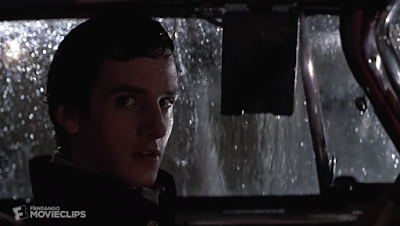 |
| Arnie irate. |
 |
| Leigh really unhappy in Christine. |
Things truly begin to turn darkward when Dennis Guilder is severely injured while playing football and is subsequently hospitalized for weeks, effectively "taking him out of the game" and life, and certainly dampening any efforts he may have made to keep Arnie from "getting killed" under Christine's dark eclipse of influence. Soon after Dennis is hospitalized, Buddy Repperton and his band of merry idiots trash the living hell out of Christine. Dennis and Leigh have already seen the shadowy side to the changes that have been happening to Arnie, but this is where the bottom drops out and the murdering begins.
 |
| Don (Stuart Charno), Buddy (William Ostrander), Rich (Steven Tash), and Moochie (Malcom Danare) about to seal their fate. |
Christine is one of the few King works I saw at the movies well before reading the book. My mom and her boyfriend took me and my friends to a wintery evening showing. The gaggle of giggling girls were all around eleven at the time, and I remember having a blast. The adults pre-gamed, buying popcorn and making fun of the premise, while we screamed, cawed, and cackled shrill and self-conscious, over-the-moon excited to see an R-rated movie about a demon car. We were still laughing and joking afterward, though solemnly agreed between hyperactive outbursts of unaccountable mirth that the chase scenes with Christine were very scary and very effective. There was spirited debate over whether a car could really squeeze into a smaller space to smush someone to death (we overzealously agreed it could not) and railed over how stupidly everyone in the movie behaved, like, Moochie, just jump up on the hood and tumble over the bitch? Buddy Repperton, don't run down the middle of the road? Climb a tree? Go high in a building???
A couple of years later, I was well into my King fandom when my aunt Sherry gifted me a worn-to-hell copy of Christine we just happened to find while garage sale-ing one weekend. The cover was nearly falling off and it looked as old and dilapidated as that first, early-eighties shot of Christine, but I didn't care. I was greedy for new King and thrilled to get my hands on it.
 |
| Leigh and Arnie make peace. |
 |
| Arnie sees Christine. |
 |
| TRASHED. In the book, Arnie keeps her in long-term parking at the airport, but even within the confines of Darnell's Garage, you have to wonder why Christine didn't leap to life the second they laid a hand on her. She's certainly more than capable of chasing down multiple targets and going to extraordinary lengths to kill her prey. Perhaps she knows that allowing Arnie to see her destroyed so completely will forge their bond entirely, til death they do part. |
The basic plot and outcomes are about the same from book to movie, but the method of death is different in almost every case. There's also a higher body count in the book. The biggest departure, by far, is the source of Christine's supernatural power and reach. In the movie, the LeBay selling is Christine is actually the brother (George) of the original owner, Roland LeBay. Roland LeBay's sad backstory remains the same (his kid choked to death in the car, his wife killed herself in the car), except he is haunted and hounded by Christine, trying at least once to get rid of her, only to have her find her way back to him weeks later. Eventually he kills himself in Christine, too, leaving her behind to his brother to do with as he can. It is George LeBay's great fortune that a starry-eyed geek lays eyes on her in passing one afternoon and never wants to break that gaze again. Christine's supernatural power to move on her own (and play very snarky, plot specific songs at people) started on the assembly line, "on the day she was born" to paraphrase the iconic song that introduces Christine at the beginning of the film.
The book is less clear on Christine's supernatural beginnings, though it seems she was decidedly spooky and could perform contrary to her construction from almost the beginning (four-wheel drive with no kit, the kid choking, the bad vibes). While she was probably imbued with some unnamable power, it was Roland LeBay's complete devotion to her that had lasting consequences, most critically upon LeBay's death, which occurs not long after Arnie purchases Christine. In the novel, LeBay's backstory is far less sympathetic, with the kid and the wife dying in the same exact way, and Roland seeming to care about little else than Christine. It is Roland who sells the car to Arnie, and it is from George LeBay (at Roland's funeral, apparently from natural causes) that Dennis learns the ugly history of Christine. Stories of an mean, violent childhood lead to one, enduring theme: Roland LeBay's "unending fury" and singular devotion to Christine.
In the book, Arnie's changes are the direct result of Roland LeBay spiritually taking over Arnie's living body. While Christine has always had some level of supernatural power, LeBay's "single-minded purpose" and "unending fury" make her into the self-healing, vengeful murder machine of every kicked and cursed teen nerd's darkest dreams. It is mildly annoying (and not at all surprising) that even a possessed car is not allowed the autonomy to be a fully realized, entirely competent she-demon from the deepest cracks of hell without some man coming along to steal her evil thunder. It's interesting to contemplate whether it was the moviemaker's decision to make Christine wholly empowered with vengeful avarice because she didn't need no damn man . . . or because it made the narrative simpler. Probably the latter, but it's fun to dream.
 |
| "Show me." |
 |
| Christine begins. |
 |
| Self-healing trickery. |
I knew the adults found the concept of a possessed, killer car demented and silly, but I was at an age of spongey elasticity, with an imagination open to just about any weird idea. I loved the novel (and never thought twice about killer Christine's autonomy--I was 13 and completely unaware of my own). It felt somehow idealized and authentic at once, a picture of high school that fit my impressions of what it might be like, at the time still imagined from afar. Re-experiencing Christine now, the tropes are so very trope-y--the nerd, the jock, the beauty queen--but credit is due to that underlying authenticity, the voice of the teenager, that at least for the male characters, is dead on.
Do I have to rip King yet again for making a silly femme in Leigh Cabot? Nah. She's not the worst (see Firestarter, Vicky McGee), and while some her dialogue (both inner and spoken) is cringeworthy, she's not entirely flat. I also have to be cool about this because I listened to the audiobook of Christine this time around and it was read in a man's voice. We all know how I feel about the falsetto. It is just . . . no. More on the audiobook later.
When I was thirteen I did not care if Leigh Cabot sounded breathy or vapid or mildly idiotic. I'd seen Christine again on cable at a friend's house not long before reading the novel, and my impression of her had only solidified in the years between viewings. That first shot of Alexandra Paul walking down the hall with all eyes on her, shyly smiling at the boys staring as she passes, was forever locked in my mind as the epitome of Peak Validation. She was crushingly beautiful in her argyle sweater and knee socks, tall and athletic (my mind always translates bowed legs to athleticism), with hair so on-point perfect for the times I catapulted past green oceans of envy straight to the adolescent stars of idolatry. I wanted to be Alexandra Paul. I wanted her exact clothes. I wanted her high cheekbones, feathered hair, gorgeous doe eyes, pointy nose, pouting lips, and that dumbass O-expression of huh she brought to every confrontation with Christine. Reader, I practiced that shit. Gape-mouthed O with distressed damsel ditzyness. In the mirror. At school. In public. The shame.
 |
| Run, Moochie, run. |
 |
| Cornered . . . but safe? |
 |
| NOTSAFENOTSAFENOTSAFE. |
 |
| Fuuuuuu- |
The movie is well-acted, with some standard issue jokes and camp, and is far more sexist than the book, as was the norm for any teen-set movie in the 80s. While the movie retains some of the more memorable lines from King's novel, like when Arnie almost offhandedly tells Dennis how "part of being a parent is trying to kill your kids," a lot of the labor of crafting realistic teen characters gets flattened into those well-known stereotypes. Keith Gordon does a phenomenal job with hapless, scared, horn-rimmed Arnie, less so with avarice-stricken, demonoid Arnold held under the hypnotic glow of Christine's dashlights. John Stockwell is a believable Dennis, tending toward mildly amused, mildly annoyed, or mildly distressed. With Alexandra Paul adding that extra point to the teenage love triangle, they are visually and competently a perfect cast.
What the movie only skims is that tremendous churn under the outwardly mild waters of teenhood. Of course, plenty of parents would say "mild waters my EYE" to which I would plead patience. It is a wild time of rampant hormones and unhinged outbursts, but if you were anything like me and my friends, you know that you were keeping a lot of secrets and actively misdirecting parents and adults from what was really going on in your life and, most importantly, in your head. When Arnie makes the comment about parents trying to kill their kids ("As soon as you have a child, you see your own tombstone," he further elucidates), it is well before Christine's influence starts to infiltrate his personality. He's been dealing with overbearing parents his whole life. For the first time, ever, just on the brink of his last year of childhood, Arnie asserts his independence and refuses to budge. Later on, LeBay's personality overlays any independence Arnie had forged, but in the beginning it is his will standing against their once impenetrable front. The angst is well fertilized, deep rooted, and overdue.
 |
| Buddy outmatched. |
 |
| Christine ablaze. |
 |
| Easily the scariest shot of the movie. |
 |
| One way or another . . . |
 |
| . . . I'm gonna getcha getcha getcha getcha. |
 |
| Buddy down. See the figure in the fire? |
 |
| Char-broiled. |
On the flipside, Dennis Guilder, the narrator of the beginning and end of the story, is a 22-year-old young professional relating events that happened when he was seventeen, just five years prior. Through his eyes the reader sees that inevitable, narrow track to which every child finds himself welded: grade school leads to junior high leads to high school, all the while stacking the rails with activities, clubs, and sports, resolving finally--in the middle-class world of Dennis, Arnie, and Leigh--to one, fated terminal: college. When Arnie threatens to drop his college prep courses if his parents do not allow him to register Christine, his parents--both college professors, naturally--see it as nothing short of leveling nuclear-grade threats at Arnie's future (and their status as parents). While extreme, Arnie knows it is the only thing that will get him what he wants from a strong-willed mother and a father who supports his wife unequivocally.
For Dennis, the detonation and collateral damage that starts the day they bring Christine home has its own reality-shifting consequences. His closest friendship from childhood is strained, then fractured, and his relationship with the Cunninghams, a family he's grown up with and loves, becomes tense, sad, and estranged. His own well-oiled and dependable track toward a possible football scholarship is blown to hell when he is badly injured on the field, hospitalized, and essentially put on the sidelines of his friend Arnie's increasingly alarming circumstances, first with the wanton destruction (and desecration) of Christine, then with the steadily increasing and inarguably Arnie-linked body count.
 |
| Dennis and Arnie have a heart-to-heart about true love. |
 |
| "Let me tell you a little something about love, Dennis. It has a voracious appetite. It eats everything. Friendship. Family. It kills me how much it eats. But I'll tell you something else. You feed it right, and it can be a beautiful thing, and that's what we have." (1) |
Yet in the midst of all this stress, both mundane-but-future-killing and supernatural "but not in a fun way," Dennis Guilder is still a teenaged boy. This is most apparent when Leigh Cabot makes the scene. For all his smirking and scowling at ugly Arnie's instant obsession with double-ugly Christine, Dennis seems unaware of the fact that he is similarly smitten with Leigh from the start. King's young narrator spends an amusing-bordering-on-embarrassing amount of time extolling the angelic, perfect, too-perfect, beautiful, intoxicating, otherworldly attributes of Leigh Cabot. His eyes run lovingly over her curves just as Arnie runs his hands over Christine's fins.
It would be easy to dismiss as overwrought and misguided "character" building, but to me it rang crystal true for that teenwired mind. In the midst of death, we are in Hornytown. Dennis Guilder may be experiencing some extraordinarily horrible things in this chapter of his young, middle-class, all-American life, but he's still got time to size up his best friend's girl and grow a boner.
 |
| The Final Showdown. Leigh is trapped. |
 |
| Christine banged up. |
 |
| This. I practiced this. |
 |
| Dennis drives the dozer. |
 |
| Arnie transformed. |
 |
| Christine reborn. |
There's also time to have awkward, half talks with parents who are just trying to understand what's going on with their son and his once-close, now so distant friend. There are wonderful respites of sibling torment, when Dennis steals his little sister's treats and teases her mercilessly as she volleys it right back. There is still time to be a teenager, which in and of itself can be an overwhelming journey, even without the possessed, murderous car full of gnarly ghosts riding shotgun. And there is still time to be short-sided, puerile, and flawed, as Dennis Guilder's entire narrative is threaded throughout with the unselfconscious fat-phobic shaming of a more narrow-minded, less mature perspective. You might try and say it was a sign o the times, but the ratio does not bear that out. By comparison to any other King work up to 1983, Christine's fat-bias is abundant and borderline embarrassing. I'd far rather believe this was a character device rather than some internal, self-hating manifestation of '83 King's subconscious.
Character flaws and unlikely villainous Plymouths aside, King's story of average American kids grappling with the homicidal rampage of a infernal Fury still bristles and shakes with hot thrills and guilty fun.
 |
| Catapulted through Christine's window after another lunge for Leigh, Arnie has one more jump scare in store for his ex. |
 |
| One last caress goodbye. Y'all, there's a shot where his fingers linger at the Plymouth's V and I seriously CAN NOT. |
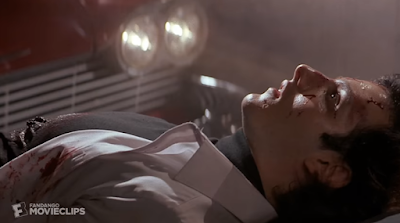 |
| Teenage Death Songs. |
 |
| Christine's odometer rolls back to zero. |
 |
| But Dennis dozes her down. In the end, she ends up cubed at the junkyard, finally defeated. Or is she . . . ? |
(All subsequent comments are reserved for the book)
Grade: B+ Classic King
Scary? (0-nope to 10-you will die): 6. It undoubtedly rates higher with other fans, and I do give a big hat-tip to the thriller aspect of the hunt-chase-kill scenes, but the scare factor is never going to exceed the mid-range for me as long as it has anything to do with "possession" or "devils." I am the person who laughs through The Exorcist and only gets mad that they made that little girl Linda Blair say and do those seriously horrifying things. I know, I know, I am only tempting the devil to possess me for my sass, but seriously, don't demons have more interesting prey to jump than me? Like, get over yourself no demon wants you. Also they aren't real. Except for the inner ones. Those effers are everywhere.
Warnings: Bigotry abound. Typical high school, mean-mouthed, dirt-kicking, low-class jibes. The adults do not fare better, with the low/poor and criminal class giving the high school kids a run for the money. All the terrible words are present, repeatedly.
Artifact: The Internet Archive is under siege! As we speak, a syndicate of publishers is suing the IA for "copyright infringement," to which the IA has politely responded "bullllllllllshit." A brief summary of the conflict can be found here and the Internet Archive's full response can be found here. Wherever you fall on the open source spectrum (which the IA never has been, certainly not in the way the publishers would have you believe), it would be GREAT if everyone could finally and completely remove their heads from their asses and realize that we are in COVID TIMES, not to be confused with a brief squall, or a tornado that torpedos your cow across the county, or an earthquake that knocks over Aunt Rose's antique salt shaker and shatters it all to hell. Also not to be confused with a partisan hoax, an overblown disaster porn wetdream, or a worldwide conspiracy to ruin your good time. Covid is real and covid is SERIOUS.
Suddenly finding the King selection on IA decimated, I reached out to the Wichita library to see what was being done with books during these "highly contagious but still so many people won't wear masks" times. They sent a prompt reply, detailing the logical, reasonable efforts they are taking to ensure that they do not contribute to the spread of Covid-19. The stacks are off limits to the public, minimal services are available, but groupings of folks are not permitted. Staff handle the returned books masked and gloved and essentially let the books sit for a spell, sort of a book quarantine, until they should be good and ready to be reshelved or set aside for the next person on the wait list. It was all very conscientious and wonderful to hear. The Terror Rat that scurries through the walls of my brain does not agree.
Terror Rat insists that the particles are, in fact, everywhere. Everywhere everywhere. Terror Rat can barely stand to touch library books during normal times. Terror Rat's favorite word is contaminated. And while Terror Rat needs to calm the fuck down, she does have one very good argument that I just can't shake. By the time everything in Kansas was essentially "shut down," let's say April 1 2020, we'd seen just over 420 cases with 9 deaths from Covid-19. To date (September 29 2020), Kansas has weathered 58,629 cases and 637 deaths. Considering the nature of airborne, infectious disease and the insanely uneven and nonsensical public policies to mitigate the spread of coronavirus, is it fair to assume that there are many, many more active cases now than there were when we "shut everything down" in March? Terror Rat wants to know how "opening up" the country now, when there are more cases in more places, makes any kind of sense? Terror Rat is waiting.

In the meantime, I had to find some other way to read Christine. The free Audible trial beckoned, I figured beggars can't be choosers, and leapt. I am so happy I did.
First, let's get this out of the way right now: the narrator is that gawdam kid from Maximum Overdrive y'all. The kid on the bike, riding through the streets, seeing the hilarious carnage (remember the bloody ice cream truck). He was also a near-victim to a particularly homicidal soda machine. It's that kid! Who is a man now, but oh my God, I love the symmetry. And I love that he found a real niche. Holter Graham is a very talented voice actor.
It was such a delight to be able to really sink into the story and just let it ride, cruise if you will, until it was time to stop for the night. While I will likely never get used to that falsetto for the female characters, Graham handled it far more smoothly than my previous King audiobook experience. Let's face it, Leigh Cabot was always going to be especially grating with her repetitive "what do we do what do we do" dialogue, so I was prepared for that. It was clear that the shortcomings of the character were just as responsible for drawing my ire as any fakery on the reader's account, especially whenever Graham voiced Dennis Guilder's sister or Arnold Cunningham's mother. Neither took me out of the story the way Leigh Cabot's murmuring mopery did . . . in fact, it was really just that babyish tinge, missing from the other two female voices, that really set my teeth on edge. Just like it did with Charlie in Firestarter. It's funny because Alexandra Paul's voice was all breathy baby through much of the movie adaption. Guess I don't like men doing baby voices? The audience already has to stretch the accommodation for the suspension of disbelief when listening to an audiobook, particularly when each person has their own inner voice cultivated over decades of reading. Allowing some "other" into your headspace like that is more than a little intimate. The more unnatural or unreliable that voice (girl baby voices, per se), the more likely the listener is to reject it.
By far my very favorite quote from the book, made all
the better by Holter Graham.
If you are like me, still essentially sequestered, still cooking, baking bread, and you, too, have a germaphobe Terror Rat ripping around your skull, digging furrows in your circuits and sparking shorts and misfires through your synaptic ability to cope with This Covid Bulllllshit, I'd recommend giving audiobooks a whirl, especially ones narrated by Holter Graham. He does a fantastic job, especially taking the wheel as the narrator, slouched cool and sullen in the cab of Christine, to give this particular listener one hell of a ride.
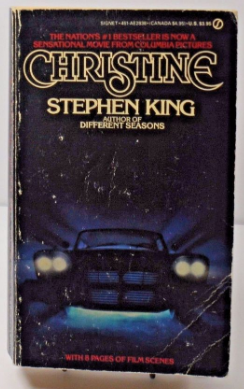 |
| Terrible quality screenshot of a first edition, movie tie-in paperback, the same edition I once owned. |
(Movie screenshots via YouTube from Movieclips and Columbia Pictures. Artistic interpretation gif via tumblr with audio from Christine, Stephen King, unabridged audiobook, released 1/1/16, Simon and Schuster, narrated by Holter Graham.)


